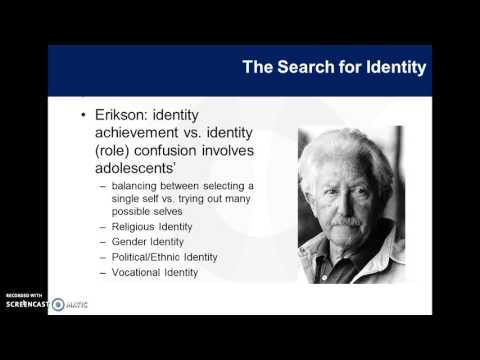
Erikson's Identity vs. Role Confusion/Marcia Identity States
Introduction to Adolescent Socio-Emotional Development
Overview of Adolescence
- The discussion begins with an introduction to adolescent socio-emotional development, focusing on Erik Erikson's theory, particularly the crisis of identity versus role confusion.
- A comparison is drawn between adolescence and toddlerhood, highlighting that both stages involve rapid physical changes and newfound independence.
Physical Development in Adolescents
- Just as toddlers experience significant physical growth (e.g., learning to walk), adolescents undergo major changes such as growth spurts and sexual maturation.
- Both groups also show rapid advancements in verbal skills; toddlers learn to speak while adolescents develop abstract thinking abilities.
Independence and Exploration
- Both toddlers and adolescents strive for independence, testing boundaries set by parents. This includes trying new activities or staying out late.
- Examples illustrate how both age groups push limits: toddlers explore kitchens while teenagers may challenge parental rules through attitude.
Erikson's Stages of Psychosocial Development
Key Stages Leading to Identity Formation
- Erikson’s psychosocial development stages include trust vs. mistrust in infancy, autonomy vs. shame in early childhood, initiative vs. guilt, industry vs. inferiority, culminating in identity vs. role confusion during adolescence.
Understanding Identity
- Identity is defined as a consistent self-concept encompassing roles, attitudes, beliefs, and aspirations; adolescents navigate this by exploring various identities.
The Process of Identity Exploration
Trying on Different Selves
- Adolescents experiment with different identities (e.g., athlete or goth), reflecting their search for a unique self amidst various possibilities.
Personal Anecdotes on Identity Formation
- The speaker shares personal experiences from high school where they explored different activities (cheerleading, music, tennis), illustrating the trial-and-error nature of identity formation.
Cultural Context and Timing
Historical Perspective on Identity Development
- The discussion acknowledges that Erikson's theories were developed during the mid-to-late 20th century when cultural contexts differed significantly from today’s environment.
Modern Implications of Erikson's Theory
Understanding Identity Development in Adolescence
The Evolution of Identity Formation
- Most 18 to 20-year-olds do not have their identities fully formed by 2016; this process may extend until around age 25, varying from person to person.
- Gender identity is perceived differently today compared to the past; for adolescents, it involves understanding roles and expectations associated with being a man or woman.
- Current discussions on identity also encompass transgender issues, sexual orientation, political beliefs, and ethnic identity—elements that were less emphasized in earlier frameworks.
- Vocational identity is crucial as well; individuals are expected to decide on their career paths during adolescence, although this decision-making process has shifted later than in previous generations.
Erikson's Psychosocial Crisis of Adolescence
- Erikson posited that the psychosocial crisis of adolescence is "identity versus role confusion," typically resolved by age 20. In his time, marriage followed shortly after this stage.
- If an adolescent fails to establish a clear sense of self (role confusion), it can hinder their ability to form intimate relationships later in life.
Cognitive Development During Adolescence
- Adolescents reach formal operational thought, allowing them to think abstractly and hypothetically about various roles they might assume in society.
- This cognitive development enables adolescents to explore different identities through trial and error—experimenting with interests such as sports or arts.
James Marcia's Theory of Identity States
- James Marcia expanded upon Erikson’s theory by introducing four identity states based on two dimensions: crisis and commitment.
Four Identity States
- Achievement:
- Involves experiencing a crisis leading to commitment after actively exploring alternatives.
- Foreclosure:
- Commitment without crisis; individuals adopt roles from parents or society without questioning them.
- Moratorium:
- Active exploration occurs without yet making a commitment—a healthy state for adolescents seeking direction.
- Diffusion:
- Characterized by no commitment or crisis; adolescents lack awareness or concern regarding their identity.
Factors Influencing Identity Achievement
- Achieving identity often varies across different aspects (e.g., vocational vs. religious). An individual may feel secure in one area while still exploring others.
Developmental Stages in Young Adults and Adolescents
Moratorium and Achievement vs. Diffusion and Foreclosure
- The speaker highlights that moratorium (a period of exploration) and achievement (having made commitments) are more prevalent among young adults compared to adolescents.
- In contrast, diffusion (lack of direction or commitment) and foreclosure (commitment without exploration) are typical characteristics observed in early adolescence, particularly around ages 13 to 14.
- The speaker suggests that it is common for a 13 or 14-year-old to experience diffusion or foreclosure regarding significant life aspects such as politics or religion.
- By the time individuals reach ages 18 to 20, they tend to transition into moratorium or achievement stages, indicating a shift towards greater self-exploration and commitment.