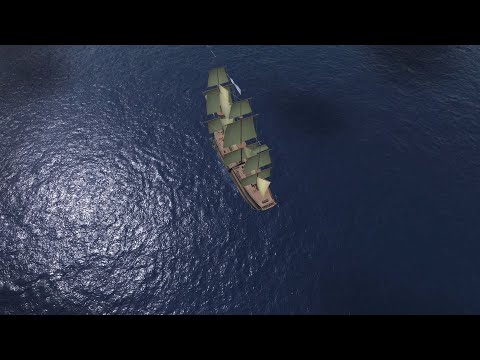
Slave Ship "L’Aurore", a 3D Video
The Journey of the L’Aurore: A Slave Ship's Voyage
Overview of the Transatlantic Slave Trade
- Between 1500 and 1867, over 40,000 voyages transported 12.5 million enslaved Africans to the Americas in exchange for European goods.
- The ship L’Aurore, which departed from La Rochelle, France on August 28, 1784, is one of the few documented slave ships. It was bound for Africa to acquire captives for sale in Saint-Domingue (Haiti).
Conditions on Board the L’Aurore
- As the ship approached Africa, it became evident that approximately 600 captives faced dire conditions during their two-month Middle Passage to the Caribbean.
- The main deck featured a barricado, a wooden wall designed to control male slaves, topped with spikes and swivel guns. Additionally, iron chains restricted movement among shackled men.
Treatment of Captives
- Male captives were brought up daily from below deck and chained to an upper deck chain while women and children remained behind the barricado without shackles but isolated from men.
- The crew enforced strict discipline using whips and guns as they forced enslaved individuals below deck at night into cramped quarters divided by wooden walls. Men were still shackled in pairs when taken below.
Living Conditions Below Deck
- Enslaved men were packed tightly together; some lay on platforms while others were forced under them in spaces measuring only 14 to 18 inches wide and 30 inches high. This resulted in extreme discomfort and lack of personal space.
- Captives endured these stifling conditions for at least 14 hours daily, suffering from poor hygiene and limited access to food and water throughout their journey lasting two or three months before reaching the Caribbean.
Visual Documentation