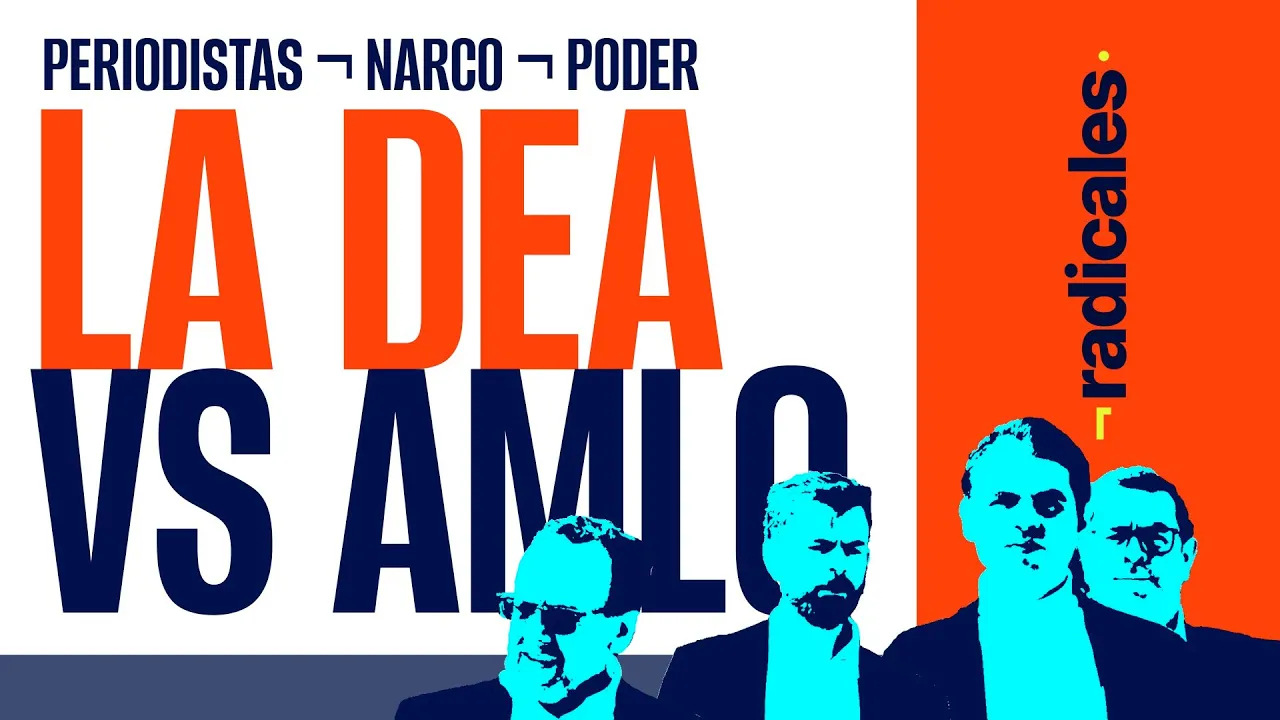
¬RADICALES presentan: LA DEA VS AMLO. Periodismo, narco y poder.
Introduction and Music
The video starts with music playing in the background.
Opening Remarks
The host makes some opening remarks.
- The host welcomes the audience.
- Music continues to play in the background.
Discussion on Articles about Campaign Financing
The host introduces the main topic of discussion, which is the recent articles published about alleged illegal campaign financing for Andrés Manuel López Obrador in 2006.
- The host mentions that three articles were published by different media outlets.
- These articles focus on the alleged illegal financing of López Obrador's campaign.
- The host emphasizes the seriousness of these allegations and their potential impact.
- It is mentioned that these articles are seen as an attack from the DEA (Drug Enforcement Administration) of the United States.
- The host highlights that they will discuss the motivations and incentives behind bringing up this investigation after 13 years, just four months before an election in Mexico.
Continuation of Discussion on Articles
The discussion on the articles continues.
- Music plays briefly in between segments.
- The host reiterates the importance of discussing this topic and introduces a guest expert.
- Applause can be heard from the audience.
Background Information on Articles
More information is provided about the articles and their context.
- The host explains that three articles were published by US and German media outlets.
- These articles revolve around an accusation from 2006 regarding illegal campaign financing for López Obrador.
- It is mentioned that this accusation was initially investigated by the DEA in 2010 and closed in 2011. However, it has now been reopened after 13 years, close to a Mexican election.
- The host suggests that the motivations behind bringing up this investigation again are related to electoral interests in 2024.
Motivations and Context of the Investigation
The motivations and context behind the investigation are discussed.
- The host emphasizes the importance of understanding the motivations and context surrounding this investigation.
- It is suggested that there may be political motives from both the United States and Mexico.
- The guest expert's interpretation of the situation is highlighted as significant.
- The host mentions that it is crucial to consider the context of the 2006 campaign and its financial aspects.
- There is a discussion about whether there were indications of illegal financing during that time, considering López Obrador's campaign was relatively austere.
- It is noted that while there may not be strong evidence for illegal financing, politics can involve hidden actions.
Analysis of Campaign Financing in 2006
An analysis of campaign financing in 2006 is presented.
- The guest expert shares their perspective on campaign financing during the 2006 election.
- They mention that López Obrador's campaign was focused on grassroots activities rather than extensive media spending.
- There is a discussion about whether there were signs of inequitable resources or excessive spending from illegal sources during that time.
Lack of Indications for Illegal Financing
The lack of strong indications for illegal financing during the 2006 campaign is discussed.
- The guest expert expresses their opinion that there are few elements to suggest significant illegal financing during that time.
- They mention examples such as Carlos García Luna, who had questionable wealth compared to his official salary but was not directly linked to López Obrador's campaign finances.
Contextualizing the Investigation
The importance of understanding the context and motivations behind the investigation is emphasized.
- The host highlights that the investigation should be seen within the broader context of power struggles in Mexico.
- It is mentioned that multiple political actors and interests are involved, including those from the United States.
- The role of media outlets in disseminating information related to the investigation is discussed.
- The primary source of information for these articles is identified as the DEA and the US government, indicating a political rather than journalistic motive.
Weaknesses in Media Coverage
Weaknesses in media coverage and intellectual dishonesty are addressed.
- The host criticizes both the quality of reporting on this topic and the intellectual dishonesty present in Mexican media.
- It is suggested that these weaknesses contributed to the short-lived impact of the articles.
- The intended blow against López Obrador's government was not as significant as initially anticipated due to these weaknesses.
Fragility of Allegations
The fragility of allegations made against López Obrador's government is discussed.
- The host explains that previous allegations against López Obrador were based on testimonies from a protected witness who had been extensively used during Felipe Calderón's presidency.
- Specific individuals, such as Tomás Ángeles Dávila and Genaro García Luna, were implicated based on this witness's testimony.
- However, it is noted that these allegations lacked strong foundations and were ultimately short-lived.
Media Power and Marginal Impact
The influence of media power and marginal impact are highlighted.
Lack of Professional and Moral Authority in Media
The speaker discusses the lack of professional and moral authority in many media outlets and journalists who attack President López Obrador. They differentiate between Anabel Hernández and Doche Vela, highlighting that while Hernández writes a column accusing the president, Inside Crime provides a different format of analysis.
Differentiating Anabel Hernández and Doche Vela
- Anabel Hernández consistently accuses President López Obrador, Morena, and the left in her column.
- Inside Crime's analysis shows similarities to Hernández's column but is more methodical.
- It is likely that the authors of Inside Crime discussed their approach with Tim Golden, a journalist with expertise in Mexican politics.
Analysis vs. Reporting
The speaker compares the approach of Inside Crime, which focuses on analysis rather than reporting news. They discuss how Tim Golden's article raises doubts about President López Obrador's alleged involvement with drug cartels but questions its relevance since similar accusations are made frequently.
Focus on Analysis
- Inside Crime prioritizes analysis over reporting news.
- Tim Golden's article raises doubts about President López Obrador's alleged corruption with drug cartels.
- However, similar accusations are frequently made by other journalists like Carmen Aristegui.
Utilization of Characters for Political Attacks
The speaker highlights the use of specific characters to attack political figures. They mention Álvaro Delgado as an example and discuss how these characters have been used to target individuals like General Ángeles Daguilar.
Character Utilization for Attacks
- Characters used for attacks against President López Obrador have been previously employed by Ada or others.
- These characters have been used to politically attack specific individuals, such as General Ángeles Daguilar.
Anticipating Attacks on President López Obrador
The speaker discusses their anticipation of upcoming attacks on President López Obrador through the release of two books and other means. They emphasize the urgency for critics to question the president's moral authority before the elections.
Anticipation of Attacks
- Two books are expected to be released, aiming to link Morena and President López Obrador directly with drug cartels.
- The speaker had previously discussed this anticipated attack with Álvaro Delgado.
- Critics aim to raise doubts about the president's moral authority before the elections.
Uncertainty Regarding Electoral Impact
The speaker expresses uncertainty about the potential electoral impact of these attacks. They mention previous instances where similar attacks quickly lost credibility and highlight the importance of monitoring future polls.
Uncertainty About Electoral Impact
- Previous attacks, such as those related to Instituto Baker, quickly lost credibility.
- It is uncertain whether these attacks will have a significant electoral effect.
- Future polls will provide insights into any potential impact.
Condemning Illegal Campaign Financing
The speaker emphasizes that they do not defend illegal campaign financing and condemn its negative consequences on Mexican politics and society.
Condemnation of Illegal Campaign Financing
Political Parties in Mexico and Potential Intervention
The speaker discusses the possibility of all political parties in Mexico intervening in elections. They mention that it wouldn't be surprising if there was an intention to intervene in the 2012 and 2018 elections. Additionally, they suggest that individuals close to the candidates may have tried to take advantage of their proximity.
Potential Intervention by Political Parties
- All political parties in Mexico may have intentions to intervene in elections.
- It wouldn't be surprising if there was an intention to intervene in the 2012 and 2018 elections.
- Individuals close to the candidates may have attempted to exploit their relationship for personal gain.
Illegal Financing and Media Impact
The speaker emphasizes the negative impact of illegal financing, especially when it is criminal and undermines democratic principles. They also highlight the significance of three texts being published on the same day between 5 pm and 9 pm across different media outlets, suggesting a deliberate attempt at creating a media effect.
Negative Impact of Illegal Financing
- Illegal financing, particularly when criminal, undermines democratic principles.
- Three texts published on the same day between 5 pm and 9 pm across different media outlets aimed for a media effect.
DEA as a Political Actor
The speaker discusses how the Drug Enforcement Administration (DEA) is not solely a security agency but also an inherently political actor. They mention three underlying hypotheses from their book about DEA's involvement in Mexican politics. One hypothesis suggests that DEA is not centralized but consists of district offices with divergent interests.
DEA as a Political Actor
- The DEA is not just a security agency but also an inherently political actor.
- Hypotheses from the speaker's book suggest DEA's involvement in Mexican politics.
- The DEA is not centralized and consists of district offices with divergent interests.
DEA's Involvement in Mexican Elections
The speaker highlights that the DEA participates politically in all presidential elections, both in Mexico and the United States. They mention internal divisions within the DEA and express curiosity about which part of the agency and which agents are involved in these political activities.
DEA's Political Involvement
- The DEA participates politically in all presidential elections in Mexico and the United States.
- There are internal divisions within the DEA, including differences between retired and active agents.
- Curiosity about which part of the agency and which agents are involved in political activities.
Messages from the DEA to Mexican Electorate
The speaker suggests that the messages conveyed by the DEA through their actions extend beyond intervention in Mexico. They mention internal conflicts within the agency, particularly regarding migration control, as well as sending messages to President Biden.
Messages from the DEA
- The messages conveyed by the DEA extend beyond intervention in Mexico.
- Internal conflicts within the agency, including dissatisfaction with President Biden's handling of migration.
- Sending messages to President Biden through their actions.
Criticism Towards Genaro García Luna
The speaker questions where so many followers and supporters of Genaro García Luna came from recently. They mention previous accusations linking López Obrador to organized crime, citing examples such as terrorist attacks in Morelia and Diego Fernández de Ceballos' kidnapping.
Accusations Against López Obrador
- Questions arise about recent support for Genaro García Luna.
- Previous accusations linked López Obrador to organized crime, such as the Morelia terrorist attacks and Diego Fernández de Ceballos' kidnapping.
Comparing Legal Proceedings
The speaker highlights the importance of distinguishing between a public trial that took years to prepare and an investigation that failed to progress. They criticize equating the accusations against Genaro García Luna with those made against President López Obrador, emphasizing the difference in evidence and legal processes.
Distinguishing Legal Proceedings
- Distinguishing between a lengthy public trial and a closed investigation.
- Criticizing the equivalence drawn between accusations against Genaro García Luna and President López Obrador.
- Emphasizing differences in evidence and legal processes.
Irresponsible Accusations Against López Obrador
The speaker recalls irresponsible accusations linking López Obrador to criminal activities, such as being behind terrorist attacks in Morelia. They mention Ricardo Alemán as one of the individuals making these baseless claims.
Irresponsible Accusations
- Recalling irresponsible accusations linking López Obrador to criminal activities.
- Mentioning Ricardo Alemán as one of the individuals making baseless claims.
Attempts to Link López Obrador with Organized Crime
The speaker discusses various attempts by adversaries of López Obrador to link him with organized crime. They mention instances like insinuations after Diego Fernández de Ceballos' kidnapping and present it as part of a larger pattern aimed at associating him with criminal elements.
Attempts to Link López Obrador with Organized Crime
- Adversaries have made multiple attempts to link López Obrador with organized crime.
- Insinuations made after Diego Fernández de Ceballos' kidnapping.
- Part of a larger pattern aimed at associating López Obrador with criminal elements.
Deshonestidad Intelectual (Intellectual Dishonesty)
The speaker mentions a photograph showing López Obrador greeting the mother of El Chapo Guzmán as the supposed maximum proof of his involvement with organized crime. They criticize this intellectual dishonesty and express their intention to delve deeper into the topic.
Intellectual Dishonesty
- A photograph showing López Obrador greeting El Chapo Guzmán's mother is presented as maximum proof of his involvement with organized crime.
Use of Speculations and Weak Indications in Linking President with Powerful Cartels
The speaker discusses the prevalence of using speculations and weak indications to create a narrative linking the current president with powerful cartels. They highlight the danger of relying on information from sources that are considered respectable and credible.
Dangers of Using Speculations for Credibility
- The speaker expresses concern about using these speculations as confirmation of previous claims regarding the president's links to drug trafficking.
- They argue that this approach lacks intellectual honesty and may be used to gain credibility for previously unsubstantiated allegations.
Irrelevance of Truth in Manipulation
- The speaker emphasizes that truth has become irrelevant in this situation, as some journalists and commentators prioritize their preconceived notions over factual evidence.
- They mention how this mindset leads to a deliberate strategy aimed at sowing doubt rather than seeking objective truth.
Strategy of Destabilization
- The speaker suggests that there is a clear strategy to destabilize Mexico, not only by actors within the country but also by certain agencies in the United States government.
- They mention the involvement of institutions like DEA and CIA, who have been implicated in efforts to destabilize Mexico.
Truth Irrelevance and Consensus among Journalists
The speaker explores the notion that truth has become irrelevant among journalists and opinion leaders in Mexico. They discuss how consensus based on prejudice or judgment without evidence can lead to coordinated efforts to sow doubt.
Disregard for Truth and Focus on Prejudice
- The speaker highlights how many journalists and opinion leaders prioritize their preconceived notions over factual evidence, leading them to disregard the importance of truth.
- They emphasize that this mindset allows for coordinated efforts across different media outlets to cast doubt on certain individuals or situations.
Manipulative Coordination
- The speaker suggests that the coordinated efforts to sow doubt are not coincidental but rather a deliberate strategy.
- They mention the use of three different media outlets or platforms to publish articles or opinions that lack substantial evidence.
Desestabilization Efforts
- The speaker argues that these coordinated efforts aim to destabilize the country, not only by actors within Mexico but also by external forces, particularly from the United States.
- They mention the involvement of various agencies in the U.S. government, including DEA and CIA, in these destabilization efforts.
Involvement of External Actors in Destabilization
The speaker discusses how external actors, particularly from the United States, play a role in destabilizing Mexico. They highlight the participation of various agencies and express concerns about their intentions.
Participation of External Actors
- The speaker mentions that certain agencies from the U.S. government, such as DEA and CIA, have been involved in destabilization efforts in Mexico.
- They suggest that this involvement is part of a broader strategy aimed at undermining stability within the country.
Evidence of Destabilization Strategy
- The speaker points out that there is credible evidence supporting direct participation of external actors in Mexico's destabilization.
- They emphasize that this evidence goes beyond mere speculation and conjecture.
Potential Links with Criminal Elements
- The speaker expresses concern about potential links between certain individuals or parties associated with Morena (political party) and criminal elements in different regions of Mexico.
- They mention specific states like Michoacán, San Luis Potosí, Tamaulipas, Sinaloa, and Baja California where these connections may exist.
Exposing Connections with Organized Crime
The speaker discusses the importance of exposing individuals who have connections with organized crime. They argue for transparency and accountability in dealing with such cases.
Importance of Exposing Connections
- The speaker believes it is crucial to expose individuals who have links with organized crime.
- They argue that exposing these connections allows for appropriate punishment and prevents those involved from exerting influence or power.
Transparency and Accountability
- The speaker supports the idea of transparency and accountability when it comes to individuals associated with criminal elements.
- They believe that exposing these connections serves the greater good and helps maintain a just society.
Recent Example of Exposing Immoral Behavior
The speaker provides a recent example of exposing immoral behavior, highlighting the importance of holding individuals accountable for their actions.
Recent Exposure of Immoral Behavior
- The speaker mentions a recent incident involving the daughter of a prominent individual being exposed in a video engaging in questionable behavior.
- They emphasize that this exposure is significant as it holds the person accountable for their actions.
Consequences of Exposing Immorality
- The speaker acknowledges that such exposures may provoke negative reactions, but they argue that it is essential to hold individuals accountable regardless.
- They highlight the importance of not fearing the exposure of connections with organized crime or immoral behavior.
Evaluating Political Alliances
The speaker discusses the evaluation of political alliances, emphasizing the need for critical analysis and avoiding alliances based solely on gaining votes.
Evaluating Political Alliances
- The speaker emphasizes the importance of evaluating political alliances critically.
- They argue against forming alliances solely based on gaining votes without considering ethical implications or potential problems associated with certain partners.
Questionable Alliances
- The speaker questions alliances like Morena's alliance with Partido Verde Ecologista de México (Green Ecologist Party) in San Luis Potosí.
- They mention concerns about candidates like Gallardo, who has been accused by society for his alleged links to organized crime.
Reasoning Behind Alliances
- The speaker encourages a thoughtful analysis of the reasoning behind political alliances.
The Opposition and Licenses of the Left
In this section, the speaker discusses how the opposition is seen as deeply immoral and corrupt. They also mention that the left-wing party, Morena, wants to take certain liberties when it comes to their actions. The president, López Obrador, has made efforts to visit certain areas and improve infrastructure to combat crime.
Opposition's Immorality and Corruption
- The opposition is described as deeply immoral and corrupt.
- Morena, a left-wing party, wants to take certain liberties in their actions.
President's Efforts Against Crime
- President López Obrador has visited areas like Badirahuato multiple times to generate economic growth and open new roads.
- Academics previously argued against creating voids of state presence as it leads to an increase in crime.
- The president's personal presence in these areas is not for receiving money but rather for engaging with the community.
Reporting on Tim Golden's Text
This section focuses on a conversation about a text written by Tim Golden. The speaker mentions that they were unable to publish it due to time constraints but highlights some key points from the text.
Importance of Tim Golden's Text
- The speaker mentions a text written by Tim Golden that was not published due to time constraints.
- They discuss how the text does not explicitly point out López Obrador's involvement in corruption or wrongdoing.
- There is a specific focus on Nico (a person mentioned in the text) as someone who wanted to harm López Obrador.
Misrepresentation of Headlines
In this section, the speaker discusses how headlines can be misleading or misrepresentative of the actual content. They mention an example where a headline accuses Nico of having ties to drug trafficking, but the actual content of the article does not support this claim.
Misleading Headlines
- The speaker mentions a headline from Sinembargo that accuses Nico of having ties to drug trafficking.
- They highlight that the actual content of the article does not support this accusation.
- The importance of honesty and accurate reporting is emphasized.
Linking López Obrador to Narcotrafficking
This section focuses on attempts to link López Obrador to narcotrafficking. The speaker questions the validity of these claims and highlights the hypocrisy of those making them.
Attempts to Link López Obrador to Narcotrafficking
- There are attempts by some individuals to link López Obrador with narcotrafficking based on conjecture rather than concrete evidence.
- The speaker points out the hypocrisy of those making these accusations, highlighting cases where politicians associated with other parties have been involved in criminal activities.
Systemic Issues and Prohibition
In this section, the speaker discusses systemic issues related to drug prohibition and its impact on society. They express concern about how difficult it is for political systems, law enforcement, and justice systems to combat drug-related problems effectively.
Systemic Issues and Drug Prohibition
- The speaker raises concerns about systemic issues caused by drug prohibition.
- They question whether corruption and crime related to drugs are isolated incidents or part of a larger systemic problem.
- The challenges faced by political systems, law enforcement, justice systems, and electoral processes in combating drug-related issues are highlighted.
Reflection on Drug Prohibition
This section focuses on the challenges posed by drug prohibition and the lack of regulation. The speaker reflects on the difficulty of combating drug-related problems and highlights a specific point from their reading.
Challenges of Drug Prohibition
- The speaker reflects on the challenges posed by drug prohibition and the lack of effective regulation.
- They express concern about the difficulty in stopping drug-related issues at various levels, including political, law enforcement, justice, and electoral systems.
- A specific point from their reading is mentioned but not elaborated upon.
DEA's Attempted Bribery and Entrapment
This section discusses the DEA's alleged plan to bribe the team of López Obrador with $5 million in an attempt to corrupt them. It also highlights the concept of entrapment, which is legal in the United States but illegal in Mexico.
DEA's Plan and Entrapment
- The DEA allegedly planned to use $5 million to bribe López Obrador's team.
- Entrapment is a technique that is legal in the United States but illegal in Mexico.
- The intention was to offer money while recording it, creating video scandals to later accuse them of corruption.
DEA's Conflict with López Obrador
This section explains why the DEA has conflicts with López Obrador. It mentions that López Obrador implemented guidelines against the presence of DEA agents in Mexico, dissolved their intelligence unit, and restricted their aircraft operations.
Conflicts between DEA and López Obrador
- López Obrador implemented guidelines against the presence of DEA agents in Mexico.
- He dissolved the DEA's intelligence unit in Mexico.
- He restricted the operation of DEA aircraft from Toluca airport.
- These actions have caused grievances from the DEA towards López Obrador.
Metrics of Success for the DEA
This section discusses how success metrics for the DEA are linked to failures for Mexico. It highlights that increased confiscations by the DEA at the border often result in more deaths and victims within Mexican territory.
Metrics of Success for the DEA
- The success metrics for the DEA, such as increased confiscations at the border, translate into more deaths and victims within Mexican territory.
- The DEA's success is a failure for Mexico.
Distinction of Illegalities and Election Financing
This section discusses the distinction of illegalities and election financing. It mentions allegations of illegal financing in the 2006 election, involving both López Obrador and Felipe Calderón.
Distinction of Illegalities and Election Financing
- One thesis suggests that López Obrador received illegal financing from organized crime in the 2006 election.
- The intention is to highlight the involvement of organized crime in politics.
- It is noted that there were also allegations of illegal financing towards Felipe Calderón in the same election.
- Various actors, including business organizations, contributed significant amounts of illegal money during elections.
Financing Accusations and Manipulation
This section discusses accusations regarding the financing of political movements. It mentions accusations towards the Mexican Electricians' Union, government entities, and even Russia.
Financing Accusations and Manipulation
- There have been accusations that political movements were financed by various entities, including the Mexican Electricians' Union, government entities, and even Russia.
- These accusations are often used to discredit political projects or individuals.
- Lack of seriousness and rigor can be observed in these accusations.
Persistence of Attacks on López Obrador
This section highlights how attacks on López Obrador persist despite lack of success. It mentions that while attacks may continue, they are unlikely to reach the magnitude seen in 2006 due to significant changes since then.
Persistence of Attacks on López Obrador
- Attacks on López Obrador will likely continue but are unlikely to reach the magnitude seen in 2006.
- Significant changes have occurred since 2006, including the territorial power of Morena and increased control over factors of power.
- Attacks may still occur, but they are not expected to be as impactful as in the past.
Changes and Power Shifts
This section discusses the changes and power shifts that have occurred since 2006. It highlights the increased territorial power of Morena and its influence over various factors of power.
Changes and Power Shifts
- Significant changes have occurred since 2006, including a shift in territorial power towards Morena.
- Morena now has significant influence over various factors of power, including business organizations.
The Loyalty of the Army and Control Over Intelligence Agencies
This section discusses the loyalty of the army to the president and how intelligence agencies are under his control, except for the power judicial. It also mentions that media coverage on certain topics involving President López Obrador is delayed or weak.
Army's Loyalty and Control Over Intelligence Agencies
- The army is loyal to President López Obrador as he is their supreme commander.
- Intelligence agencies, including those from the prosecutor's office and the National Intelligence Commission, are under the control of the president.
- The power judicial is not under President López Obrador's control.
Opposition's Attacks on Election Results
This section highlights how opposition parties challenge election results in certain states. It also mentions that media coverage has changed since 2006.
Challenges to Election Results
- Opposition parties question election results in some states.
- Media coverage has changed since 2006 when it comes to publishing articles about López Obrador's alleged links to drug trafficking.
Funding of NGOs and Opposition Activities
This section discusses funding sources for Mexican NGOs with oppositional activities. It also mentions a curious event related to a candidate from an opposition coalition visiting the United States.
Funding of NGOs and Opposition Activities
- Mexican NGOs with oppositional activities receive funding from various sources, including Claudio x González and organizations associated with him.
- A candidate from an opposition coalition visits the United States for a six-day tour, meeting with officials from different agencies and major media outlets.
Involvement of US Agencies in Mexico
This section highlights the involvement of US agencies, such as the DEA and USAID, in Mexico. It also mentions the role of Claudio x González and his connection to funding.
Involvement of US Agencies
- Various US agencies, including the DEA and different government departments, continue to operate in Mexico.
- Mexican NGOs and media outlets receive funding from these US agencies.
- Claudio x González is mentioned as one of the individuals receiving funding from USAID.
Curious Events Surrounding López Obrador's Alleged Links to Drug Trafficking
This section discusses a curious event related to a candidate from an opposition coalition visiting the United States amidst allegations linking López Obrador to drug trafficking.
Curious Event Related to López Obrador's Alleged Links
- A candidate from an opposition coalition visits the United States for a six-day tour, coinciding with events related to Mexico's Constitution Day.
- The candidate meets with officials from the Department of State, USAID, Secretary General of the OAS, and major US media outlets.
Juan Pardinas and Media Influence
This section mentions Juan Pardinas' role as director of Reforma newspaper and his impact on media influence. It also discusses López Obrador's conflict with a "deep state" within the US.
Juan Pardinas and Media Influence
- Juan Pardinas is mentioned as an influential figure who served as director of Reforma newspaper.
- The conflict between López Obrador and a "deep state" within the US is discussed.
- The transcript refers to Vigil viil as a powerful acting DEA agent who receives attention from Mexican press but is highly discredited in the US.
Conflict with the "Deep State" and Congress in the US
This section discusses López Obrador's conflict with the "deep state" within the US and highlights issues within the US Congress.
Conflict with the "Deep State"
- López Obrador has a conflict with a "deep state" within the US, which is described as a group of older individuals holding positions in certain Senate committees for decades.
- The transcript mentions that true representation of minorities in the US Congress is lacking, making it an ongoing experiment rather than a fully functioning democracy.
Model Failure and Political Cases
This section discusses how failures in the US war on drugs are due to political cases being built instead of addressing the core issue. It also mentions funding and discretionary authority as part of this model.
Failures in War on Drugs and Political Cases
- The failure of the US war on drugs is attributed to building political cases instead of addressing the root problem.
- The lack of a backup plan or alternative approach to dealing with drug cartels is mentioned.
- Discretionary authority and financial participation play a role in perpetuating this flawed model.
Potential Success or Continuation of DEA's Approach
This section discusses how the success or continuation of DEA's approach depends on President López Obrador's effectiveness in combating drug cartels. It also highlights concerns about agency models and their personal benefits.
Success or Continuation of DEA's Approach
- The success or continuation of DEA's approach depends on President López Obrador's effectiveness in combating drug cartels.
- Concerns are raised about agency models that prioritize personal benefits over overall success.
- Funding, authority, and involvement in governments contribute to these models.
The Problem of Addiction and DEA's Approach
This section discusses the problem of addiction and how President López Obrador's success or failure in addressing it impacts the DEA's approach. It also mentions the discretionary authority and financial involvement of agencies.
Problem of Addiction and DEA's Approach
- The success or failure of President López Obrador in addressing addiction will impact the effectiveness of the DEA's approach.
- Discretionary authority, financial participation, and personal interests are mentioned as factors influencing agency approaches.
- The transcript suggests that these issues should be a cause for concern.
The Potential Consequences of Foreign Intervention
In this section, the speaker discusses the potential negative outcomes of foreign intervention in national politics. They highlight the importance of questioning the motives behind such interventions and emphasize the need for a common policy and trust between nations.
Potential Negative Outcomes
- There is a possibility that foreign intervention could be seen as an attack on national sovereignty, leading to public outrage.
- The speaker questions the ethics of a visit made by Sochil Galves to the United States, suggesting it may be unethical and raises concerns about the information she brings back.
- The government of Mexico, including President López Obrador, should demand answers from the Department of State regarding their intentions and whether they view Mexico as an enemy or a trading partner.
- The speaker suggests that if foreign interference continues, it may lead to distrust and espionage between neighboring countries.
Importance of Choosing Allies Carefully
This section focuses on the significance of selecting appropriate allies in politics. The speaker highlights how aligning with certain individuals or groups can damage political movements and reputations.
Selecting Allies
- Morena (a political party) and its leaders should pay attention to their choice of allies.
- Aligning with questionable individuals or groups can harm political movements in the long run.
- It is crucial to consider future consequences when forming alliances, especially for upcoming elections.
Addressing Security Concerns and Preventing Party Catastrophes
Here, the speaker emphasizes addressing security concerns within political parties and preventing potential catastrophes. They stress that taking action now can avoid long-term damage to both parties and society.
Security Concerns
- The presence of powerful organized crime groups cannot be ignored, and it is possible that they have attempted to infiltrate all political parties.
- The speaker suggests that investigating the links between politicians and criminal organizations should have started earlier to prevent future issues.
- It is important to distinguish between individual cases and the overall reputation of a political party.
Transparency in Reporting and Analyzing Reality
This section highlights the importance of transparency in reporting and analyzing reality. The speaker emphasizes the need for truthful information and critical analysis when scrutinizing those in power.
Reporting Truthfully
- The publication of alleged connections between President López Obrador and drug trafficking puts journalistic integrity into question.
- It is crucial to maintain honesty in reporting, even if someone explicitly tells the truth, as seen through media coverage.
- Society should not become cynical or dishonest when analyzing reality or holding those in power accountable.
Similarities Between Political Parties
In this section, the speaker discusses the similarities between different political parties. They argue that both left-wing and right-wing parties share responsibility for certain issues due to their failure to address them adequately.
Shared Responsibility
- The left-wing parties also bear some responsibility for not addressing certain issues appropriately.
- There are multiple sources indicating an agreement between Juan Camilo Mourino's secretary (under Felipe Calderón's administration) and Acosta Chaparro (a drug lord).
- The lack of investigation into these connections raises questions about accountability within political parties.
Analysis of Genaro García Luna and Felipe Calderón
In this section, the speaker discusses the involvement of Genaro García Luna and Felipe Calderón in Mexico. There are allegations that Felipe Calderón made an agreement with organized crime, while Genaro García Luna was kept in his position despite being accused of various crimes.
The Role of Felipe Calderón
- Felipe Calderón has been implicated in making an agreement with organized crime.
- There have been accusations that he reached a deal with criminal organizations.
- Despite these allegations, he remained in power and did not take action against Genaro García Luna.
Genaro García Luna's Position
- Genaro García Luna was kept in his position despite being accused of various crimes.
- He was seen as a lightning rod for criticism, but Felipe Calderón did not remove him from his role.
- It is suggested that there may have been reasons why García Luna was not dismissed.
Future Actions for the Left
This section focuses on the potential actions that the left-wing can take to address issues and dissociate themselves from problematic individuals or situations.
Dissociating from Problems
- The left-wing should work towards disassociating themselves from problematic situations.
- An example is given regarding public backlash when Hank's daughter posted a video showcasing their zoo.
- If the left-wing had not distanced themselves from such situations, they would have faced criticism for having ties to individuals like Hank.
Responsibility of the Left
- The left-wing also bears responsibility for such incidents due to occasional slip-ups.
- It is important for them to avoid aligning with individuals linked to organized crime or controversial activities.
- The speaker acknowledges that this topic could be discussed at length, but concludes the chapter.
Criticizing the Left and Conclusion
This section highlights the criticism faced by the left-wing and concludes the discussion for Chapter 5.
Criticism of the Left
- The left-wing is criticized for having associations with individuals linked to organized crime.
- There are accusations that they have connections with people accused of murder.
- The speaker mentions an incident involving Hank's daughter showcasing animals, which received backlash due to these associations.
Conclusion of Chapter 5
- The discussion for Chapter 5 concludes here.
- The participants had a productive and engaging conversation.
- They express their anticipation for the next episode, bidding farewell until then.
Closing Remarks
In this section, closing remarks are made, expressing gratitude and encouraging viewers to like and subscribe to Studio B.
Thanking Viewers
- The participants thank viewers for their time and engagement throughout the episode.
- Gratitude is expressed towards those who have liked and subscribed to Studio B.
Call-to-action
- Viewers are encouraged to like and subscribe to Studio B.