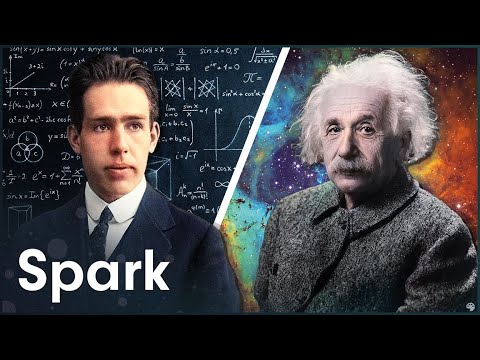
Einstein vs Bohr: The Secrets Behind Quantum Physics
Introduction
The introduction sets the stage for the video by discussing how the rules of our universe seem simple, but as scientists peer deep into the building blocks of matter, they find a universe completely unlike our own.
The Weird World of Quantum Mechanics
- Scientists discovered that in the realm of the very small, things could be in two places at once.
- They also found that their fates are dictated by chance and that reality itself defies all common sense.
- Everything we thought we knew about the world might turn out to be completely wrong.
Birth of Quantum Mechanics
This section discusses how a humble object, the light bulb, is responsible for the birth of quantum mechanics.
The Light Bulb Problem
- Engineers knew that if you heated a filament with electricity it glowed, but they didn't understand why.
- Something as basic as the relationship between temperature and color was still a complete mystery.
Max Planck's Solution
- In 1900, Max Planck was enlisted to help solve this problem.
- He took on a deceptively simple problem - why does the color of light change as the filament gets hotter?
Blackbody Radiator Experiment
- To investigate this problem, Planck and his colleagues built a blackbody radiator - a special tube they could heat to a precise temperature and measure its color or frequency of light produced.
Why is Blue So Hard to Make?
This section discusses the difficulty in producing blue and ultraviolet light, despite it being a part of the visible spectrum. It also introduces the concept of the "ultraviolet catastrophe" and the photoelectric effect.
The Ultraviolet Catastrophe
- Blue and ultraviolet light are difficult to produce compared to red light.
- Scientists in the late 19th century were perplexed by this phenomenon, which they called the "ultraviolet catastrophe."
- Max Planck found a mathematical link between color, frequency, and energy of light but did not understand its connection.
The Photoelectric Effect
- Scientists studying radio waves discovered an unexpected connection between light and electricity.
- Using a goldleaf electroscope, scientists found that ultraviolet light could remove static electric charge from leaves more effectively than red light.
- This new puzzle became known as the photoelectric effect.
Light as Waves
This section explains how scientists used to view light as waves and how this theory worked for certain phenomena like shadows and soap bubbles.
Wave Theory of Light
- Light was widely accepted as a wave-like behavior spreading through space.
- Shadows and soap bubbles were explained using this wave theory.
Absurdity of Wave Theory
This section explains how scientists struggled to reconcile the wave theory of light with the ultraviolet catastrophe and photoelectric effect.
Water Waves vs. Light Waves
- Water waves behave differently depending on their intensity, but this is not the case for light waves.
- If light was a wave, more intensity should knock out more electrons, but this is not what happens in the photoelectric effect.
Albert Einstein's Theory of Relativity
In this section, we learn about Albert Einstein and his famous theory of relativity.
The Arnholt Sternbach Observatory in Berlin
- The observatory was home to a large telescope that made it a popular destination for the public to engage with new science.
- Albert Einstein gave a famous lecture on his theory of relativity at the observatory.
Einstein's Theory of Light Quanta
- In 1905, Einstein proposed that light should be thought of as tiny bullet-like particles called quanta instead of waves.
- This idea solved all the problems with light at once and signaled a revolution in physics.
- Using an analogy involving red and heavier blue and gold balls, we see how thinking of light as particles solves the mystery of the photoelectric effect.
The Paradox of Light
- Although light was definitely a wave, according to Einstein's theory it was also definitely a particle. This paradox would become central to debates about the nature of reality itself.
The Cultural Revolution and Physics
In this section, we learn about the cultural revolution happening in 1922 and its impact on physics.
The Cultural Revolution
- In 1922, Europe is still recovering from World War I while experiencing significant cultural changes such as James Joyce's Ulysses being published and Chaplin releasing his first serious movie.
Impact on Physics
- No bullet points with timestamps available.
Introduction
The introduction sets the stage for a discussion on the upheaval that took place in physics during the early 20th century, which had far-reaching consequences.
The Epic Battle of Physics
- The upheaval in physics during the early 20th century was an epic battle fought between two sides: a new wave of modernist revolutionary scientists led by Niels Bohr and Albert Einstein, who represented the voice of reason.
- This battle raged for decades and was fought across the world in universities, conferences, bars, and cafes.
- It began with a deceptively simple experiment that uncovered something entirely unexpected about electrons.
The Bell Laboratories Experiment
This section discusses an experiment carried out at Bell Laboratories in New Jersey that uncovered something entirely unexpected about electrons.
Electrons as Tiny Lumps of Matter
- At the time, it was accepted without question that electrons were tiny lumps of matter - small but solid particles like miniature billiard balls.
- In the experiment at Bell Laboratories, they fired a beam of electrons at a crystal and watched how they scattered.
Wave-like Behavior
- Firing electrons through two gaps produced bands of light and dark similar to what is seen when water waves pass through two gaps.
- Each individual electron passed alone through the slits before hitting the screen but still contributed to the signature wave pattern.
- Each electron had to be behaving like a wave to explain this strange result.
Quantum Mechanics
This section discusses how Niels Bohr and his colleagues created quantum mechanics - a crazy theory of light and matter that embraced contradiction.
Embracing Contradiction
- Quantum mechanics is almost impossible to understand because it embraces contradiction.
- As Niels Bohr himself said, "Anyone who isn't shocked by quantum theory hasn't understood it."
- Quantum mechanics is a crazy theory of light and matter that defies common sense.
Conclusion
The upheaval in physics during the early 20th century was an epic battle fought between two sides: a new wave of modernist revolutionary scientists led by Niels Bohr and Albert Einstein, who represented the voice of reason. The experiment at Bell Laboratories uncovered something entirely unexpected about electrons - they exhibited wave-like behavior. This strange result led to the creation of quantum mechanics - a crazy theory of light and matter that embraced contradiction.
The Copenhagen Interpretation
Niels Bohr's interpretation of quantum mechanics, known as the Copenhagen interpretation, claimed that one can never know where an electron actually is until it is measured. This means that the electron itself is everywhere until it is observed. Albert Einstein disagreed with this interpretation and argued passionately with Bohr about whether quantum mechanics meant giving up on reality or not.
Bohr's Interpretation
- Electrons are waves of chance that pass through both slits at the same time, producing interference.
- Before being measured, electrons exist in a ghostly state of possibility and are neither here nor there.
- When an electron hits a screen, it becomes a particle and its position becomes real.
- According to Bohr's interpretation, only by looking do we conjure their position into existence.
Einstein's Disagreement
- Einstein hated the Copenhagen interpretation because it gave limits to knowledge that he didn't think should be final.
- Over the next 10 years, Einstein and Bohr would argue passionately about whether quantum mechanics meant giving up on reality or not.
- With two other scientists Nathan Rosen and Boris Podolsky, Einstein thought they'd found a way to win the argument against Bohr.
Entanglement
- At the heart of Einsteins argument was an aspect of quantum mechanics called entanglement.
- Entanglement is a special relationship between a pair of quantum particles whose fates are intertwined forever linked wherever they are created together.
- The Copenhagen interpretation says that until you measure one of the coins neither of them is heads or tails, and here's where entanglement makes this weird situation even weirder.
Einstein's Challenge
- Einstein refused to believe in instantaneous faster-than-light communication between two entangled particles.
The Debate on the Nature of Reality
This section discusses the debate between Einstein and Bohr on the nature of reality, specifically in relation to quantum mechanics.
Objective Reality vs. Hidden Reality
- Quantum particles are not like spinning coins but more like a pair of gloves separated into boxes.
- The true description of reality is either Bohr's coins or Einstein's gloves.
- The battle to understand the nature of reality was deadlocked as the world plunged into war.
Success and Pragmatism
- Quantum mechanics led to a profound understanding of semiconductors, which helped create the modern electronic age.
- It produced lasers revolutionizing communications, breathtaking new medical advances, and breakthroughs in nuclear power.
- Most working physicists deliberately chose to ignore Einstein's objections because quantum mechanics worked.
John Bell: A Lone Dissenter
- John Bell was an original thinker with real courage in his convictions who settled the argument once and for all.
- He was born in Belfast into a poor working-class family and struggled to get into Queen's University Belfast to study physics.
- He started pondering deep questions about quantum mechanics at Britain's Atomic Energy Research Center Harwell.
John Bell: An Original Thinker
This section provides more information about John Bell, his background, and his contributions to physics.
Early Life and Career
- John Bell was born in Belfast into a poor working-class family; he was insatiably curious, fiery, and stubborn.
- He struggled to get into Queen's University Belfast to study physics but eventually became one of the greats of physics.
- He worked at Britain's Atomic Energy Research Center Harwell where he built an early experimental nuclear reactor called Dido.
Contributions to Physics
- John Bell settled the debate between Einstein and Bohr on the nature of reality in relation to quantum mechanics.
- He was an original thinker with real courage in his convictions, and his rise to become one of the greats of physics is remarkable.
- Physicists like him consider him a hero.
John Bell's Brilliant Idea
In this section, the speaker explains how John Bell came up with a way to determine whether Einstein or Bohr was right about the nature of reality.
The Card Game Analogy
- The speaker uses a card game analogy to explain Bell's idea.
- The rules of the game are simple: if two cards dealt are the same color, the player wins; if they are different colors, the player loses.
- The deck is rigged so that every pair comes out as opposite colors.
- To catch the dealer out, the rules of the game are changed so that if two cards dealt are opposite colors, the player wins.
Deciding Who Was Right
- Bell reduced his idea into a single mathematical equation that tells us once and for all how reality really is.
- By changing the rules of the game after each round, it becomes impossible for the dealer to predict which rules will be played by and stack the deck correctly.
- If we win as many games as we lose, then Einstein was right. If not, then there is no sensible explanation and reality is truly unknowable at a fundamental quantum level.
Ignored by Physics Community
- At first, Bell's equations seemed untestable and were ignored by physicists.
- A small group of hippy physicists working at Berkeley in California would change this perception.
Hippy Physicists at Berkeley
In this section, we learn about a group of hippy physicists who worked at the University of Berkeley in California and their love for quantum mechanics.
The Hippie Physicists
- A small group of hippy physicists worked at the University of Berkeley in California.
- They loved quantum mechanics and saw parallels with their own esoteric beliefs.
The Hippie Physicists and Quantum Mechanics
This section discusses how the hippie physicists' interest in Eastern mysticism led them to explore Niels Bohr's secret signalling and how they used Bell's equation to experimentally test quantum mechanics.
The Hippie Physicists
- The hippie physicists were interested in Eastern mysticism and mixed it with quantum mechanics.
- They saw Niels Bohr's secret signalling as proof that physics supported their own ideas.
- They realized that with a bit of mathematical sleight of hand, they could take Bell's equation and experimentally test it.
Testing Quantum Mechanics
- John Clauser borrowed some equipment from the lab he was working in and set up the first genuine test of quantum mechanics.
- Over the next few years, the experiment was improved by a team led by Allen Aspects in Paris, making its results more reliable.
- A modern version of the experiment involves using a crystal to convert laser light into pairs of entangled like quanta photons. These photons are passed round and bent back again until they pass through detectors.
- The two photons are like two cards placed by an evil dealer. Each detector measures a property of the photons called polarization, which is equivalent to the color of playing cards in a game.
Experimental Test for Quantum Mechanics
This section explains how an experimental test for quantum mechanics works.
How It Works
- Dials allow measuring a second property of the photons, equivalent to guessing both sides of playing cards.
- The experiment involves running the laser and measuring the number of photon pairs coming through it.
- The more photons, the more accurate the experiment becomes.
- Running the experiment three more times corresponds to four different settings of dials. Each run is like a different set of rules for the quantum dealer.
- If the numbers come out less than two, then it's proof that the dealer has been stacking the deck (Einstein's view).
- If the result is greater than 2, then something else is at work (Bohr's view).
Results
- The final result is 0.56, which means Albert Einstein was wrong and Niels Bohr was right.
- The two entangled photons' properties couldn't have been set from the beginning but are summoned into existence only when we measure them.
Einstein's Dream of Finding a Reasonable Common-Sense Explanation was Shattered
In this section, the speaker discusses how Einstein's dream of finding a reasonable common-sense explanation for light quanta was shattered. The weird results of quantum mechanics won't go away and will rear its ugly head somewhere.
Quantum Mechanics is Weird
- Einstein wrote that 50 years of conscious brooding have brought him no nearer to the question what are light quanta.
- Einsteins dream of finding a reasonable common-sense explanation was shattered for good.
- The weirdness of the quantum world won't go away it'll rear its ugly head somewhere.
The Greatest Scientific Revolution Ever Brought About by a Light Bulb
In this section, the speaker talks about how scientists are still using powerful light sources like x-rays to unlock nature's mysteries.
Diamond Light Source
- The greatest scientific revolution ever was brought about by a light bulb.
- Scientists are still using powerful light sources like x-rays to unlock nature's mysteries.
- The diamond light source is Britain's single largest science facility where x-rays produced here are 10 billion times more powerful than a hospital x-ray.
Investigating New Materials with Powerful Light Beams
In this section, the speaker discusses how researchers at Diamond Light Source use powerful light beams to investigate new materials which may have the potential to bring about an electronics breakthrough as great as any before.
Potential Electronics Breakthrough
- Researchers at Diamond Light Source use powerful light beams to investigate new materials.
- These materials may have the potential to bring about an electronics breakthrough as great as any before.
Quantum Mechanics Thrills and Frustrates
In this section, the speaker talks about how quantum mechanics is capricious, counterintuitive, and even sometimes feels just plain wrong. However, it still surprises us every day and our knowledge of the quantum world is still far from complete.
Quantum Mechanics is Capricious
- Quantum mechanics thrills and frustrates the speaker.
- Our knowledge of the quantum world is still far from complete.
Conclusion
In this section, the speaker concludes by saying that quantum mechanics still has greater truths about nature yet to be discovered.
Greater Truths About Nature Yet to be Discovered
- The speaker believes that there are greater truths about nature yet to be discovered in quantum mechanics.
Turn any video into a summary like this
YouTube links, meetings, lectures. With transcripts, search, and chat.