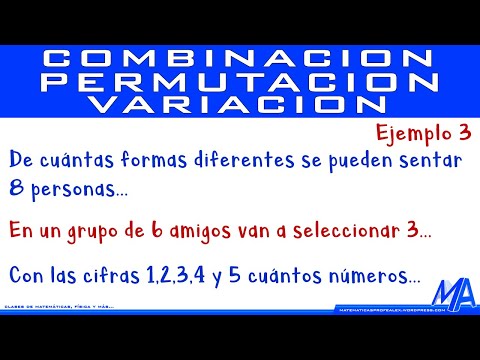
Combinaciones, permutaciones y variaciones | Ejemplo 3
Combinatorial Exercises: Permutations and Combinations
Introduction to the Course
- The speaker welcomes viewers to a combinatorics course, focusing on exercises related to combinations, permutations, and variations.
- The video aims to solve three classic exercises that serve as practice for previously covered material. Future videos will increase in difficulty.
Exercise 1: Seating Arrangements
- The first exercise asks how many different ways eight people can sit in a row of eight seats, emphasizing that order matters in this scenario.
- An analogy is provided using bus seating preferences (aisle vs. window), illustrating that the arrangement affects individual choices.
- The example shows that switching two individuals' seats results in different arrangements, confirming the importance of order when seating.
Methodology for Calculation
- Since order matters, this problem involves either variations or permutations. The speaker prefers using a box method for clarity.
- For each seat filled, the number of available options decreases: 8 choices for the first seat, then 7 for the second, continuing down to 1 choice for the last seat.
Formula Application
- Using multiplication of available options gives the total arrangements; however, applying permutation formulas is also valid.
- All elements are used since all eight people will be seated; thus it’s classified as a permutation without repetition.
Final Calculation
- The formula used is n! , where n = 8 . This results in 8! = 40,320 .
Exercise 2: Selecting Friends for a Task
- In this exercise involving six friends (Álex, Blanca, Claudia, Diana, Esteban, Felipe), three are selected to form a group for an unspecified task.
Importance of Order
- It’s crucial to determine if order matters when selecting members. A test with different selections illustrates that changing their order does not create distinct groups.
Conclusion on Selection Type
Understanding Combinations and Permutations
The Importance of Order in Selection
- Alex discusses the irrelevance of selection order when all participants (Álex, Diana, and Claudia) perform the same task.
- If roles were assigned differently (e.g., leader, assistant), the order would matter since each person would have a distinct responsibility.
Distinguishing Between Combinations and Permutations
- Since the order does not matter in this scenario, it is classified as a combination rather than a permutation or variation.
- The problem involves selecting 3 individuals from a group of 6, requiring the application of combination formulas.
Applying Combination Formulas
- To solve for combinations, identify 'n' (total items = 6 friends) and 'r' (items to select = 3).
- The formula used is n! / (r! * (n - r)!); substituting gives us 6! / (3! * 3!).
Simplifying Factorials
- Expressing 6! as 6 × 5 × 4 × 3!, allows for cancellation with the denominator's factorial.
- Care must be taken not to mistakenly cancel different factorial terms; only identical factorial terms can be simplified.
Final Calculation of Combinations
- After simplification, calculations yield that there are twenty different ways to form groups of three from six friends.
- Examples include various combinations like A with B and C; this illustrates practical applications of combinations.
Exploring Further Exercises on Combinations
Key Questions in Problem Solving
- Emphasis is placed on understanding whether order matters and if all elements will be utilized in exercises involving combinations or variations.
Distinct Digits in Number Formation
- A new exercise involves forming three-digit numbers using distinct digits from 1,2,3,4,5, highlighting that repetition is not allowed due to "distinct" criteria.
Specific Placement Constraints
- When requiring that '5' occupies the tens place consistently while forming numbers with other digits emphasizes how placement affects overall arrangements.
Analyzing Order Relevance Again
Understanding Variations and Permutations in Combinatorics
Introduction to the Method of Boxes
- The discussion begins with clarifying that the problem involves multiple arrangements rather than a simple combination, emphasizing the use of permutations.
- The "method of boxes" is introduced as a practical approach for solving problems related to variations and permutations, which will be demonstrated through an example.
Setting Up the Problem
- The focus is on placing the digit '5' in the tens place, establishing it as a fixed point with only one option available for that position.
- For the hundreds place, there are four options (1, 2, 3, or 4), since '5' cannot be reused. This highlights the importance of distinct digits in this arrangement.
Calculating Options
- After selecting a digit for the hundreds place (e.g., '2'), three options remain for the units place (1, 3, or 4), demonstrating how choices decrease based on previous selections.
- The total number of combinations can be calculated by multiplying available options: 4 times 1 times 3.
Distinguishing Between Variations and Permutations
- A distinction is made between using all elements versus selecting specific ones; here n = 5 (total digits), while r = 3 (digits chosen).
- It’s clarified that due to constraints (the middle digit must always be '5'), this scenario represents variations rather than permutations.
Adjusting for Fixed Elements
- Since '5' remains constant in its position, only four other digits can vary. Thus, we focus solely on these four numbers when calculating variations.
- The method simplifies further by eliminating non-variable elements from consideration when determining possible arrangements.
Final Calculation Steps
- With two positions left to fill from four variable digits, we apply variation formulas: n!/(n-r)! = 4!/(4-2)! = 12.
- Simplifying yields 4 times 3, confirming that there are indeed twelve unique arrangements possible under these conditions.
Conclusion and Further Learning Opportunities
Turn any video into a summary like this
YouTube links, meetings, lectures — with transcripts, search, and chat.