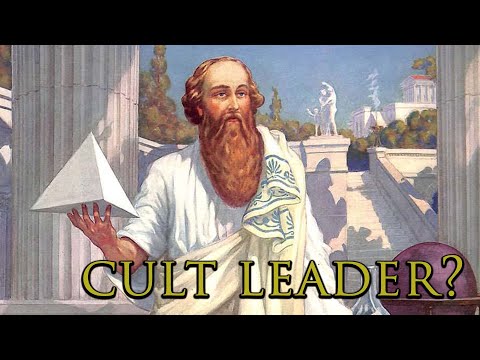
Pythagoras & His Weird Religious Cult
Who Was Pythagoras?
Introduction to Pythagoras
- Pythagoras is a well-known figure among ancient Greek philosophers, alongside Plato, Aristotle, and Socrates.
- Common associations with Pythagoras include mathematics and geometry; however, he may also be viewed as a cult leader or shaman.
Historical Context
- Pythagoras is classified as a pre-Socratic philosopher, indicating he lived before Socrates (6th to 5th centuries BC).
- He is often regarded as the originator of fundamental philosophical ideas that influenced later thinkers like Plato.
Myths vs. Reality
- There are many legends surrounding Pythagoras, complicating efforts to discern historical facts from myth.
- The followers of Pythagoras formed a distinct group known as the Pythagoreans, characterized by specific beliefs and practices.
Sources of Information
- No writings exist directly from Pythagoras; most accounts come centuries after his death.
- The "Accusmata," sayings attributed to him, provide insights into his teachings and lifestyle.
Life and Travels
- Accounts of his life were recorded in the 3rd and 4th centuries CE by authors like Diogenes Laertius and Porphyry.
- Early life details are scarce; some suggest he traveled to Babylon and Egypt for wisdom.
Pythagorean Way of Life
Establishing Influence
- At around 40 years old, Pythagoras moved to Croton in Southern Italy where he began gathering followers.
- His fame stemmed not from mathematical theories but from being perceived as a sage capable of extraordinary feats.
Reputation and Mystique
- Many viewed him as semi-divine with significant psychic abilities rather than merely a philosopher.
Pythagoras: The Shaman of Ancient Wisdom
Pythagorean Teachings on the Soul
- Pythagoras is described as a shaman with secret wisdom, capable of being in multiple places simultaneously and possibly traveling to different realms.
- He taught that the soul is distinct from the body, immortal, and survives after death—a teaching that was unusual for his time but later influenced Plato and others.
- Pythagoras likely espoused the theory of reincarnation, illustrated by a story where he recognizes an old friend's soul in a puppy being whipped.
- His views suggest that souls undergo divine judgment after death, facing punishment or reward in the afterlife—though details remain unclear.
- Pythagoras gained a devoted following in Croton, forming a secret society focused on esoteric teachings about the soul.
The Pythagorean Way of Life
- The early Pythagoreans adhered to specific rules and rituals that distinguished them from other groups; they followed established Greek religious practices with unique modifications.
- A vegetarian diet was part of their lifestyle, potentially linked to beliefs about reincarnation; this reflects their commitment to ethical living.
- Various ritualistic rules were observed, such as not entering temples barefoot or making offerings correctly—emphasizing respect for divine practices.
- Some peculiar prohibitions included not burying the dead in wool and avoiding beans due to various symbolic interpretations related to life and death.
- Their lifestyle encouraged moderation and contemplation through aphorisms like "do not vex with sharp words" and "cling not to this life," echoing themes found in ancient mystery cults.
Connections to Mystery Cults
- Many scholars draw parallels between Pythagoreanism and Orphic mystery cults centered around Orpheus, highlighting shared features such as initiation rites and ethical living.
Pythagorean Mysticism and Philosophy
The Pythagorean Initiation and Esotericism
- The Pythagoreans, from at least the fifth century, were associated with various rights including initiation into mysteries that depicted terrors of Hades, aiming to create a favorable state for initiates before and after death.
- Their practices included secret rituals and an ascetic lifestyle intended to purify the soul for a better afterlife or reincarnation, highlighting the esoteric nature surrounding Pythagoras and his teachings.
- A notable practice among the Pythagoreans was silence; potential initiates were reportedly required to observe a five-year period of silence, which also involved keeping secrets about their master's teachings.
- This secrecy contributed to both intrigue and criticism of the group, leading to attacks against them in the late 6th century BC, forcing Pythagoras to relocate to Metapontum where he is believed to have died around 490 BC.
Mathematics and Philosophy: The Legacy of Pythagoras
- While often associated with mathematics, there is little direct evidence linking Pythagoras himself with mathematical ideas; many concepts attributed to him may actually stem from later philosophers like Plato who projected their own ideas backward onto him.
- Despite this uncertainty, it is possible that Pythagoras had some foundational thoughts on numbers' role in reality. His movement survived posthumously, evolving into two camps: the Acousmaticoi (focused on religious aspects) and the Mathematici (who engaged more with philosophical questions).
Influence of Later Philosophers
- In later centuries (4th century), figures identifying as Pythagorean began discussing concepts such as unlimitedness and limit in relation to numbers' significance in understanding reality.
- Notable later philosophers like Philolaus argued that reality was based on harmony between these concepts, making numbers essential for comprehending the cosmos.
- Innovations in mathematics and geometry emerged from these later Pythagoreans who integrated mystical philosophies surrounding numbers into their teachings.
Key Concepts in Pythagoreanism
- Central beliefs included that reality consists fundamentally of numbers; this notion manifested through geometric theories explaining cosmic workings.
- Mathematical ratios were crucial within their philosophy—geometry's connection with music theory exemplified how they understood harmony through numerical relationships.
Cosmology and Musical Theory
- The Pythagoreans developed significant theories regarding music theory based on mathematical ratios corresponding to auditory experiences—key elements included determining intervals like fourths, fifths, and octaves.
The Legacy of Pythagoras and His Influence
The Concept of the Music of the Spheres
- The Pythagoreans believed in a theory called the "music of the spheres," suggesting that celestial bodies create harmonious music as they move, linking mathematics and geometry to concepts of harmony.
Origins of Pythagorean Ideas
- It is plausible that many ideas attributed to later followers originated with Pythagoras himself, rather than being fabricated from scratch by his disciples.
Esoteric Teachings vs. Ritualistic Practices
- Pythagoras may have had secret teachings about numbers and harmony beyond the ascetic lifestyle and rituals followed by some adherents, distinguishing between practical (Accusmaticoi) and philosophical (Mathematico) followers.
Resurgence in Neo-Pythagoreanism
- By the 4th century, traditional Pythagoreanism faded, but a resurgence known as neo-Pythagoreanism emerged before the common era, where individuals revered Pythagoras as a foundational philosopher.
Influence on Later Philosophical Movements
- Neo-Pythagoreans were significantly influenced by Platonism and contributed to developing Neoplatonism, tracing philosophical ideas back to Pythagoras.
Cultural Legacy in Late Antiquity
- Even in late antiquity, individuals associated with Pythagorean principles were recognized for their distinct lifestyles—vegetarianism, simple clothing, unkempt hair—akin to ancient "hippies."
Enigmatic Figure in Philosophy
- Pythagoras remains an enigmatic figure within Greek philosophy; his diverse teachings were carried forward differently by various groups over centuries.
Misconceptions About His Contributions
- Many people recognize his name through mathematical contributions like the theorem often misattributed to him while overlooking his mystical aspects and religious cult affiliations.
Future Discussions on Mathematical Ideas