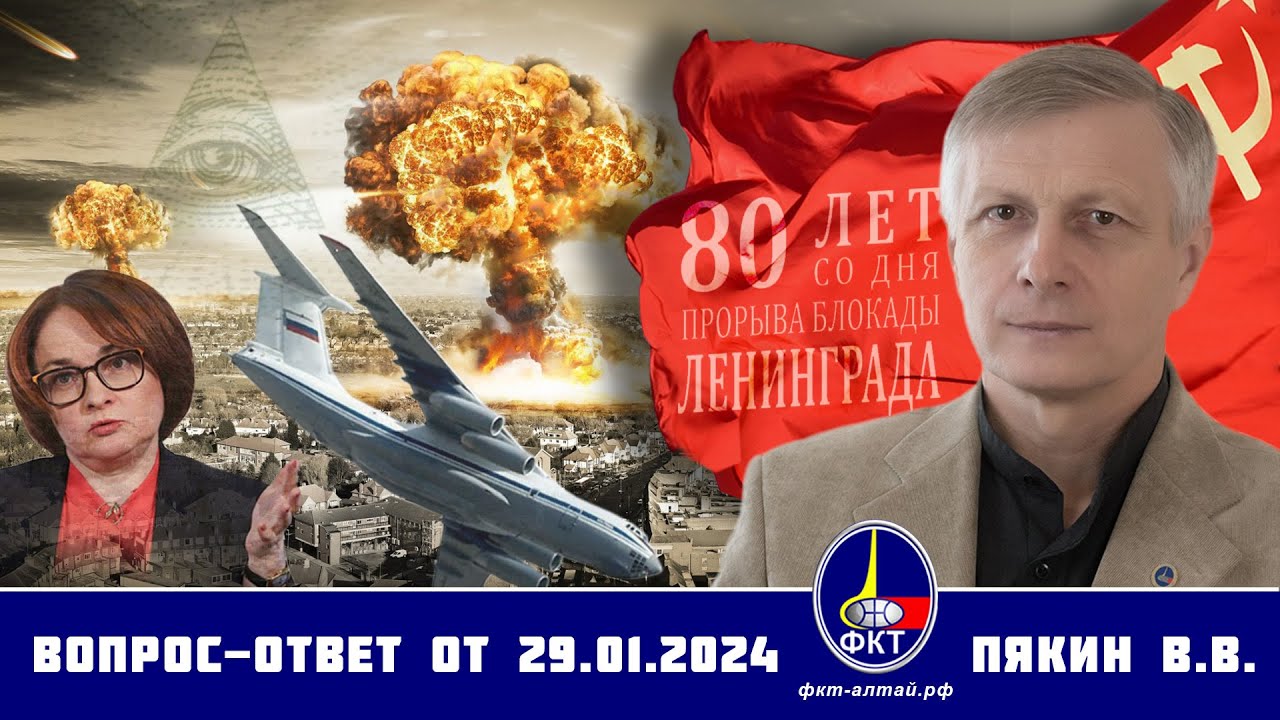
Валерий Викторович Пякин. Вопрос-Ответ от 29 января 2024 г.
New Section
The section discusses the development of state symbols and sovereignty, challenging the assumption that national flags evolved naturally. It delves into how ideologies shape flag designs and their significance in global hierarchies.
Internal Predictor of the USSR
- The world system of national flags did not evolve spontaneously; individuals involved in designing and approving flags would be surprised to learn their ideas were implanted through leadership schemes.
- Explores how global state hierarchies are reflected in national flags and other symbols, shedding light on their formation and expression.
- Recent discussions about a potential nuclear war between the West and Russia have sparked concerns globally, with experts suggesting either an imminent nuclear conflict or a belief that Russia has already triumphed.
- Examines the prevailing sentiments in Russia, where some feel victorious and relaxed while others anticipate further conflict, highlighting the delicate balance before potential warfare.
Global State Symbols
- Addresses the downing of a Russian military transport plane by terrorists, questioning the motives behind such actions despite established protocols for prisoner exchanges.
- Discusses deliberate targeting of Ukrainian troops by surrounding them without mercy during conflicts, illustrating ruthless tactics employed even against surrendering soldiers.
- Highlights instances where Ukrainian prisoners faced severe treatment at Russian hands, emphasizing calculated efforts to eliminate captives rather than adhere to agreed-upon procedures.
Strategic Warfare Considerations
- Analyzes the shooting down of a significant military aircraft as a primitive act with strategic implications beyond immediate losses, indicating a lack of interest in negotiation or dialogue from certain parties.
- Considers the broader implications of such actions on diplomatic relations and future engagements, suggesting a pattern of behavior aimed at undermining Russia's position internationally.
Nuclear War Speculations
- Explores the rationale behind escalating tensions and discussions around an inevitable nuclear conflict with Russia, attributing Western preparations for such scenarios to perceived Russian vulnerabilities.
- Critiques Western strategies focused on inflicting discomfort on Russia rather than seeking constructive dialogue or resolution, reflecting underlying animosity driving geopolitical decisions.
Confidence Dynamics
- Examines Western confidence in launching a nuclear strike against Russia predicated on assumptions that Russia would not retaliate due to fear or reluctance to harm its allies.
- Observes shifts in Western perceptions towards assured non-retaliation by Russia as key to contemplating aggressive actions without fear of reprisal.
Elite Logic Analysis
Russian Foreign Policy Strategy
In this section, the speaker discusses Russia's foreign policy strategy and how it should prioritize protecting its interests on all platforms and levels.
Russia's Assertiveness in Protecting Interests
- Russia needs to defend its interests on all platforms and levels.
- Lithuania's actions blocking access to Kaliningrad are seen as a challenge that Russia must address assertively.
- Russia responds to actions harming its interests by providing resources but also ensuring it is not exploited.
Challenges Faced by Western Economies
This part delves into the challenges faced by Western economies due to their conflict with Russia and how they struggle to communicate this reality to their populations.
Economic Struggles and Anti-Russia Sentiment
- Western economies face difficulties due to conflicts with Russia.
- France and Germany are actively engaged in conflicts against Russia, impacting their economies.
- Israel's military actions against Iran in Syria are justified as a threat, similar to Western actions against Russia.
Impact of Economic Warfare on Russia
The impact of economic warfare on Russia is discussed, highlighting how external forces aim to weaken the country economically.
Economic Resilience Amidst Challenges
- The West aims economic blows at Russia but faces challenges due to Russian economic resilience.
- The West targets Russian economy through various means but struggles due to Russian self-sufficiency.
- Despite efforts to undermine the Russian economy, strategic planning has helped maintain stability.
Strategic Responses and Future Outlook
Strategic responses from both sides are analyzed along with the future outlook of the ongoing conflicts between Russia and the West.
Strategic Maneuvers and Consequences
- Western economies unite against Russia but face challenges in achieving their goals.
- France and Germany actively participate in anti-Russia activities without clear communication with their citizens.
Russian President Putin's Speech Insights
In this section, Russian President Putin discusses the rationale behind Russia's military actions and addresses the issue of Western deception.
Western Deception and Military Strategy
- Putin emphasizes that Russia's decision not to strike back at the West is due to strategic reasons, highlighting the importance of maintaining a legitimate military presence.
- Strategic targets in Ukraine are spared from attacks, showcasing a calculated approach to military operations.
- The flexibility and efficiency of Ukrainian transport infrastructure are acknowledged, underscoring the need for precise targeting in military strategies.
- Suggestions are made regarding disrupting Ukrainian logistics through targeted strikes on supply chains and storage facilities.
- Examples of successful disruptions in Ukrainian logistics are discussed, emphasizing the importance of reconnaissance and strategic planning.
Putin's Justification for Special Military Operation
Here, Putin explains the necessity of Russia's special military operation in response to repeated Western deception.
Necessity of Special Military Operation
- Putin justifies the special military operation as a response to consistent deception by Western partners.
- Questions arise about Russia's sovereignty and decision-making processes when faced with continuous deceit from Western nations.
- Despite being portrayed as an aggressor, Russia asserts that it had no choice but to initiate the special military operation due to external pressures.
- The impact of repeated deception on mutual respect between nations is highlighted, questioning how a country can be respected if it can be deceived repeatedly.
Analysis of Minsk Agreements
This segment delves into the implications and interpretations surrounding the Minsk agreements.
Interpretation of Minsk Agreements
- Criticisms towards the Minsk agreements stem from their perceived alignment with Russian interests rather than fostering peace.
- The obstruction of Minsk agreement implementation is attributed to Russian elite interests aiming at preventing Ukraine's demilitarization and denazification.
- Media manipulation by both Russian elites and Western powers contributes to justifying actions that hinder Minsk agreement fulfillment.
New Section
The discussion revolves around the demilitarization of Ukraine, its potential entry into NATO, and the conditions set by Russian elites for negotiations.
Demilitarization of Ukraine and Russian Conditions
- Russia proposes that Ukraine does not conduct denazification or demilitarization. Instead, it suggests that Ukraine should join NATO. Russia demands a contribution from Ukraine and insists that territories currently liberated from fascists remain under Russian control.
- There is readiness on the part of some to capitulate fully, expressing a desire to destroy Russia. This aligns with actions taken by the entire Russian elite. Putin's meeting with students highlighted specific stories, including that of a disabled fighter discussing bank loans provided during combat.
- The conversation shifts to credit holidays where individuals are charged interest even when not requiring money at present. This practice aims to exploit individuals fully under patriotic pretenses.
New Section
The focus is on how state actions impact individuals taking loans and serving in military roles.
State Actions and Individual Impact
- Individuals who are mobilized by the state face disruptions in their lives due to military service requirements. This situation raises questions about loan repayments and financial burdens placed on families.
- When an individual is conscripted into service by the state, their ability to repay loans is compromised as they face risks such as injury or death. The state's obligation to alleviate financial burdens in such cases is emphasized.
New Section
Exploring the implications of state-mandated military service on loan obligations and individual well-being.
State Mandates and Loan Obligations
- When an individual is drafted into military service by the state, all outstanding loans should be waived by banks rather than burdening the individual or their family with repayment responsibilities.
- State actions disrupting an individual's life through conscription necessitate banks writing off all debts incurred before military service initiation. It highlights the ethical responsibility of banks towards those serving in defense roles.
New Section
Discussing how banks should handle loan obligations for individuals entering military service mandated by the state.
Bank Responsibilities in Military Service
- Banks should absolve individuals called up for military duty from all debts as a consequence of their service commitment imposed by the state.
- By mobilizing individuals for military purposes, states must ensure that banks relieve them of any financial liabilities incurred prior to enlistment, acknowledging the sacrifices made during active duty.
New Section
Examining how bank practices impact individuals serving in defense roles due to state mandates.
Impact of Bank Practices on Military Personnel
- Individuals fulfilling contractual obligations with states for military service face financial hardships exacerbated by banking practices post-enlistment.
Russian City Renaming Debate
The speaker discusses the renaming of cities in Russia, particularly focusing on the controversy surrounding the renaming of Stalingrad to Volgograd and Leningrad to St. Petersburg.
Renaming of Cities
- Brezhnev's role in renaming cities is questioned.
- The significance of historical events like the Battle of Stalingrad and their impact on city names is debated.
- Criticism is directed towards the renaming of Stalingrad to Volgograd, emphasizing the historical importance and heroism associated with the original name.
- The speaker highlights the heroic nature of Leningrad during WWII and criticizes its renaming to St. Petersburg.
- The enduring legacy and symbolism attached to city names are emphasized, advocating for preserving historical significance.
Impact of Historical Renaming
This segment delves into how historical renaming reflects shifts in ideology and societal values, particularly during periods like Perestroika in Russia.
Ideological Shifts
- Discussion on ideological changes during Perestroika era and rejection of communist ideals.
- Influence of Communist Party nomenclature on decisions regarding state symbols like flags.
- Controversy surrounding the renaming of Leningrad to St. Petersburg by the CPSU despite historical significance.
Controversy Surrounding Renaming Decisions
Addressing public resistance, political motivations, and implications behind city renaming decisions in Russia.
Public Resistance
- Critique against disregarding public sentiment in favor of political agendas during city renaming processes.
- Importance placed on honoring historical sacrifices through maintaining original city names like Leningrad.
- Legal violations highlighted concerning the process leading to reverting city names back to their historical roots.
Political Implications & National Identity
Exploring how political decisions impact national identity, memory preservation, and patriotism through city naming practices.
National Identity Preservation
- Historical context provided regarding previous name changes such as Petrograd under Bolshevik rule.
- Criticism towards erasing patriotic history through arbitrary renamings without considering public sentiment or national pride.
Russian Economic System and Global Relations
In this section, the speaker discusses the Russian economic system, its interactions with global powers, and the implications of certain economic policies on Russia's position in the international arena.
Russia's Economic Strategy
- The Central Bank and Ministry of Finance are working to prevent the formation of a ruble zone to avoid reliance on the dollar.
Global Trade Dynamics
- Many countries are willing to work with Russia in rubles, but current actions by the Central Bank and Nabiullina push Russia towards using dollars.
International Relations
- Despite potential for collaboration with 140 out of 192 countries, Russian economic policies under Nabiullina hinder working in rubles.
Impact of Economic Policies on Russia
This segment delves into how specific economic policies, particularly those related to currency usage and inflation control, affect Russia's economic standing globally.
Currency Usage
- Nabiullina's policies favor using the dollar over the ruble, impacting Russia's economic independence.
Inflation Control
- By lowering the ruble value against the dollar, Nabiullina inadvertently harms Russia's economy by inviting inflation.
Geopolitical Implications and Elite Interests
Here, discussions revolve around geopolitical consequences of economic decisions and how they align with elite interests within Russia.
Elite Interests
- The speaker suggests that Russian elites may not prioritize preserving Russian interests over Western influence.
Geopolitical Threats
- There is a looming threat of nuclear war orchestrated by Western powers against Russia due to geopolitical tensions.
New Section
In this section, the speaker discusses the concept of a global predictor and its historical implications for Russia.
Global Predictor and Russian History
- The global predictor initiated a project centuries ago to transform Russians into a different identity to weaken Russia.
- There is an interest in engaging with Russia to save civilization on Earth, highlighting the importance of global cooperation.
- The United States is consuming a significant portion of global resources and producing waste, posing a threat to the planet's sustainability.
New Section
This part delves into the role of the United States in global affairs and suggests reformatting its structure for sustainable development.
Role of the United States
- The US elites sustain their lifestyle through exploiting resources globally, hindering planetary sustainability.
- Restructuring the US as an ordinary state is proposed to ensure global civilization's survival.
New Section
Here, there is a discussion about how the US is perceived as a state and its impact on global dynamics.
Perception of the United States
- The US is portrayed as living off world exploitation rather than contributing positively to global welfare.
- It is suggested that transforming the US into an ordinary state would benefit global stability and sustainability.
New Section
This segment explores historical governance methods and their relevance in contemporary society.
Historical Governance Methods
- Past eras allowed for effective long-term governance due to different social dynamics compared to modern times.
Russian Political Analysis
In this section, the speaker discusses political dynamics related to Russia and the United States, highlighting tensions and potential conflicts.
Russian Perception of the US
- The speaker mentions a sentiment where some individuals harbor animosity towards Russia, believing that Russia should not exist. This sentiment dates back to actions taken in the 1990s aimed at destroying Russia.
Control Dynamics between States
- There is a discussion on global power dynamics, with an emphasis on how certain regions may challenge central authority. An example is provided with Texas challenging federal control in the United States.
Texas vs. Federal Government
- The situation in Texas is highlighted as a potential conflict point with the federal government. Reference is made to Texas starting a confrontation based on the US Constitution's first article.
Global Conflict Escalation
This section delves into escalating global conflicts and their implications for international relations.
Internal Strife in the US
- The speaker discusses civil unrest within the United States, citing instances like Pennsylvania showing signs of tension similar to those seen in Texas.
International Conflict Scenarios
- Actions by Israel against Palestinian territories are mentioned, along with attacks on American bases in Syria and Iraq by various groups.
US Response and Global Implications
This part focuses on responses from the US to international conflicts and their broader impact.
Red Lines Crossed
- A scenario is described where red lines set by the US are crossed without immediate retaliation, leading to questions about future responses.
Military Engagement Challenges
- Challenges faced by the US due to involvement in multiple conflicts globally are highlighted, indicating limitations on engaging in new military confrontations effectively.
New Section
In this section, the speaker discusses the importance of understanding complex social systems and the need for knowledge in managing them effectively.
The Significance of Knowledge in Social Systems
- The speaker emphasizes that crucial knowledge about super-systems is found in the works of the internal predictor of the USSR.
- Changes in a state's symbols, such as flags, indicate shifts in its role and function within the international hierarchy.
- Additional volumes on war, economics, simulation activities, and societal security contribute to a comprehensive understanding of governance.
- Works like "Flit iz Bin" provide analytical insights into societal concepts and are essential for grasping societal security theories.
- Understanding conceptual frameworks on societal security is vital for individuals to contribute positively to society and protect their interests.
New Section
This segment delves into individual responsibility in contributing to societal stability through knowledge acquisition and proactive engagement.
Individual Contribution to Societal Stability
- Individuals play a critical role in either facilitating or hindering societal processes based on their understanding of societal security concepts.
- Strengthening the state, ensuring peace, and securing family well-being are achievable through personal actions aligned with societal security principles.