Ley de Contratos del Sector Público - 9/2017 - 1a parte
Understanding the Public Sector Contracts Law 9/2010
Introduction to the Topic
- The video discusses Law 9/2010, which pertains to public sector contracts, acknowledging its complexity and potential confusion.
- The presenter plans to break down the law into manageable sections ("islands of information") for better understanding over subsequent videos.
Structure of the Law
- The law consists of a preliminary title and four main books, totaling 347 articles that may seem overwhelming at first glance.
- Emphasis is placed on understanding Article 1, which outlines the purpose of the law: regulating public sector contracts.
Key Principles of Public Sector Contracts
- Unlike Law 39, this law specifies that deadlines are counted in calendar days unless stated otherwise (e.g., "business days").
- Article 1 aims to ensure equal access for bidders, transparency in procedures, and non-discrimination among participants.
Objectives and Regulations
- The law mandates that all contract-related information be publicly available online through various government platforms.
- It emphasizes safeguarding free competition and selecting economically advantageous offers while considering social and environmental criteria.
Definitions and Scope
- Article 2 defines public sector contracts as those with economic benefits for contractors; they cannot incur losses when engaging with public administration.
Understanding the Public Sector and Contractual Framework
Overview of the Public Sector Entities
- The public sector is represented by various entities, including local entities, managing bodies, common services of social security, autonomous organizations, and independent administrative entities. These are depicted as a green sphere representing public administration.
- Within the public sector, adjudicators have the capacity to award contracts. This includes public administrations, public foundations, and mutual insurance societies represented by a blue sphere.
- The intersection of these spheres indicates entities that can perform administrative contracts regulated by law. For example, any ministry qualifies as part of the public sector with adjudicating powers.
Adjudicating Powers in Different Entities
- An entity manager within the public sector also holds adjudicating power but must act on behalf of a superior entity for contract awards.
- Public foundations qualify as part of the public sector if they possess over 50% public capital; however, they may not always be considered adjudicators depending on their contractual types.
- Commercial companies are included in the public sector if they also meet the 50% threshold for public capital but do not necessarily hold adjudicating authority.
Exclusions from Contract Law
- A summary will follow regarding excluded contracts under articles 4 to 11. These exclusions are significant for exam preparation due to their unique characteristics outside standard regulations.
- Contracts excluded from general norms include those governed by specific treaties like EU functioning treaties related to defense and security or research and innovation.
Specific Excluded Contracts
- Various legal transactions such as sales, donations, leases concerning real estate or negotiable securities are excluded from this law framework.
- Financial transactions involving securities or actions transferred through institutions like Spain's central bank are also exempted from standard contract laws.
Employment Contracts and Other Exclusions
- Employment relationships for civil servants and labor contracts fall outside this law since they adhere to distinct regulations rather than general contract law principles.
- Public service fees (tariffs), rates, and prices are similarly excluded from this legal framework due to their specific nature in governance contexts.
Types of Contracts: Administrative vs Private
- Arbitration services were previously included under administrative contracts but now fall outside current regulations; political campaign contracts awarded by parties are also excluded.
- There exist two main types of contracts: administrative contracts governed by specific rules versus private ones which do not meet certain criteria outlined in articles 25 and 26.
Contracts in Public Administration
Overview of Excluded Contracts
- The discussion begins with the classification of contracts, particularly focusing on those that can be considered private. The relevant articles governing these contracts are Articles 12 to 18, which include five main types and a sixth mixed type.
Types of Administrative Contracts
- The five primary types of administrative contracts discussed are:
- Works Contract: Involves the execution of construction projects along with necessary project documentation.
- Concession of Works: A contract allowing a private entity to execute and exploit public works.
- Concession of Services: Similar to works but focuses on service delivery.
- Supplies Contract: Pertains to the procurement of goods or services.
- Mixed Contracts: Combine elements from the above categories.
Definition and Scope of Works Contracts
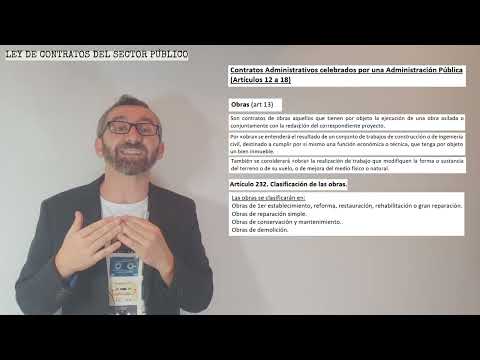
- Works contracts are defined as agreements aimed at executing construction tasks, which may also involve drafting related projects. An "obra" (work) is described as any construction or civil engineering task intended for economic or technical purposes involving real estate. Examples include modifying land or constructing buildings.
Classification of Works
- According to Article 232, works can be classified into several categories:
- First Establishment: Creating a new property from scratch.
- Reform: Altering existing structures within public administration.
- Restoration and Rehabilitation: Restoring functionality versus providing new functionalities post-construction.
- Major Repairs: Necessary repairs affecting structural integrity due to damage (e.g., load-bearing walls).
Restoration vs. Rehabilitation
- Key distinctions between restoration and rehabilitation:
- Restoration maintains original functionality after renovation (e.g., restoring an old post office).
- Rehabilitation, however, changes the building's function while preserving its aesthetic (e.g., converting an old cinema into a clothing store). Examples from Alicante illustrate these concepts effectively.
Additional Types of Works
- Other types mentioned include:
- Simple Works: Addressing unforeseen damages requiring immediate attention.
- Conservation and Maintenance Works: Regular upkeep due to wear over time (e.g., fixing cracks).
- Demolition Works: Involves tearing down structures entirely when necessary.
Understanding Concessions
Concession Contracts Explained
- Concessions allow public administrations unable to perform certain tasks themselves to delegate these responsibilities to private companies for execution and exploitation in exchange for fees or tolls. This is crucial when public resources are insufficient for specific projects like infrastructure development.
Legal Framework for Concessions
- The legal basis for concession contracts is outlined in Article 14, detailing their purpose in executing various aspects related to public works such as maintenance, repair, and operation rights associated with constructed facilities like highways or airports. These concessions often involve long-term agreements where private entities manage operations while recouping costs through user fees.
Understanding Service Concessions and Supply Contracts
Overview of Service Concessions
- Various contracting authorities delegate the management of services to individuals or legal entities, where the compensation is either through the right to exploit contract services or a fee.
- A service concession allows public administration to outsource services it cannot provide directly due to lack of public employees, exemplified by waste collection contracts with private companies.
- Municipalities often lack public workers for tasks like street cleaning, leading them to contract private firms for these essential services.
Duration and Limitations of Concessions
- The duration of service concessions must be limited; indefinite contracts are not permissible. Specific administrative clauses govern these durations.
- Generally, contracts should not exceed five years; however, certain circumstances may necessitate longer terms.
- The law stipulates maximum durations: 40 years for works-related concessions, 25 years for non-health service concessions, and 10 years for health-related service concessions.
Extensions and Economic Balance
- All specified durations can be extended by up to 15% to restore economic balance in specific situations.
Understanding Supply Contracts
- Supply contracts involve acquiring goods through purchase or leasing arrangements. They can include financial leases or options to buy products.
- These contracts require suppliers to deliver multiple goods successively at unit prices (e.g., bulk paper supplies).
- Contracts also cover equipment leasing and manufacturing items tailored specifically for administrative needs based on defined specifications.
Exclusions from Supply Contracts
- Custom-developed software does not fall under supply contracts; instead, they are classified as service contracts when tailored specifically for an entity's needs (e.g., employee time-tracking systems).
- Standard software purchases (like Microsoft Office), which are not customized but rather off-the-shelf products, qualify as supply contracts.
Understanding Contract Extensions and Types
Contract Extensions
- The discussion begins with the concept of contract extensions, emphasizing that contracts can have one or multiple extensions as long as they do not exceed a total duration of five years.
- Examples are provided: a two-year supply contract could include two one-year extensions, or a three-year contract without extensions, all adhering to the five-year limit.
Contracts for Services
- Transitioning to service contracts, defined in Article 17, which encompasses any agreement that is neither construction nor supply-related.
- Most public administration contracts fall under this category, including services like security and cleaning.
Characteristics of Service Contracts
- Service contracts may involve ongoing obligations where payments are made periodically (e.g., monthly cleaning services).
- The maximum duration for service contracts mirrors that of supply contracts—five years—including possible extensions.
Exploring Mixed Contracts
Definition and Structure
- Mixed contracts contain elements from different types of agreements (works, supplies, services), directly linked together.
- When assessing mixed contracts involving works exceeding €50,000, a project must be developed to comply with legal requirements.
Practical Examples
- An example illustrates purchasing an air conditioning unit (a supply contract), which requires installation (a service). This combination forms a mixed contract due to the interlinked nature of both components.
- If the air conditioning unit costs €3,000 while installation costs €500, the primary economic consideration determines the type of mixed contract established.
Cost Considerations in Mixed Contracts
- A scenario is presented where if the air conditioning unit were cheaper than installation costs during sales events (e.g., Black Friday), it would shift the classification towards a service-focused mixed contract.
Conclusion on Administrative Contracts
Summary of Key Points
- The session concludes by summarizing various types of administrative contracts discussed: works, services, concessions.
Understanding Minor Contracts
Overview of Minor Contracts
- The naming of a contract is based on its estimated economic value, which excludes VAT. This is referred to as the "valor estimado del contrato."
- Different types of minor contracts include minor works, services, and supplies; terminology may vary among individuals.
- Minor contracts are poorly defined in the law across three different articles (Article 29, Article 118, Article 132), necessitating a consolidated understanding.
Key Characteristics of Minor Contracts
- A minor contract's duration cannot exceed one year and does not allow for extensions or renewals.
- The definition of a year for these contracts is flexible; it can start at any point within the calendar year.
- Any entrepreneur with legal capacity and professional qualification can be awarded a minor contract.
Administrative Requirements
- The approval process for minor contracts requires only expenditure approval and invoice incorporation into the file.
- For minor works contracts, additional documentation such as a budget and project plan may be required when mandated by regulations.
Regulated Major Contracts
Introduction to Major Contracts
- Transitioning from minor to major contracts involves understanding those subject to harmonized regulation.
- Articles 19 to 23 outline major contracts known as SARA (Sistemas de Adquisición Regulada).
Financial Thresholds for Major Contracts
- Major contracts are categorized based on financial thresholds:
- Works/concessions exceeding €5.35 million,
- Supplies by general administration exceeding €139,000,
- Non-general administration entities exceeding €214,000.
Importance of Estimated Value
- Understanding the estimated value is crucial since it determines whether a contract falls under harmonized regulation.
- Examples include:
- Minor works valued below €35,000,
- Harmonized service contracts valued around €1 million over four years.
What Are Lots in Public Sector Contracts?
Understanding the Concept of Lots
- The concept of "lots" is designed to prevent the fragmentation of expenses within public sector contracts, allowing for division into manageable blocks that can be awarded to different companies.
- For construction contracts, each lot must be under one million euros; if multiple lots exist, their total cannot exceed 20% of the overall contract value. For service or supply contracts, individual lots should not exceed 80,000 euros.
Practical Application of Lots
- An example illustrates a large office renovation project where separate lots are created for construction work (walls and flooring), furniture supply (tables and chairs), and lighting installation.
- By dividing the contract into specific lots, it increases competition as different companies may bid on various parts rather than being required to handle everything together.
Benefits and Regulations Surrounding Lots
- The publication of all lots simultaneously is essential since their combined value determines the overall contract price. This approach allows for diverse bidding from various companies.
- Awarding can occur based on economic evaluation or best quality-price ratio; this flexibility helps avoid expenditure fragmentation which could lead to non-compliance with public procurement regulations.
Legal Framework and Compliance
- Fragmentation of expenses can lead to circumvention of mandatory publication requirements when certain thresholds are exceeded; thus, proper lot structuring ensures compliance with legal obligations.
- Contracts exceeding specified amounts must be published in official state bulletins or EU journals; improper division might result in fraudulent awards unintentionally.
Jurisdictional Considerations in Public Contracts
- Public contracts are categorized by monetary thresholds: those above five million euros fall under harmonized regulations while others do not require such adherence regardless of amount.
- Certain types of contracts—like audiovisual services or defense-related agreements—are exempt from these regulations irrespective of their financial scale.
Phases and Dispute Resolution in Contract Management
- Public sector contracts follow five phases: preparation, awarding, effects, modification, and termination. Each phase has distinct regulatory frameworks guiding them.
- In case of disputes regarding standard administrative contracts, jurisdiction typically falls under administrative law; however, special cases may invoke specific legal norms relevant to those sectors.
Jurisdicción Contencioso-Administrativa y Civil
Proceso de Jurisdicción
- La jurisdicción contencioso-administrativa se refiere a los juzgados o salas que corresponden para resolver problemas o discrepancias entre la administración y las empresas.
- En el contexto de la modificación y extinción, se mencionan tres fases en las que se puede presentar un problema.
- Se plantea una pregunta sobre si el juicio debe ser privado en la fase administrativa o si debe trasladarse a la jurisdicción civil.
Turn any video into a summary like this
YouTube links, meetings, lectures. With transcripts, search, and chat.