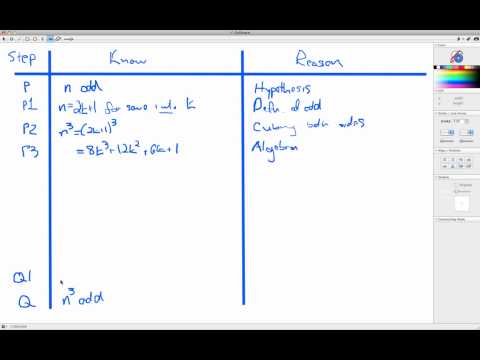
Direct proofs of conditional statements using know-show tables (part 1) (Screencast 1.2.2)
Direct Proof of Conditional Statements Using No-Show Tables
Introduction to the Topic
- The screencast introduces the concept of direct proofs for conditional statements, specifically using no-show tables. It is part one of two examples and references the Sunstrom textbook for further reading.
Understanding the Conjecture
- The conjecture discussed states: "If n is odd (and an integer), then n cubed is also odd." The speaker emphasizes the need for a proof despite initial observations suggesting its truth.
Definition of Odd Integers
- A clear definition of "odd" is provided: An integer n is odd if there exists another integer k such that n = 2k + 1 . For example, 7 can be expressed as 2 times 3 + 1 .
Setting Up the No-Show Table
- The speaker sets up a no-show table to prove the conditional statement. In this context:
- Hypothesis: n is odd.
- Conclusion: n^3 is odd.
Importance of Direct Proof Structure
- Conditional statements are true except when the hypothesis holds but the conclusion does not. Thus, a direct proof aims to eliminate this possibility by showing that if the hypothesis is true, so must be the conclusion.
Steps in Proving the Conjecture
- The first step in proving involves assuming that n is indeed odd (hypothesis P).
- After assuming P, we aim to reach our conclusion about n^3 . This requires establishing valid mathematical reasoning throughout each claim made.
Working Through Definitions and Algebra
- Starting from P (n being odd), it follows from definition that n = 2k + 1 .
- Next, cubing both sides leads us to express n^3 = (2k + 1)^3 , which can be expanded using algebraic methods.
Expanding and Rephrasing Goals
- Upon expanding, we find n^3 = 8k^3 + 12k^2 + 6k + 1 .
- To show that n^3 is odd means demonstrating it can be expressed as 2l + 1, where l represents some integer distinct from k.
Understanding the Proof of Oddness for n Cubed
Exploring the Expression for n Cubed
- The speaker begins by discussing the expression n^3, indicating that it can be expressed as a combination of terms plus one. This sets up the exploration of its properties.
- A common factor of two is identified in the expression, allowing for factoring out to yield 2(4k^3 + 6k^2 + 3k) + 1. This step emphasizes algebraic manipulation and simplification.
Establishing Integer Properties
- The speaker claims that 4k^3 + 6k^2 + 3k is an integer, which is crucial for proving that n^3 can be expressed in a specific form.
- The closure properties of integers are discussed, highlighting that integers remain closed under addition and multiplication. This principle supports the assertion that combining integers results in another integer.
Finalizing the Argument
- The conclusion drawn is that n^3 = 2L + 1, where L is defined as an integer from previous steps. This formulation directly leads to proving that n^3 is odd.