UD2 Componentes fundamentales de los sistemas microinformáticos 15
Memory Types and Locations in Computers
Overview of Memory Configuration
- The discussion begins with an overview of memory types, focusing on their locations in desktop, laptop, and mobile devices. Emphasis is placed on desktop configurations.
- Modern CPUs typically have integrated memory controllers, contrasting with older systems that used separate chipsets (Northbridge and Southbridge).
- The integrated memory controller defines the characteristics of accessible memory based on CPU specifications, including compatibility with different RAM types (e.g., DDR4 vs. DDR3).
Slot Configurations and Channels
- Memory slots are usually located near the CPU; common configurations include 2 to 8 slots depending on the system type (gaming or server).
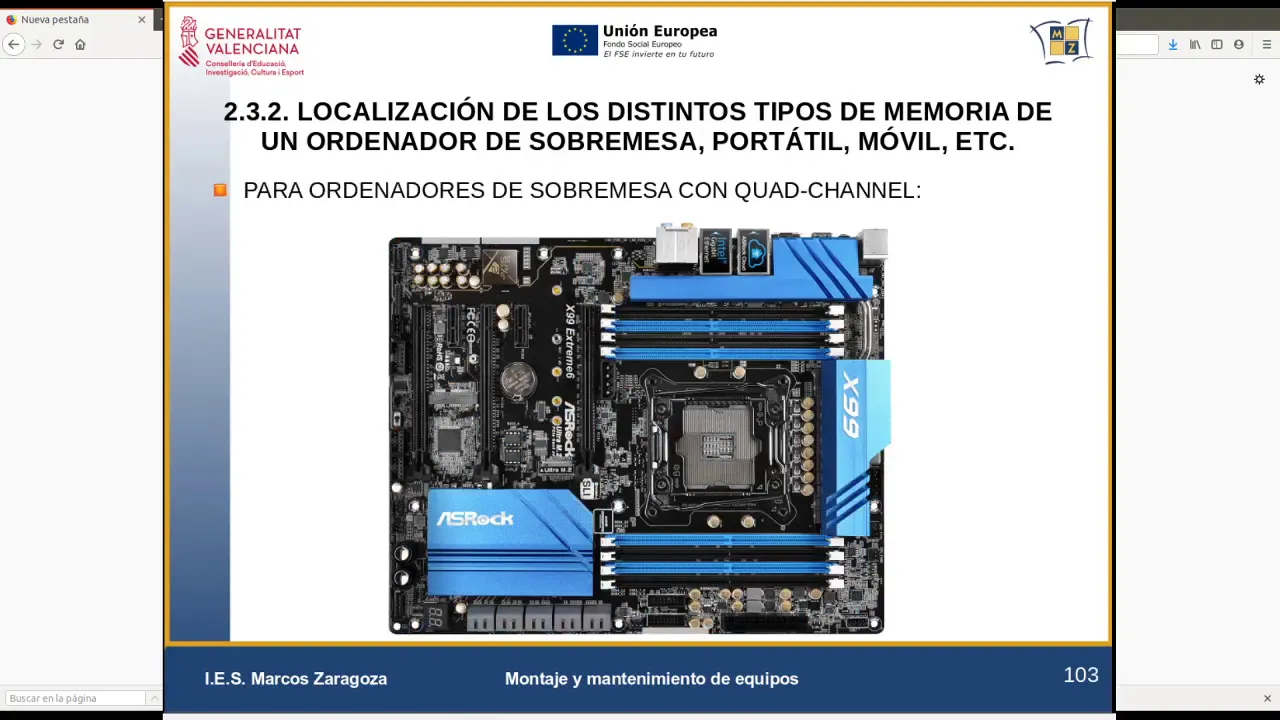
- Different channel configurations exist: single-channel (2 slots), dual-channel (4 slots), and triple-channel (6 slots). Each configuration impacts performance.
- SODIMM modules are highlighted as smaller form factors suitable for compact builds like mini ITX systems.
Practical Examples and Visual Aids
- An example of a motherboard layout shows various slot colors indicating different channels for optimal memory installation.
- Discussion includes practical advice on consulting motherboard manuals for proper module installation to avoid performance loss.
Manufacturer Insights
- The speaker navigates manufacturer websites to find examples of motherboards designed for gaming and workstations, emphasizing dual-channel capabilities.
- Key differences between non-ECC buffered and unbuffered RAM are noted; unbuffered RAM is more common due to cost-effectiveness despite lower reliability.
Advanced Server Configurations
- Server motherboards often feature additional PCI Express slots for multiple graphics cards using technologies like SLI or CrossFire.
Hardware Overview and Memory Specifications
Memory Characteristics and Recommendations
- Discussion on the importance of memory characteristics, emphasizing the recommendation to purchase modules from reputable brands like Gigabyte for better performance.
- Mention of ultra-durable memory with a 30-year warranty, highlighting the significance of control circuitry in preventing damage to motherboards during module installation.
Workstation Capabilities
- Explanation of dual-channel support and configurations for high-performance workstations, particularly for video editing and engineering applications.
- Overview of graphics card configurations such as SLI or Crossfire, noting that multiple PCIe x16 slots are available for enhanced graphical performance.
Storage Connectivity
- Description of server capabilities including ten SATA ports for extensive disk connectivity, crucial for data storage solutions in server environments.
Processor Compatibility
- Clarification on processor compatibility with high-end processors like Intel's Xeon series; mentions socket type LGA 1551 relevant to workstation setups.
Mobile Devices and RAM Limitations
Mobile RAM Configuration
- Insight into mobile device RAM configuration where RAM is typically soldered onto the motherboard without expansion slots, making upgrades challenging.
Integrated Memory Chips
- Discussion about integrated memory chips in mobile devices (e.g., Samsung), which usually range from 2GB to 4GB. These chips are directly soldered onto the PCB.
Internal Storage Features
Turn any video into a summary like this
YouTube links, meetings, lectures. With transcripts, search, and chat.