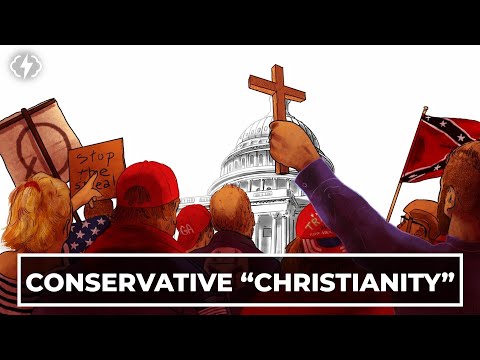
How Conservatives Co-Opted Christianity
Introduction and the Link Between Conservatism and Christianity
This section explores the association between conservatism and Christianity in America, particularly within the Republican Party. It raises questions about why this link exists and discusses the possibility of using religion in a more progressive way.
The Origins of the Link Between Conservatism and Christianity
- Historically, people tend to associate Christianity with conservatism in America, especially due to the Republican Party's stance on controversial religious topics like abortion and LGBTQ rights.
- The Republican Party has actively worked to position itself as the party aligned with Christian values.
- However, it is important to note that this strong association between Christianity and conservatism only emerged since the 1980s.
Early Christian Practices and Socialist Principles
- In its early days, Christianity was practiced in a socialist manner, with principles such as common ownership of property, community support for the needy, and criticism of wealth hoarding.
- Figures like Basil of Caesarea and John Chrysostom implemented socialist principles within their interpretation of Jesus' teachings.
- Christian social systems were described as not based on ruthless competition or greed but rather on egalitarian values found in leftist literature.
Diversification of Christianity's Political Alignment
- Over time, Christianity spread diversely across different political alignments worldwide.
- In addition to Calvinists who leaned towards proto-capitalism, there were also progressive movements like the Social Gospel in early 20th century America.
- Walter Rauschenbusch's work within the Social Gospel movement criticized capitalist exploitation from a Christian perspective.
Leftist Politics and Religion: Martin Luther King Jr. as an Example
- Martin Luther King Jr., a Baptist minister, exemplifies the alignment of religiosity with leftist politics.
- MLK's religious beliefs led him to challenge the deep inequality of capitalist society and advocate for social justice.
- His speeches emphasized the need for a radical revolution of values that prioritizes people over profit motives and property rights.
The Shift Towards Conservatism in Christianity
This section delves into the factors that contributed to Christianity becoming synonymous with conservatism, particularly in the 1920s.
Higher Criticism and Fissures Among Protestants
- In the 1920s, higher criticism gained traction in German academic circles, questioning the infallibility of the Bible.
- This movement created divisions among Protestants between those who rejected any critique of the Bible's nature and those who integrated emerging science into their faith.
- The teaching of Darwin's theory of evolution further intensified these divisions within Christianity.
The Scopes Monkey Trial and Biblical Origins
- The Scopes Monkey Trial was a historic legal case where high school teacher John T. Scopes was accused by Tennessee of teaching evolution, which contradicted biblical origins.
[t=XXX] Title
...
Subtitle
- Bullet point description
- Sub-bullet point description
- Sub-bullet point description
Scopes Trial and the Rise of Conservative Christianity
This section discusses the impact of the Scopes Trial on conservative Christianity and the rise of conservative Christian media, particularly through the influence of Amy Semple McPherson.
The Schism between Progressive and Conservative Christians
- The Scopes Trial deepened the divide between progressive mainline Protestants and conservative white evangelical Protestants.
- Despite losing the case, conservative evangelicals were pushed into mass media, realizing they could increase their influence beyond the physical walls of the church.
Amy Semple McPherson and Conservative Christian Media
- Amy Semple McPherson, born in 1890, gained fame by questioning evolution as a high schooler.
- She became a charismatic speaker in Los Angeles and tapped into the power of radio to reach massive audiences.
- McPherson's sermons had a significant impact on conservative Christianity, popularizing televangelism and bringing about the first American megachurch.
- Her sermons often portrayed America under attack by foreign forces, immigration, evolution, and atheistic communism.
- She emphasized defending faith against what she perceived as an amoral system not founded on God's word.
Patriotism, Xenophobia, and Anti-Semitism
- American patriotism became intertwined with Christianity during this time.
- Refusing to salute the American flag was seen as unpatriotic and unchristian.
- Older white Protestant immigrants were viewed favorably while new non-white immigrants were associated with anti-American values.
- McPherson's rhetoric echoed today's Trumpist rhetoric regarding patriotism, xenophobia, anti-Semitism, conservatism, and Christianity.
Televangelism and Political Influence
- Other charismatic Christians like Billy Graham, Oral Roberts, Pat Robertson, and Jerry Falwell followed in McPherson's footsteps.
- They used television to spread Christian nationalism further into the 20th century, solidifying the role of televangelism in American society.
- In 1979, Jerry Falwell created the Moral Majority, a political group that exchanged an enormous voting bloc for a comprehensive evangelical program within the Republican Party.
- Evangelicals grew in socioeconomic and voting power, becoming a significant lobbying group with influence over party policies.
The Reagan Era and Evangelical Power
- Evangelicals saw their involvement in politics as a divine necessity during the Reagan era.
- They backed Ronald Reagan's presidency, leading to privatization, tax cuts, and conservative policies.
- Evangelicals became increasingly represented and emboldened by federal government representatives.
- They achieved political relevance like no other group in the United States.
The Impact of Cold War and Reagan Years
This section explores how the Cold War and the Reagan years influenced conservative Christianity and its political power.
Growing Socioeconomic and Voting Power
- Evangelical churches grew alongside their members' fortunes, making up a third of the American adult population.
- Televangelists played a crucial role in rallying evangelicals around key issues and shaping their involvement in politics.
The Birth of Moral Majority
- Pat Robertson announced that Protestants and Catholics together had enough votes to run the country.
- Jerry Falwell created the Moral Majority as a political group representing evangelicals' interests within the Republican Party.
Dictating Party Policies
- Evangelicals felt confident they could dictate party policies on abortion, gay rights, social programs, foreign policy stances, etc., to Republican politicians.
- They ran popular broadcast media channels, publishing houses, colleges, and became a sizable lobbying group.
The Rise of Televangelism
- Televangelists like Billy Graham, Oral Roberts, Pat Robertson, Jerry Falwell used television to spread Christian nationalism further into society.
- Their influence cemented televangelism's role in the American landscape.
Impact of Cold War and Reagan Years
- The Cold War and the Reagan years played a significant role in shaping conservative Christianity's political power.
- Evangelicals' involvement in politics grew, leading to their increased representation and influence over party policies.
The transcript is already in English.
The Role of Christianity in American Politics
This section discusses the influence of conservative evangelicals in American politics and the decline of progressive and leftist Christians. It also highlights the power of white conservative evangelicals in shaping Republican policies.
The Influence of Conservative Evangelicals
- During the Reagan era, conservative evangelicals gained significant influence in American politics.
- Mainline progressive and leftist Christians saw declining numbers during this time period.
- The red scare, cold war, and a more loosely held together community contributed to the obscurity of the Christian left in politics and society.
Dominance of Evangelicals and Conservative Christians
- Bill Clinton's victory represented a small setback for the evangelical movement.
- George W. Bush and Donald Trump's presidencies showed that a mobilized and united electorate could sway elections in favor of conservative candidates with religious social policies.
- White conservative evangelicals are firmly settled in American politics today, exerting tremendous power on Republican policies.
Christian Identity in America
- Over 46% of Americans are Protestant, with approximately 70% identifying as Christian.
- Republicans actively target the evangelical vote, which makes up about one-fourth of Americans but accounts for 30 to 40% of votes cast by this group.
- In recent presidential elections, 75 to 80% of white evangelical votes went to Donald Trump.
Revival of the Christian Left
- The Christian left is experiencing somewhat of a revival following the Trump presidency.
- Organizations like Christians for Socialism and the Institute for Christian Socialism have gained popularity.
- Black Christian voters form a significant part of the Democratic base, standing in contrast to white evangelical voters.
Progressive Legislation Defended by Christian Groups
- Leftist or otherwise progressive political parties often embrace a Christian tradition that aligns with their values.
- Christian groups have defended progressive legislation, such as same-sex marriage, on the grounds of religious freedom.
- Elected officials who loudly proclaim Christian morality may not truly represent the faith and often ignore the will of the people.
Co-opting and Perverting Christianity
- The American version of Christianity has been co-opted and perverted for devious ends.
- Key figures in the white evangelical movement have distorted a religion with a rich history of egalitarian values.
- It is important for religious Americans to reclaim their faith from those who have turned it into a weapon of evil.
Importance of Continuous Improvement
- Continually improving ourselves is crucial, whether by recognizing co-opted issues or learning new skills.
- Brilliant, an online learning platform for STEM subjects, offers interactive lessons that cater to all skill levels.
Marxism and Dialectical Materialism
This section discusses Marxism as a scientific approach and dialectical materialism as a way to understand the world's development. It emphasizes the importance of understanding these concepts in challenging capitalism's association with divine justice.
Understanding Marxism and Dialectical Materialism
- Marxism is considered scientific, while dialectical materialism provides a political, economic, and scientific understanding of the world's development.
- These concepts can be challenging to grasp but are essential in challenging capitalist systems.
Religious Socialists' Commitment to Humanitarian Values
- Many religious socialists actively care about improving the material realities of others within a capitalist system.
- Christians, Muslims, Buddhists, and other religious individuals embrace socialist humanitarian conceptions of society.
Capitalism's Exploitation and Alienation
- Under capitalism, many religious individuals suffer from exploitation and alienation domestically and abroad.
- Correcting the notion that capitalism aligns with divine justice is critical for success in creating a more equitable society.
Religion's Role in Caring for Fellow Human Beings
- Regardless of one's opinion on religion, it is important to recognize that religious individuals can be devoted to improving the lives of others.
- Religious or not, understanding the co-opting of American Christianity and reclaiming its true values is crucial.
Continuous Self-Improvement
- Continuously improving oneself is essential, whether by recognizing co-opted issues or learning new skills.
- Brilliant, an online learning platform for STEM subjects, offers interactive lessons suitable for all skill levels.
Learning Science with Optics
In this section, the speaker discusses how learning science can be fun and provides an example of a lesson on optics. The lesson allows you to manipulate a beam of light reflecting off a gem in a box of mirrors to understand the path that light takes to reach your eye. The speaker emphasizes that changes in one aspect of an experiment can lead to other changes, highlighting the interconnectedness of everything.
Applying Lessons to Understanding the World
- Everything is related to everything else, and a change in one thing can cause further changes down the line.
- Brilliant offers fun, accessible, and expert-designed courses for various subjects.
- By learning through Brilliant, you can eventually master your chosen subject.
- To get started with learning today, visit brilliant.org.
Special Offer for Premium Subscription
- If you sign up as one of the first 200 users on brilliant.org/secondthought, you can get 20% off your annual premium subscription.
- This offer is considered one of the best deals in education.
The transcript provided does not specify any language other than English.