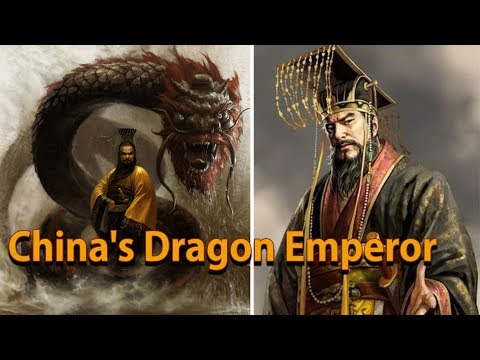
China's First Emperor - Qin Shi Huang The Dragon Emperor
The Rise of China's First Emperor: A Tale of Power and Betrayal
The Context of Qin Shi Huang's Reign
- The story revolves around the birth of China's first imperial dynasty, marked by conflict, betrayal, and a quest for power.
- Qin Shi Huang is portrayed variably as irrational, superstitious, incompetent, or tyrannical; this depiction raises questions about its accuracy.
- The historical backdrop includes nearly two centuries of war following the collapse of a 500-year-old dynasty, leading to a struggle among seven rival states.
The Unexpected Ascension to Power
- In the chaos, a young king named Ying Zheng ascends to the throne at just 13 years old amidst palace intrigue and deception.
- Despite his youth and inexperience, he would eventually unify the fractured empire into one nation.
- Most information about him comes from Sima Qian's "Records of the Grand Historian," written over a century after Qin Shi Huang's death.
Intrigue Within the Palace
- Ying Zheng’s mother, Queen Dowager Zhao, appears trustworthy but has ulterior motives involving her lover Lü Buwei.
- Lü Buwei becomes an influential advisor while concealing his affair with the Queen and potentially being Ying Zheng’s biological father.
The Plot Against King Ying Zheng
- To protect his position from potential threats posed by his mother's lover, Lü Buwei seeks to replace himself in her affections with another man named Lao Ai.
- This scheme leads to an affair between Queen Zhao and Lao Ai that threatens King Ying Zheng’s rule as they plot against him.
Rising Tensions and Conflict
- As King Ying Zheng matures into leadership at age 22, he learns about the coup planned by Lao Ai and prepares for confrontation.
The Rise of King Yingzhong
The King's Strategic Response
- The king, no longer a naive teenager, learned from his palace ministers and military advisers to carefully plan his response against threats.
- He aimed to eliminate both Lau I, who sought his throne, and Liu Bei, who was scheming in powerful regions.
Betrayal and Consequences
- Yingzhong set a trap for the rebels, realizing they had fallen into it while pondering the orchestrator behind the attack.
- Lu Buwei, once an ally responsible for Yingzhong's rise, now became a mortal enemy as he recognized Lau I's threat to his power.
- The failure of a palace coup could lead to severe punishment; thus, Lu Buwei sided with the king against Lau I to preserve his position.
Execution of Conspirators
- King Yingzhong executed or exiled Lau I and 3,000 of his men as retribution for their betrayal. He also killed Lau I's sons and mother to prevent future revenge plots.
- In a rare act of mercy, he spared Lau I’s mother but placed her under house arrest while dealing with Lu Buwei’s betrayal next.
Turning Point for the Young Ruler
- This marked a significant turning point in Yingzhong's rule as he demonstrated willingness to act decisively against threats. His actions solidified his authority as the king of Qin.
- Following these events, he unveiled an ambitious plan to unify the seven warring states by appointing capable officers regardless of their backgrounds.
Embracing Talent from Adversaries
- One notable appointment was Li Si from Chu State; he possessed exceptional legal acumen that would shape Qin Empire’s ruling ideology. This decision showcased Yingzhong's strategic thinking by utilizing talent from former enemies.
- Another foreigner promoted was Jiang Gua from Han State; however, initial trust turned problematic when it was revealed that Jiang Gua acted as a spy diverting resources away from critical projects like canal construction.
Navigating Foreign Relations
- Despite pressure from advisors to expel all foreign officers due to distrust stemming from Jiang Gua’s actions, Li Si argued for their necessity in achieving unification goals which persuaded King Yingzhong otherwise.
- Ultimately accepting foreigners led to significant agricultural advancements through completed canal projects that transformed land around Qin capital into fertile areas boosting wealth compared to other states.
Military Mobilization and Conquest Plans
- With increased treasury funds due to agricultural success, King Yingzhong prepared for military expansion by recruiting one million soldiers equipped with advanced weaponry and training techniques creating an unstoppable force ready for battle by 230 BC.(1066)
- His first target was the neighboring state of Han; previous alliances among states failed against Qin’s military might leading swiftly towards conquest.(1104)
Diplomatic Maneuvers Amidst Warfare
- As warfare escalated with bloodshed on battlefields across various states including Han and Zhao , desperate measures were taken by rival kingdoms such as Yan seeking peace through diplomatic envoys bearing gifts including severed heads symbolizing submission.(1178)
The Rise of Qin Shihuang: Unification and Reforms
The Assassination Attempt and Its Aftermath
- Yingxiong narrowly escapes an assassination attempt by an assassin, as the King's ministers are restricted from intervening due to laws governing the throne room.
- Enraged by the attack, the King accelerates military actions against neighboring states, leading to a swift conquest of six states over ten years.
The Birth of a Unified China
- Yang Jung's vision culminates in the establishment of an empire that would influence Chinese history significantly; he becomes Qin Shihuang, the first emperor at 38 years old.
- His title signifies absolute sovereignty over a newly unified territory known today as China, marking a pivotal moment in history.
Centralization and Legalism
- By adopting the title of Emperor, Yang Jung elevates his role beyond that of a king to that of an imperial ruler with cosmic significance.
- He recognizes the need for unification among diverse cultures within his realm and abolishes feudalism to centralize power into 36 prefectures directly controlled by him.
Implementation of Legalist Principles
- Officials are appointed based on merit rather than hereditary rights, reflecting a significant shift towards legalism which emphasizes law over tradition.
- Early legalists viewed human nature as selfish but believed this could be harnessed for state benefit; thus, strict laws were established under Qin's rule.
Standardization Across the Empire
- Archaeological findings reveal extensive regulations during Qin's reign through bamboo slips detailing strict laws governing daily life.
- To facilitate trade and governance, standard weights and measures were introduced alongside a unified currency (the Lian coin), simplifying economic transactions across regions.
Unifying Communication Through Writing
- A major challenge was differing writing systems among states; thus, scholars were dispatched to teach the standardized Qin script for better communication.
- The introduction of a universal written language was crucial for enforcing laws and policies effectively throughout the empire.
Legacy and Controversy Surrounding Qin Shihuang
- Despite achieving unprecedented unity in Chinese history through centralized governance and legal reforms, Qin Shihuang is often depicted as a tyrant in historical narratives.
The Legacy of Qin Shihuang: Tyrant or Visionary?
The Control of Information and Historical Narratives
- The burning of books symbolizes a government's desire to control information, define morality, and establish orthodoxy. This reflects a common theme across civilizations where narratives are shaped by those in power.
- Contrary to popular belief, the Qin Dynasty did not destroy all literature; some texts were preserved in imperial archives, indicating that Emperor Qin Shihuang valued practical knowledge like medicine and technology.
Brutality vs. Political Propaganda
- Accounts of Emperor Qin's brutality, such as burying Confucian scholars alive for possessing forbidden texts, are questioned due to their origins from historians writing over a century later, casting doubt on their accuracy.
- Historical narratives about tyrants often stem from successor dynasties aiming to discredit previous rulers. Sima Qian’s portrayal of Qin Shihuang reflects this tradition of criticizing unpopular leaders.
Reevaluating Qin Shihuang's Rule
- Many claims against Qin Shihuang may lack historical weight and could be politically motivated propaganda from the Han Dynasty aimed at justifying its own rule by vilifying the previous dynasty.
- Modern scholars argue that while he is often depicted as a tyrant, Qin Shihuang was more fair-minded than credited and took significant steps to eliminate corruption within his administration.
Achievements and Construction Projects
- Despite his harsh reputation, Qin Shihuang unified China after centuries of conflict during his 12-year reign. His military prowess led to significant political stability.
- He sought immortality through extensive travels across his empire, which also served as inspections for governance. These expeditions were part of his quest for secrets that would prolong his life and reign.
Lasting Impact on China
- The Great Wall of China stands as one of Qin Shihuang's most notable legacies—a massive construction project intended for defense against northern threats involving millions of laborers over many years.
- In addition to the Great Wall, he established a national network of roads that facilitated trade and communication throughout the empire—an infrastructure that laid foundations lasting over two millennia.
Qin Shi Huang: The First Emperor of China
Overview of Qin Shi Huang's Reign
- Scholars argue that despite historical records labeling him a tyrant, Qin Shi Huang dedicated his life to the development of China as a unified nation.
- At 50 years old, he sought immortality and was weakened by mercury pills, believed to grant eternal life; he died during a tour in his carriage.
- His body was returned to the capital and laid to rest in a lavish mausoleum designed as an underground replica of his empire, reflecting his belief in ruling after death.
Construction and Legacy of the Mausoleum
- Historian Sima Qian recorded that it took 700,000 workers 38 years to build the mausoleum, which included treasures and terracotta warriors meant to protect him in the afterlife.
- Despite the collapse of his dynasty four years after his death, many systems and policies initiated by Qin Shi Huang continue to influence modern China.
Modern Implications of Qin Shi Huang's Rule
- Today, China is home to 1.4 billion people from diverse ethnic backgrounds yet remains unified within boundaries established during Qin's reign.
- The principles set forth by Qin Shi Huang are still integral to China's national identity; he is credited with establishing the concept of empire itself.
Discovery of the Terracotta Army
- For centuries, the location and grandeur of Qin’s final resting place remained unknown until significant archaeological discoveries began in 1974.
- Workers unearthed thousands of terracotta soldiers alongside horses and chariots—an unprecedented find that sparked global interest.
Archaeological Insights into Terracotta Warriors
- The discovery revealed hundreds of life-sized clay figures known as terracotta warriors; their purpose remained unclear initially.
- As excavations continued, archaeologists found bronze weapons inscribed with details linking them directly back to Qin Shi Huang’s era.
Historical Context and Mysteries
- Excavated weapons bore inscriptions identifying ministers from Qin’s time, confirming connections between these artifacts and the emperor's tomb.
The Terracotta Warriors: Insights into Ancient China
The Rise of Qin Shi Huang
- In 246 BC, a young king named Yang Jung ascended the throne in the western state of Qin at just 13 years old, who would later become known as Qin Shi Huang, China's first emperor.
- Following royal tradition, he commanded the construction of his mausoleum early in his reign, with Xi'an serving as the capital and an important hub on the Silk Road.
Construction of the Mausoleum
- Work began around 246 BC on a burial mound for Qin Shi Huang that was significantly larger than the Great Pyramid of Giza, measuring 345 meters wide and 55 meters high.
- The Terracotta Army site is located nearly a mile from the emperor's burial mound; archaeologists believed there was more to discover beyond life-size clay soldiers.
Purpose and Composition of the Terracotta Army
- Scholars theorize that the Terracotta Warriors served as bodyguards for Qin Shi Huang in the afterlife or represented his retinue during his travels across his empire.
- Excavations revealed approximately 6,000 realistic clay figures including infantrymen, chariots, and horses which provided insights into military structure and attire during that era.
Military Innovations and Strategies
- By 221 BC, under Qin Shi Huang's rule, all rival states were defeated due to innovations that led to a formidable army characterized by unique battle formations.
- The individual expressions on each warrior reflect their fierce resolve; they are organized strategically with archers at front and infantrymen ready to strike behind them.
Advanced Weaponry Techniques
- Pit One contains an organized corps of about 6,000 warriors equipped with various weapons like spears and crossbows; their hand shapes indicate different weapon types.
- Remarkably preserved swords found during excavation showed no rust despite being buried for over two millennia due to advanced metalworking techniques involving chromium oxide.
Discoveries Beyond Pit One
- Initial excavations took over two years leading to discoveries of additional pits; Pit Two is smaller but still significant in size compared to modern sports fields.
The Innovations of the Qin Dynasty
The Role of Horse Saddles in Warfare
- Horse saddles were found to be well-decorated and significantly improved comfort for riders, enhancing their effectiveness in battle.
- Prior to this discovery, it was believed that saddles originated during the Han Dynasty; however, they were crucial for cavalry mobility and tactical advantage.
Advancements in Weaponry: The Crossbow
- The crossbowmen's automatic triggers contributed to the Qin Army's battlefield success, allowing them to fire bronze arrows continuously from a distance.
- Research indicates that these crossbows had standardized parts, enabling quick repairs on the battlefield—an early instance of weapon standardization in China.
Standardization of Military Equipment
- The Qin Dynasty was technologically advanced with weapons featuring replaceable parts, not just limited to crossbows but also including arrowheads and swords.
- This standardization ensured that soldiers were not hindered by malfunctioning equipment during combat, contributing significantly to their military success.
Tactical Strategies Employed by the Qin Army
- Unlike modern warfare where commanders are behind lines, Qin officers directed troops from a command post located behind frontlines—a unique approach for ancient battles.
- Their strategy involved using crossbowmen first to create chaos among enemies while infantry charged forward, supported by cavalry flanking maneuvers.
Unification and Reforms Under Emperor Qin Shi Huang
- In 221 BC, after years of conflict, Ying Zheng declared himself Qin Shi Huang—the first emperor—marking a significant shift from king to emperor status.
- He implemented reforms such as abolishing feudalism and centralizing legal codes which laid foundations for a unified state.
Pursuit of Immortality: The Mausoleum Project
- Despite his achievements, Emperor Qin sought immortality; he envisioned a mausoleum reflecting his power and grandeur.
- Over 700,000 laborers worked on this project for decades under harsh conditions; many died or were killed to keep secrets about the tomb hidden.
Discovery of the Terracotta Army
- Archaeological findings revealed mass graves indicating high mortality rates among workers who built the mausoleum over 38 years.
Terracotta Army: Insights into Ancient Craftsmanship
Overview of the Terracotta Army
- The Terracotta Army, located at one of the world's largest mausoleum sites, attracts nearly five million visitors annually due to its impressive excavation and unique craftsmanship.
- Each of the 8,000 life-size terracotta warriors is distinct in appearance, showcasing a highly realistic design that reflects advanced construction techniques used by palace artisans.
Construction Techniques
- Qin state artisans employed a modular construction method to create the warriors, which involved making clay ropes to form figures from bottom to top for stability.
- This technique allowed for individualization; sculptors could adjust thicknesses of clay ropes to create different body shapes and features.
Artistic Details and Representation
- Finishing touches included detailed armor and separate parts like hands and feet. Experts believe heads were modeled after real soldiers rather than purely imaginative designs.
- Studies reveal variations among warriors' facial features, indicating differences in age, function, rank, and regional origins within the empire.
Discoveries Beyond Soldiers
- In 1999, excavators found non-military figures in a nearby pit that contrasted sharply with the soldiers; these figures were dynamic and bare-chested, suggesting a different aspect of life during Qin's reign.
- Historical accounts describe lavish court life under Emperor Qin Shi Huang with performances by acrobatic troupes that entertained during banquets.
Artifacts and Archaeological Efforts
- Ongoing excavations have revealed various artifacts such as bronze cranes symbolizing longevity and stone armor intended for warriors.
- The emperor's mausoleum complex is vast (nearly one square mile), containing numerous rare objects meant for both his lifetime enjoyment and afterlife.
Preservation Efforts
- Archaeologists have discovered around 180 pits filled with artifacts that provide insights into Qin Shi Huang’s world; many items are well-preserved despite their age.
- The meticulous restoration process involves labeling artifacts for organization while ensuring careful cleaning to preserve historical integrity.
Restoration Process
- Restoration efforts include reassembling broken pieces using special tools and glues designed not to damage fragile artifacts.
Terracotta Warriors: Unveiling the Past
Discovery of Colorful Paint on Terracotta Warriors
- Researchers uncovered traces of vibrant paint on the Terracotta Warriors, indicating they were originally painted in red, yellow, green, purple, and black. This contrasts with their current reddish-brown and gray appearance due to 2000 years of exposure to dirt and debris.
- Despite fading upon excavation, remnants of paint were found on soldiers' uniform collars, showcasing how colorful these figures once were when buried.
The Appearance During Qin Shi Huang's Reign
- Archaeologists suggest that the Terracotta Army would have presented a splendid sight during Qin Shi Huang's reign 2200 years ago. Their original colors contributed to a more lifelike representation than what is seen today.
- Historical accounts indicate that Qin Shi Huang frequently toured his empire rather than remaining in his palace, reflecting his desire to oversee his conquests personally. This behavior is part of human nature—wanting to see one's possessions firsthand.
Remarkable Artifacts from the Era
- A bronze chariot discovered in pit two exemplifies the craftsmanship of Qin Dynasty artisans; it consists of about 3,000 pieces and showcases advanced construction techniques akin to modern welding processes.
- Two bronze chariots found near Qin Shi Huang's burial chamber symbolize his expectation for continued journeys in the afterlife, mirroring his earthly tours as emperor. The smaller model represents an escort chariot used during processions.
Mysteries Surrounding Qin Shi Huang's Burial Chamber
- Despite extensive excavations at the site since 1974, Qin Shi Huang's actual burial chamber remains unexplored, leaving many questions unanswered regarding its contents and layout. Scholars have expressed skepticism about historical descriptions due to their late documentation by Sima Qian a century posthumously.
- Recent studies revealed high concentrations of mercury at the burial site—twenty times higher than surrounding areas—suggesting ancient methods may have been employed for body preservation through airtight conditions during deep burials.
Preservation Insights from Other Discoveries
- The discovery of Lady Dai’s remarkably preserved body has led researchers to theorize that similar preservation methods could apply to Qin Shi Huang if he was buried under comparable conditions with sealed tomb features like jade armor common among royalty at that time.
The Legacy of Qin Shi Huang: Myths and Realities
The Unification of China
- Qin Shi Huang, also known as Chimchar Wong, unified China for the first time, establishing a new form of government with uniform laws, weights and measures, and a single writing system.
- Ancient historians suggest that the underground world created by Qin reflected the grandeur of his achievements; however, the accuracy of these accounts remains uncertain.
The Tomb of Qin Shi Huang
- The Chinese government has consistently refused to excavate the burial chamber of the first emperor, which contrasts with public interest in exploring it.
- Current plans do not include excavation due to concerns that it could damage what is being preserved; future considerations may involve using new technology for investigation.
Immortality Through Legacy
- Despite no physical exploration of his tomb, Qin Shi Huang's quest for immortality is symbolically fulfilled through archaeological work and the Terracotta Army that guards his memory.