Técnicas e instrumentos de evaluación cualitativa, cuantitativa y mixta.
Introduction to Evaluation Techniques
Overview of Presenters and Topic
- The presenters are Estefanía Bastidas, Paula Palacios, and Estefanía Cima. They introduce the topic of evaluation techniques and instruments, focusing on quantitative, qualitative, and mixed methods.
Definition of Evaluation
- Evaluation is described as an essential part of the teaching-learning process that promotes participatory and meaningful learning based on students' needs and interests.
Understanding Evaluation Techniques
What Are Evaluation Techniques?
- Evaluation techniques are procedures used by educators to gather information about student learning, answering the question: "How will we evaluate?"
What Are Evaluation Instruments?
- Instruments are tools that allow teachers to record and obtain necessary information to assess students' achievements or difficulties. Examples include checklists, tests, case studies, and portfolios.
Quantitative Evaluation
Characteristics of Quantitative Evaluation
- This type of evaluation is unidirectional (teacher evaluates), focuses on products, aims to verify achievement against objectives, and assigns grades based on numerical scores.
Advantages of Quantitative Evaluation
- It offers greater objectivity since evaluators adhere to pre-established criteria which minimizes subjectivity; it also allows for better sampling of content being evaluated.
Limitations of Quantitative Instruments
- These instruments may not effectively assess skills like writing or critical thinking; poorly designed instruments can lead to misalignment with evaluation goals.
Types of Quantitative Assessment Instruments
Objective Tests
- Objective tests consist of a series of tasks or items completed within a set time frame aimed at measuring student performance in terms of knowledge acquired. Key characteristics include objectivity, validity, reliability, and proper construction.
Key Features for Objective Tests
- Objectivity: Eliminates personal judgment affecting results.
- Validity: Ensures the test measures what it intends; clear instructions enhance this.
- Reliability: Consistency in results across multiple applications.
- Construction: Clarity in questions ensures accurate assessment outcomes.
Steps for Creating Objective Tests
- Define the purpose: Clarify what you want to evaluate.
- Specify content areas and skills to be assessed.
- Construct items using various formats (completion tasks or multiple-choice).
- Develop a specification table based on content areas and cognitive processes involved in assessment.
Advantages & Limitations
- Advantages include quick correction capabilities that can measure complex reasoning levels; limitations involve challenges in assessing argumentation procedures effectively through these tests alone.
Checklists as an Assessment Tool
Description & Purpose
- A checklist consists of criteria indicating indicators for achievement that help determine presence or absence in student learning outcomes; useful for diagnostic purposes as well as formative assessments.
Characteristics
- Checklists provide evidence regarding student performance in specific situations allowing both individual and collective evaluations through binary response scales (yes/no).
Steps for Creating a Checklist
- Define learning objectives or competencies being assessed.
- Identify indicators or statements related to those objectives.
Evaluation Techniques in Education
Types of Evaluation
- To assess competencies, it is essential to define the type of evaluation (diagnostic, formative, or summative) and create a checklist format with four columns detailing indicators.
- Performance levels should be established using numerical references based on criteria achieved, allowing for categorization into levels such as outstanding, satisfactory, or sufficient.
- Clear and precise instructions for the checklist are crucial to ensure comprehension by evaluators and participants.
Advantages of Checklists
- Checklists are effective tools for evaluating structured learning processes, identifying achievements and areas needing improvement.
- They can be applied before or after classes to review topics; results are derived from scores based on a valuation scale that reflects learning levels achieved.
Understanding Rubrics
- A rubric is an observational technique that defines specific tasks or behaviors for evaluation along with associated performance levels.
- There are two types of rubrics: holistic (providing a single score based on overall performance) and analytical (detailing each task with individual scores per criterion).
Steps to Create a Rubric
- Key steps include defining learning objectives, determining the type of evaluation (diagnostic/formative/summative), selecting rubric type, establishing criteria to evaluate, and outlining expected performance levels.
Qualitative Evaluation Insights
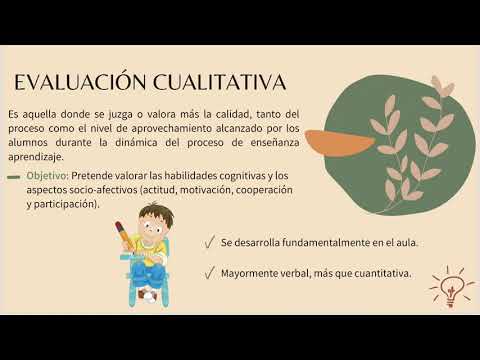
- Qualitative evaluation focuses on assessing quality throughout the educational process by analyzing student achievement dynamics through direct interaction in study contexts.
- The goal is to evaluate cognitive skills and socio-affective aspects like attitude, motivation, cooperation, and participation among students.
Characteristics of Qualitative Evaluation
- Primarily conducted in classrooms using observation as a key instrument; relies heavily on verbal information emphasizing both processes and outcomes.
Structured Written Tests
- Structured written tests focus on objectivity through closed-ended questions; they allow rapid correction while covering extensive content statistically.
Limitations of Structured Tests
- A significant drawback is their limited ability to assess beyond mere recall unless item formulation encourages complex information processing.
Product Evaluation Methods
- Product evaluations require students to create tangible outputs for assessment—these may include portfolios or scientific reports reflecting artistic skills or research capabilities.
Observational Assessment Techniques
Evaluation in Education: A Comprehensive Approach
Mixed Evaluation Methods
- The combination of qualitative and quantitative evaluation methods aims to provide a more comprehensive assessment of an individual by contrasting information from both approaches.
- Co-evaluation, defined as the joint assessment conducted by students regarding group performance, relies on established evaluation criteria or indicators.
- Self-evaluation is crucial for students to understand their starting point, the results of their efforts, and their evolution throughout the learning process.
Importance of Observation in Evaluation
- Teacher observation during activities is a key element in the evaluative process, allowing for verification and assessment of learning objectives and expected competencies.
- Evaluations can serve various purposes—formative and summative—and should integrate self-evaluation alongside peer evaluations.
Advantages of Mixed Evaluation
- Mixed evaluation fosters personal and group achievement recognition, encourages participation, reflection, constructive criticism in learning situations, and promotes responsibility within group work.
Conclusion on Evaluation Process