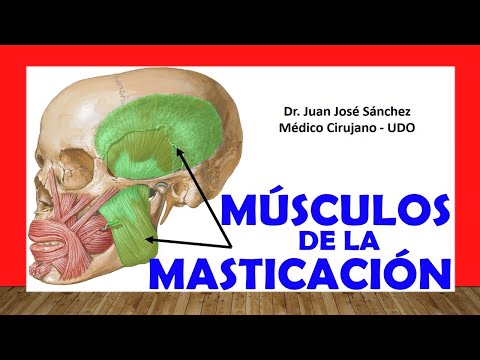
🥇 MÚSCULOS MASTICATORIOS. Fácil, Rápidos y Sencillos
Anatomy of the Masticatory Muscles
Introduction to Masticatory Muscles
- The video focuses on the anatomy of the masticatory muscles, specifically four major muscles: masseter, temporalis, medial pterygoid, and lateral pterygoid.
- Viewers are encouraged to subscribe and like the video for more content.
Masseter Muscle
- The masseter muscle is located superficially in the lateral region of the face and is covered by the masseteric aponeurosis.
- Beneath this layer lies adipose tissue from the parotid gland and buccal fat pads that contribute to facial roundness, especially in newborns.
- The muscle originates at the zygomatic arch and inserts into the external face of the ascending ramus of the mandible; it is innervated by a branch of V3 (the inferior maxillary nerve).
- Its primary function is to elevate or close the lower jaw during chewing; it has three portions: superficial, intermediate, and deep.
Temporalis Muscle
- The temporalis muscle originates from various bones including frontal, parietal, temporal, and sphenoid bones within the temporal fossa. It has both superficial and deep portions.
- This muscle inserts into the coronoid process of the mandible and also receives innervation from a branch of V3 (the inferior maxillary nerve), known as the temporal nerve.
- Its function complements that of the masseter by assisting in elevating and closing the mouth when clenching molars together.
Lateral Pterygoid Muscle
- Located deep to temporalis, this muscle consists of two heads: an upper head originating from greater wing crest of sphenoid bone and a lower head from lateral pterygoid plate.
Understanding the Pterygoid Muscles
Lateral Pterygoid Muscle
- The lateral pterygoid muscle inserts into the articular capsule, articular cartilage, and a pit called the Pterygoid fossa of the lower jaw. Understanding its insertion points is crucial for comprehending its function.
- Innervated by the lower maxillary nerve (third branch of the trigeminal nerve), this muscle helps in opening the mouth by moving the condyle forward during contraction.
- Unlike other muscles like temporalis and masseter that close the mouth, lateral pterygoid works synergistically with anterior digastric muscle to facilitate mouth opening and ensure proper jaw alignment during closure.
- The muscle has two portions originating from different anatomical landmarks: one from the greater crest of sphenoid and another from the external face of the lateral pterygoid plate, both inserting into the joint capsule.
- A deep view shows how these portions are positioned relative to each other as they connect to the temporomandibular joint capsule.
Medial Pterygoid Muscle
- The medial pterygoid muscle, also known as internal pterygoid, consists of superficial and deep portions that embrace part of the lateral pterygoid muscle.
- The deep portion originates from the internal face of lateral pterygoid lamina and palatine bone's pyramidal process; whereas, superficial portion also arises from this pyramidal process but is located deeper than upper jaw structures.
- Both portions insert into an area called pterygoid tuberosity on the internal face of ascending branch of lower jaw. This positioning is critical for their functional role in mastication.
Turn any video into a summary like this
YouTube links, meetings, lectures. With transcripts, search, and chat.