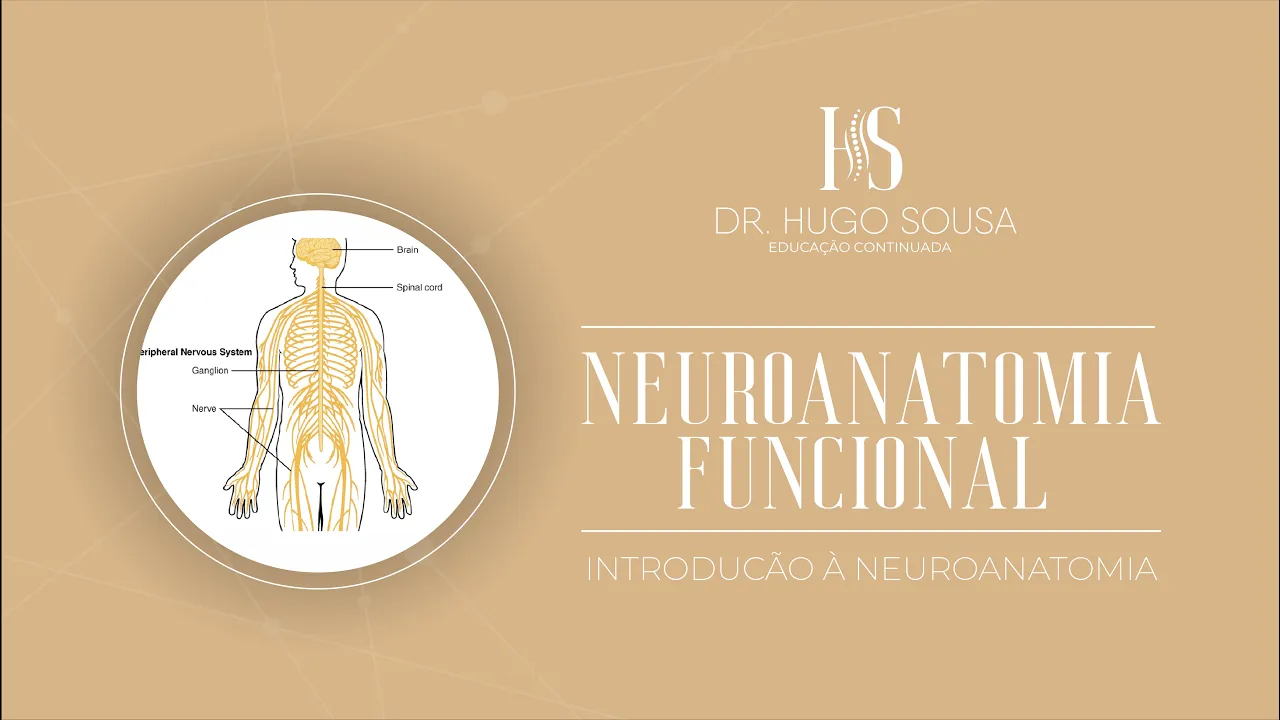
INTRODUÇÃO À NEUROANATOMIA - PARTE 1
Introduction to Neuroanatomy
Overview of the Nervous System
- The nervous system consists of a collection of organs aimed at maintaining the balance of organic functions, referred to as involuntary functions.
- Involuntary functions include regulation of blood pressure, respiratory rhythm, CO2 levels, and electrolyte balance in the body.
Functions of the Nervous System
- The nervous system integrates humans with their environment through voluntary functions, which involve higher cortical capabilities such as learning, selective attention, communication, and locomotion.
- It is essential for homeostasis and communication between different systems within the body.
Communication Mechanism
- Neurons communicate via electrical impulses mediated by neurotransmitters that facilitate intercellular communication.
Divisions of the Nervous System
Afferent and Efferent Pathways
- The nervous system can be divided into three major parts: afferent (sensory input), integrative (processing), and efferent (motor output).
- Afferent pathways are responsible for sensory information capture from organs like vision and hearing.
- Integrative structures process incoming information to generate appropriate responses or discard irrelevant data.
- Efferent pathways translate processed information into motor responses or glandular secretions.
Anatomical Division of the Nervous System
Central vs Peripheral Nervous System
- The central nervous system (CNS) comprises two main parts: the brain (encéfalo) and spinal cord (medula espinhal), both protected by bony structures—skull for the brain and vertebral column for the spinal cord.
Components of the Brain
- The brain includes:
- Cerebrum: Divided into diencephalon and telencephalon.
- Cerebellum: Often referred to as "little brain."
- Brainstem: Comprising midbrain (mesencéfalo), pons (ponte), and medulla oblongata (bulbo).
Spinal Cord Structure
Anatomy of the Nervous System
Overview of the Occipital Bone and Spinal Cord
- The occipital bone's base is observed, with its posterior part leading to the foramen magnum, where the spinal cord begins. This marks the anatomical landmark above which lies the medulla oblongata's terminal portion.
Types of Nerves in the Peripheral Nervous System
- There are two main types of nerves: spinal nerves and cranial nerves. Spinal nerves emerge from the spinal cord, totaling 31 pairs, while cranial nerves originate from the brainstem and connect to various skull bones.
Ganglia in the Nervous System
- Ganglia consist of neuron cell bodies located outside the central nervous system (CNS). They can be classified into sensory ganglia (e.g., dorsal root ganglion) and motor visceral ganglia associated with the autonomic nervous system. Examples include sympathetic paravertebral ganglia.
Nerve Terminations: Afferent vs Efferent
- Nerve terminations can be afferent (sensory stimuli) or efferent (motor functions). For instance, skin nerve endings represent afferent pathways, while neuromuscular junctions illustrate efferent pathways essential for muscle contraction.
Distinction Between Gray Matter and White Matter
- In CNS anatomy, gray matter consists of neuron cell bodies while white matter comprises myelinated axons. Neurodissection reveals this distinction clearly; gray matter appears on brain surfaces forming cerebral and cerebellar cortices, whereas white matter is deeper within structures like the spinal cord.
Structural Variations in CNS Organization
- The arrangement of gray and white matter varies throughout different CNS regions; for example, in spinal cords, gray matter forms a central "H" shape surrounded by white matter peripherally. As one moves rostrally through structures like the brainstem to higher brain areas, this organization changes significantly with nuclei interspersed among white matter fibers.
Embryological Development of Nervous System Divisions
Neuroanatomy Overview
Structure of the Rombencephalon
- The rombencephalon is divided into two parts: the metencephalon and myelencephalon. The metencephalon gives rise to the cerebellum and pons, while the myelencephalon develops into the medulla oblongata.
Ventricular System
- Within these embryological divisions, there are cavities filled with cerebrospinal fluid (CSF), produced in the choroid plexus located in the ventricular system of the central nervous system. These ventricles are dilations that play a crucial role in brain function.
Clinical Applications of Endoscopic Procedures
- Endoscopic procedures can be performed within these ventricles for clinical purposes, such as creating a diversion to reduce internal pressure. This highlights their importance in neurosurgical interventions.
Production of Cerebrospinal Fluid
- CSF is produced by choroid plexuses formed from glial cells, including ependymal cells and astrocytes, which create a selective barrier around blood vessels supplying the nervous system. This process involves blood dialysis to generate CSF effectively.
Anatomy of Ventricles
- There are several key components within the ventricular system:
- Lateral ventricles located in the telencephalon.
- A third ventricle situated in the diencephalon.
- The mesencephalic aqueduct connecting to a fourth ventricle found at the brainstem level.
Turn any video into a summary like this
YouTube links, meetings, lectures. With transcripts, search, and chat.