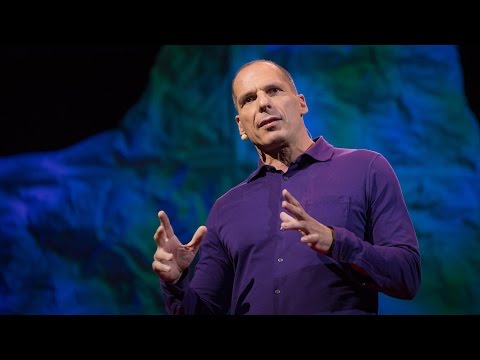
Capitalism will eat democracy -- unless we speak up | Yanis Varoufakis
Understanding the Fragility of Democracy
The Misconception of Democracy in the West
- Democracy is often taken for granted in Western societies, viewed as a permanent fixture rather than a fragile system that requires nurturing.
- The belief that capitalism inherently leads to democracy is challenged; examples like Singapore show thriving capitalism without democratic governance.
Economic Implications of Democratic Processes
- The speaker reflects on experiences representing Greece, highlighting how economic policies can override democratic processes.
- A call for authentic democracy is made, arguing that without it, societies face bleak futures and wasted technological advancements.
The Twin Peaks Paradox
Understanding Economic Disparities
- The "twin peaks paradox" describes two significant economic issues: a mountain of debt and a mountain of idle cash held by corporations and wealthy individuals.
- In recent months, $3.4 trillion was invested in wealth-producing goods compared to $5.1 trillion sitting idly in financial institutions.
Consequences of Economic Stagnation
- This imbalance results in stagnant wages and high unemployment rates among working-age populations across developed nations.
- A cycle of low aggregate demand perpetuates investor pessimism, leading to further disinvestment—a self-reinforcing loop reminiscent of Oedipus' tragic fate.
Democracy's Role in Addressing Economic Issues
Defining Democracy
- Aristotle's definition emphasizes the role of the majority (the free and poor) in controlling government decisions, despite historical exclusions.
- Ancient Athenian democracy's significance lies not just in its inclusivity but also in empowering the working poor with equal political judgment rights.
Historical Context and Evolution
- Modern liberal democracies differ from ancient models; they stem from traditions like the Magna Carta rather than direct popular empowerment.
- Liberal democracy emerged when political power was separated from economic influence, creating a struggle between these spheres over time.
The Shift of Power from Politics to Economics
Current Political Landscape
- There’s an ongoing struggle where economic interests increasingly dominate political decision-making processes.
- Politicians today may hold office but lack real power due to this shift towards corporate influence over governance.
Economic and Political Reunification: A Path Forward?
The Crisis of Separation Between Economic and Political Spheres
- The economic sphere is increasingly undermining itself by colonizing the political sphere, leading to crises characterized by rising inequality, falling aggregate demand, and corporate hesitance to invest.
- As capitalism extracts the demos from democracy, it exacerbates waste of human resources. A call for reuniting these spheres is made, inspired by ancient Athens but aiming for inclusivity.
- Automation threatens to eliminate low-wage jobs without addressing the separation between economic and political realms, which could deepen social conflicts globally.
The Dystopian vs. Utopian Future
- There’s a pressing need to democratize the reunified economic-political sphere to avoid descending into a surveillance-driven dystopia reminiscent of "The Matrix."
- The future of capitalism hinges on whether it leads to a dystopian society or a utopia akin to "Star Trek," where technology serves humanity's exploration and philosophical pursuits.
Imagining a New Economic Model
- Proposes an innovative capital market where individuals earn capital through work that follows them across jobs, eliminating traditional wage labor dynamics.
- Envisions companies owned solely by current workers, removing the divide between ownership and labor while closing gaps in investment and savings.
Global Economic Reconfiguration
- Suggests implementing a universal digital currency managed by global institutions like the IMF for international trade, promoting equitable investments in green technologies.
- This concept echoes John Maynard Keynes' proposals from 1944 but is now feasible due to advancements in technology within a unified political-economic framework.
Towards Authentic Democracy
- The proposed world combines libertarianism (empowered individuals), Marxism (bridging capital-labor divides), and Keynesian principles aimed at fostering authentic democracy.
- The realization of this vision depends on collective political choices made democratically; failure could lead us toward dystopia instead of utopia.
Relevance of Marx Today
Analyzing Modern Implications
- Yanis Varoufakis emphasizes that if his analysis holds true regarding economic-political reunification, then Marx's insights are still relevant today amidst technological changes threatening aggregate demand.
- He references Larry Summers’ notion of secular stagnation as indicative of potential instability affecting democracies worldwide if these issues remain unaddressed.
Conflicted Ideologies
- Varoufakis identifies himself as a "libertarian Marxist," acknowledging influences from both Hayek and Keynes while expressing confusion over their conflicting ideologies—highlighting complexity in modern thought.
Hypocrisy in Western Perspectives on China
Critique of Western Democracy Perception
- Varoufakis critiques Western views on China as hypocritical; he argues that liberal democracies confine democracy politically while neglecting its significance in economic spheres where real power resides.
Economic Systems and Democracy: A Historical Perspective
The Relationship Between Economic Structures and Democracy
- The speaker argues that the economic sphere operates without democracy, drawing a provocative comparison between modern China and 19th-century Britain, suggesting that liberalism does not inherently require democratic governance.
- The discussion highlights parallels between China's current economic development and Britain's Industrial Revolution, emphasizing the hypocrisy in criticizing China for following a path similar to that of Western nations in the past.
Reflections on Greek Finance Ministry Experience
Insights from YV's Tenure as Finance Minister
- YV reflects on his time as Greece's Finance Minister, describing it as both exciting and disappointing due to missed opportunities to reform the Eurozone beyond just Greece.
- He identifies a significant architectural fault line within the Eurozone that threatens its stability, which he believes was ignored by Eurozone powers despite clear evidence.
Consequences of Denial in Economic Policy
- YV warns against maintaining an unsustainable economic system through political will, likening it to historical failures such as those seen in the Soviet Union. He predicts abrupt changes when denial is no longer tenable.
- He expresses concern about the future of the Eurozone if structural changes are not made, indicating that its survival is at stake.
Personal Accountability and Mistakes Made
Acknowledgment of Errors During His Term
- YV candidly admits to making mistakes during his tenure, stating that any finance minister claiming otherwise after six months is likely dangerous or misleading.
- He cites signing an extension for a loan agreement as his greatest mistake, believing there was genuine interest from creditors in finding common ground—an assumption he later realized was incorrect.
Critique of Eurozone Policies
- YV criticizes the troika of lenders for their failure to acknowledge catastrophic policy errors over five years, highlighting severe economic consequences for Greece akin to conditions worse than those experienced during the Great Depression.
Commitment to European Unity Despite Criticism
Pro-European Stance Amidst Challenges
- Despite expressing strong criticism towards EU policies and structures, YV reaffirms his commitment to Europe. He fears that if the Eurozone collapses, it could unleash destructive forces detrimental not only to Europe but also globally.
Turn any video into a summary like this
YouTube links, meetings, lectures. With transcripts, search, and chat.