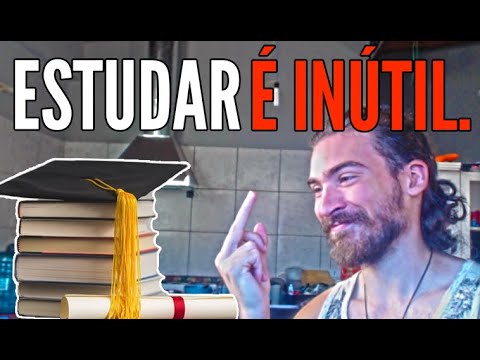
Como Aprender QUALQUER COISA sem NUNCA Estudar
How to Learn Anything Without Studying
Introduction to Learning Without Traditional Study
- The speaker introduces a method for learning without traditional studying, emphasizing its effectiveness throughout their life.
- They highlight the importance of practical knowledge and how it has shaped their worldview and philosophy.
The Concept of Study
- The speaker argues that the anthropological concept of study is relatively new, primarily involving sitting in classrooms and absorbing theoretical knowledge.
- Historically, most learning occurred through direct observation and practical experience rather than formal education systems.
Evolutionary Perspective on Learning
- The discussion shifts to our primal instincts, suggesting that survival needs drive our learning processes more than abstract concepts.
- Emphasizes that early humans learned essential survival skills rather than pursuing knowledge for pleasure or enlightenment.
Practical Learning vs. Theory
- The speaker asserts that all learning should be rooted in practical application; theory alone lacks relevance without real-world context.
- They caution against relying solely on academic theories, which may not translate into useful life skills or experiences.
Observational Learning in Primitive Societies
- An example is given about how children in primitive tribes learn from their environment without formal schooling.
Understanding Social Behavior and Development
The Influence of Community on Individual Behavior
- Individuals begin to emulate the behaviors of their parents and community, especially as they grow older. This process starts early in life and continues through adolescence.
- As adolescents develop, they require more complex learning experiences compared to children, gaining independence from parental guidance.
- Learning is driven by necessity; individuals focus on acquiring skills that are relevant and useful for their lives rather than irrelevant information often taught in educational settings.
Practical Learning Through Observation
- The knowledge gained throughout an individual's life is directly related to their environment and practical needs, emphasizing the importance of applicable learning.
- In a hypothetical society, individuals must establish themselves as functional members within their community, which requires understanding social roles.
The Role of Social Obligations
- A lack of social role leads to immaturity; individuals must fulfill certain obligations to contribute meaningfully to their communities.
- To perform social roles effectively, individuals need a clear set of guidelines or rules that help them understand how to contribute positively.
Observational Learning in Adolescence
- Unlike formal education systems that provide theoretical knowledge without practical application, real-life learning occurs through observation and participation in community activities.
- For example, a 12-year-old boy learns about leadership by observing male figures in his tribe who fulfill various roles such as providers or leaders.
Initiation Rites and Their Importance
- As adolescents grow older, they engage in initiation rites that mark their transition into adulthood; these rites have diminished significantly in modern society.
- Understanding the responsibilities associated with adult roles becomes clearer as young people observe daily practices within their families and communities.
Freedom Within Responsibilities
- Once individuals fulfill their societal obligations, they gain the freedom to pursue personal interests or hobbies that resonate with them.
- Engaging in meaningful activities outside obligatory tasks fosters individual growth while maintaining contributions to the community.
Understanding the Role of Genuine Interest in Learning
The Importance of Social Function and Genuine Interest
- The individual must contribute to society; otherwise, they face dire consequences. Fulfilling social obligations allows one to pursue personal interests that resonate with them.
- Learning is driven by genuine interest rather than mere obligation. Observing skilled individuals and practicing is essential for effective learning.
- Genuine interest leads to automatic learning as one engages in practical activities, highlighting the importance of experience over theoretical knowledge.
Critique of Traditional Education Systems
- The speaker criticizes traditional education for being overly theoretical, suggesting it often delays practical engagement until after years of study.
- Personal experiences in school were enjoyable socially, but the speaker views much of the theoretical content as useless and disconnected from real-world applications.
- The educational system is described as outdated and ineffective, focusing too heavily on theory while neglecting practical functions necessary for true learning.
Philosophical Foundations of Learning
- Philosophy should be grounded in practical principles; any philosophical exploration must lead to concrete outcomes or understanding.
- Academic pursuits should aim at self-discovery and societal contribution rather than just fulfilling academic requirements without purpose.
Practical Approaches to Learning
- While some subjects have clear purposes (e.g., mathematics), much of what is taught lacks relevance outside academia, emphasizing a disconnect between education and real-life application.
- Effective learning can occur through three fundamental principles: observation, practice, and intercession—avoiding unnecessary theoretical constraints.
Observation as a Key Learning Tool
- Observation involves studying masters in one's field to gain insights into their practices rather than relying solely on formal education paths.
The Importance of Practical Learning
Observing Real-World Application
- The speaker emphasizes the necessity of observing individuals who effectively perform their roles in real-life situations, highlighting that traditional schooling often lacks this practical observation.
- Acknowledges that while some exceptional teachers exist, the educational system typically does not allow students to learn from the best due to a focus on academicism rather than practical skills.
The Role of Masters in Learning
- It is argued that learning should come from masters who practice what they preach, as opposed to theoretical instruction from those lacking real-world experience.
- The speaker critiques traditional education for failing to provide opportunities for genuine learning through observation and practice.
Access to Global Knowledge
- Despite limitations in formal education, the world offers vast opportunities for practical learning; individuals can connect with experts globally.
- Examples are given, such as learning complex subjects like aerospace engineering or simple skills like playing guitar, emphasizing the importance of finding quality instructors.
Integration of Theory and Practice
- The speaker stresses that modern technology allows learners access to top-tier educators worldwide, which was previously restricted by geographical boundaries.
- Mastery in any skill is directly proportional to one's ability to observe and practice under skilled guidance.
Principles of Effective Learning
- Two fundamental principles are outlined:
- Observation must precede practice.
- Practical application is essential; theory alone cannot lead to mastery without hands-on experience.
Balancing Theory with Practice
- Emphasizes that knowledge must be tested through practice; merely accumulating theoretical knowledge without application leads to gaps in understanding.
- Critiques academia's focus on theory over practical application, arguing for a balance where both elements coexist harmoniously.
Continuous Learning Process
- The integration of theory and practice should occur simultaneously rather than sequentially; immediate application reinforces learning.
- Using an example of learning guitar, it’s highlighted that without attempting to play oneself after observing a master, one will never truly learn.
Conclusion on Learning Dynamics
- Both observation and active participation are crucial; neglecting either aspect hinders effective learning.
Learning and Transcendence in Personal Development
The Role of Observation and Practice
- Learning begins with observing, absorbing information, and practicing. However, it is crucial that this initial phase does not become the sole focus of one's learning journey.
- The third principle discussed is intercession, which delves into more subtle yet fundamental aspects of learning that transcend mere practical skills.
Beyond Practical Skills
- Mastery in a skill like playing the guitar involves both observation and practice; however, true learning encompasses deeper principles beyond just these methods.
- Learning can be influenced by advanced spiritual and physical factors rather than being strictly theoretical. This suggests a holistic approach to understanding skills.
Understanding Principles of Wealth and Self-Knowledge
- The discussion shifts to concepts such as Stoicism and wealth-building principles, emphasizing self-discovery as a pathway to personal development.
- Engaging with deeper philosophical questions leads one beyond basic practices into profound insights about values and reality.
Transcendence in Practice
- Even basic practices have underlying transcendental principles. For instance, musicians like David Gilmour exemplify how spirituality can elevate musical expression beyond technical skill.
- There exists a point where practice reaches transcendence, merging primal instincts with higher consciousness.
Philosophy of Life and Intercession
- A summary of the discussion emphasizes life philosophy as essential for deep personal growth. Intercession serves as a secret ingredient for developing a comprehensive worldview.
- This principle allows individuals to connect seemingly unrelated ideas through an understanding of universal truths.
Analogy of the Sphere
- An analogy involving spheres illustrates how different perspectives shape our understanding of reality. Each person's viewpoint is limited by their position on the sphere's surface.
- A person at the center has access to all points on the sphere's surface, symbolizing an enlightened perspective that transcends individual limitations.
Depth in Understanding Reality
- To truly engage with life effectively requires grappling with universal laws and perceptions that go beyond superficial understandings.
- The metaphor highlights how individuals can deepen their comprehension by moving away from isolated viewpoints toward a more integrated understanding of existence.
Exploring Depth in Understanding Reality
The Analogy of Digging Deep
- The speaker uses the analogy of digging to illustrate the need for deeper understanding, suggesting that just as one can reach the core of a sphere by digging, individuals must delve beyond surface-level perceptions to grasp complex realities.
- Emphasizes the importance of transcending rational thought and engaging with unconscious aspects, spirit, and consciousness to avoid superficiality in understanding.
Superficial Existence vs. Profound Insight
- Discusses how being trapped in a robotic routine limits one's ability to perceive the entirety of existence; true insight requires moving beyond mere daily tasks.
- To achieve freedom and comprehension, one must actively seek depth by "digging" into their experiences and thoughts.
Learning Beyond Rational Limits
- Highlights that personal development involves not only acquiring skills (like playing an instrument) but also evolving as a human being through philosophical exploration.
- Stresses that understanding subtleties requires techniques that disconnect from logical reasoning, indicating that some concepts are too profound for rational thought alone.
The Principle of Intercession
- Introduces the concept of intercession as learning from others' philosophies and life experiences; genuine interest is crucial for effective learning.
- Points out that choosing mentors wisely is essential; ineffective teachers can hinder learning despite good material.
Choosing Inspirational Mentors
- Advocates for selecting mentors who inspire personal growth; emphasizes gender considerations when choosing role models based on psychological perspectives.
Observing Life Philosophies
The Importance of Observation in Learning
- The speaker emphasizes the need to observe individuals considered as masters, focusing on their life philosophies and practical applications.
- Observations extend beyond actions; they include conversations, body language, and subtle interactions that reveal a person's worldview.
- Masters express their principles and values through discussions, which can be insightful for understanding their perspectives.
- Effective communication transcends words; it reflects underlying beliefs and causes that shape an individual's worldview.
- Engaging with various worldviews allows one to connect with different models of reality without deep study into each individual.
Intersecting Worldviews
- The concept of intercession is introduced, where insights from multiple masters converge to form a deeper understanding of complex ideas.
- Each master presents unique experiences but shares common principles that can lead to profound realizations about life.
- Listening to diverse perspectives reveals overlapping themes among different thinkers, highlighting shared truths across varied philosophies.
- The intersection of ideas from various sources is where significant insights emerge, allowing for a richer comprehension of complex concepts.
- As more voices are included in the learning process, recurring themes become apparent, indicating universal principles upheld by many.
Understanding Dimensions Beyond Conventional Thinking
- The speaker discusses the challenge of visualizing multidimensional concepts using simple two-dimensional representations on paper.
- By manipulating these dimensions metaphorically (e.g., circles), one can begin to grasp higher-level understandings beyond basic perceptions.
- This analogy illustrates how limited views fail to capture the full spectrum of reality; deeper exploration leads to greater awareness of complexities.
- Philosophical discussions often touch upon dimensions that exceed physical understanding—these require abstract thinking and openness to new ideas.
- True comprehension involves assimilating knowledge rather than merely understanding it; this process cannot always be articulated clearly.
Integrating Insights from Multiple Sources
- Continuous engagement with various masters enriches one's foundational understanding by exposing them to diverse viewpoints and teachings.
Understanding Reality Through Diverse Perspectives
The Importance of Multiple Perspectives
- The speaker emphasizes the value of having various perspectives on reality, which allows for a deeper understanding that transcends mere rationality.
- They discuss developing a philosophy based on intersecting ideas, enabling them to articulate specific practices and objective issues more clearly.
- The ability to return to a conscious level after exploring deeper understandings is highlighted as a significant skill in their learning process.
Complexity and Abstraction in Learning
- All topics discussed are seen as abstractions from a core perception of reality developed over years through genuine anthropological learning rather than formal study.
- Practical experiences and observations have led to insights about various subjects, such as nutrition and microbiomes, all rooted in fundamental principles.
Pursuing True Understanding
- The speaker encourages listeners to seek real learning by focusing on foundational principles rather than getting lost in superficial details.
- A call is made to construct a life philosophy that addresses the essence of understanding reality, suggesting that true answers lie at the core rather than on the surface.
Foundations of Effective Learning
- They assert that comprehensive knowledge allows one to find answers easily across different domains once foundational understanding is established.
- The goal is not superficial personal development but fostering deep comprehension applicable throughout life.
Key Principles for Learning
- Three essential principles for effective learning are introduced: purposefulness, observation, and intercession.
- Purposefulness: Learning must have an objective; aimless study lacks depth.
- Observation: Learn from masters who excel in desired skills through direct engagement with their practices.
- Intercession: Engage with multiple mentors to gain diverse insights into complex philosophical concepts.
The Value of Non-Academic Learning
The Role of Education in Society
- The speaker argues that traditional education may not be necessary for success, suggesting that one can live a fulfilling life without formal study.
- Emphasizes the idea that societal pressures often dictate the need for academic achievement, but this is not an absolute requirement.
- Highlights the potential superiority of experiential learning over academic processes, asserting that real-world experiences can lead to greater personal development.
- Discusses the importance of respecting one's own human essence and understanding personal entropy as a means to navigate life effectively.
Turn any video into a summary like this
YouTube links, meetings, lectures — with transcripts, search, and chat.