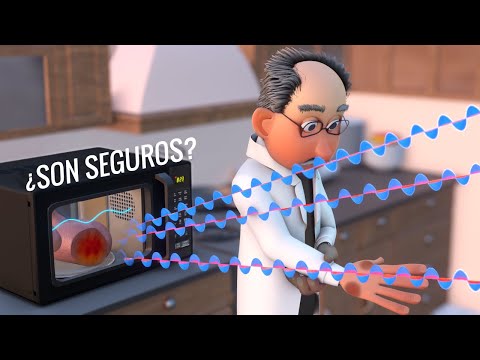
Horno Microondas | ¿Cómo funciona?
Introduction to Microwave Ovens
This section introduces the concept of microwave ovens and addresses concerns about potential health risks associated with electromagnetic radiation.
How Microwave Ovens Work
- Microwave ovens cook food using electromagnetic waves, specifically microwaves.
- The accidental discovery of the microwave oven was made when a scientist observed that a chocolate bar in his pocket had melted while experimenting with a device called a magnetron.
- High-power microwaves have the ability to heat food by causing water molecules to rotate and generate friction, resulting in heat production.
Interaction of Electromagnetic Fields with Water Molecules
- Water molecules in most foods are polar, meaning they have positive and negative charges.
- When an electric field is applied to water molecules, they start rotating due to the torque produced by the field's oscillating electric component.
- The continuous oscillation of electric fields causes water molecules to collide with each other, generating friction and heat in the food.
Efficient Use of Electromagnetic Radiation
This section discusses how microwave ovens efficiently use electromagnetic radiation through reflection and resonance techniques.
Reflection Technique for Energy Retention
- Metal surfaces inside microwave ovens act as reflectors, bouncing microwaves off their surfaces.
- By placing a reflector on one side of the source, the reflection continues, trapping electromagnetic radiation within a confined area.
- Reflecting microwaves helps retain energy within a volume for efficient cooking.
Resonance Cavity Technique for Intensity Enhancement
- Resonance cavities increase the intensity of electromagnetic waves by creating standing waves or stationary patterns.
- Standing waves occur when two waves with equal amplitude and frequency traveling in opposite directions superpose and create constructive interference at specific points.
- By positioning reflectors at specific points, resonance cavities create standing waves, resulting in enhanced intensity of electromagnetic waves.
Formation of Standing Waves
This section explains the formation of standing waves and how they contribute to the cooking process in microwave ovens.
Formation of Standing Waves through Reflection
- When two waves traveling in opposite directions with the same amplitude and frequency meet, they superpose and create constructive or destructive interference.
- By reflecting waves multiple times between reflectors placed at specific positions, standing waves are formed.
- Standing waves have points of high energy (antinodes) and points of zero energy (nodes).
Utilizing Standing Waves for Cooking
- The dimensions of the closed cavity in a microwave oven are determined by the wavelength of the standing wave.
- Certain points within the standing wave pattern have high energy intensity, while others have zero intensity.
- These variations result in different temperature zones within the oven, creating hot and cold spots during cooking.
Demonstrating Hot and Cold Zones
This section discusses how to demonstrate hot and cold zones inside a microwave oven using grated cheese.
Observing Hot and Cold Zones
- Placing grated cheese inside a microwave oven for one minute reveals hot and cold zones.
- The cheese will melt more quickly in areas with higher energy intensity (hot zones) and remain unchanged or less melted in areas with lower energy intensity (cold zones).
By following these sections, you can understand how microwave ovens work, their efficient use of electromagnetic radiation through reflection and resonance techniques, the formation of standing waves, and how hot and cold zones are created during cooking.
Microwave Technology Overview
This section provides an overview of microwave technology and how it overcomes the problem of uneven heating in traditional cooking methods.
Components of a Microwave
- A modern microwave consists of a rotating plate that helps cook food evenly.
- The key component responsible for producing microwaves is called a magnetron.
- The magnetron emits microwaves in all directions to confine the wave.
Propagation of Microwaves
- The magnetron is connected to a waveguide, which guides the waves into the cooking chamber to heat the food.
- Microwaves are not the only electromagnetic waves capable of heating food, but they have certain advantages.
- Longer wavelength waves can easily pass through food without transferring much energy, while shorter wavelength waves are absorbed more quickly on the surface and do not penetrate deep enough for uniform cooking.
Safety Concerns
- Powerful microwaves produced by ovens can be dangerous if humans come into direct contact with them.
- However, electromagnetic radiation produced by microwave ovens remains confined within the oven's chamber and does not pose health risks.
Advantages of Microwave Cooking
This section discusses why microwave cooking is superior to conventional heating methods and how microwaves penetrate and cook food more efficiently.
Penetration and Speed
- Microwaves can penetrate into food, allowing for even cooking both inside and outside.
- Microwave cooking is faster compared to conventional methods.
Convection Cooking vs. Microwave Cooking
- Convection cooking heats food from outside to inside, requiring thermal energy to travel inward. This method is suitable for achieving crispy surfaces or soft interiors.
- Microwave cooking is preferred when quick and uniform heating is desired.
Timestamps provided are approximate.