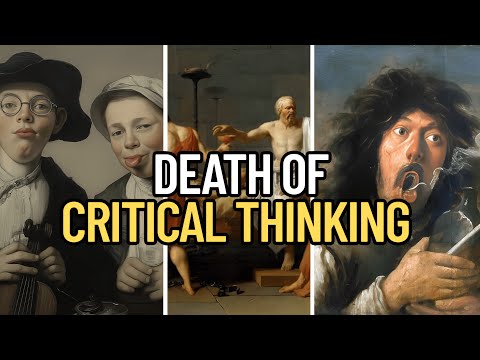
How We Ended Up Raising the Stupidest Generation
The Decline of Critical Thinking
The Tragedy of Our Age
- A quote highlights the struggle between facts and ignorance: "You can silence 50 scholars with one fact but you cannot silence an idiot with 50 facts." This reflects the current state where critical thinking is diminishing, leading to collective stupidity.
- The speaker questions why critical thinking is declining faster than ever, setting the stage for a deeper exploration into its historical emergence.
Understanding Critical Thinking
- Critical thinking is defined as a disciplined habit of questioning assumptions, seeking evidence, and applying reason before accepting beliefs. It emphasizes not being fooled by oneself or others.
- Socrates introduced the Socratic method, which involves asking probing questions to expose contradictions in thought. His famous assertion was that true wisdom lies in recognizing one's own ignorance.
Historical Context
- Socrates faced execution for his relentless questioning, illustrating the societal threat posed by independent thought. His legacy continued through Plato and Aristotle, who further developed logic and inquiry.
- Enlightenment thinkers like Kant encouraged individuals to think independently ("sapere aude"), reinforcing critical thinking as essential for progress in science and democracy.
The Modern Crisis of Critical Thinking
- Despite its rich history, critical thinking faces decline today due to information overload—an overwhelming amount of data that hinders deep reflection.
- Psychologists term this phenomenon "information overload," where rapid data influx forces mental shortcuts instead of thoughtful analysis.
Consequences of Information Overload
- Reliance on technology leads to diminished reasoning skills; people often choose quick answers over engaging in complex problem-solving.
- Nobel laureate Daniel Kahneman describes two modes of thought: System 1 (fast and intuitive) versus System 2 (slow and rational). Critical thinking resides in System 2, which atrophies when we rely on machines for answers.
Echo Chambers: A Threat to Thought
The Impact of Echo Chambers
- Echo chambers arise from social media algorithms that reinforce existing beliefs by curating content aligned with users' past interactions. This creates environments where dissenting opinions are rarely encountered.
- As individuals surround themselves with like-minded voices, their willingness to engage critically diminishes. This phenomenon exacerbates the decline in critical thinking skills across society.
The Dangers of Confirmation Bias and Sensationalism
Understanding Confirmation Bias
- The mind tends to become lazy over time, favoring information that confirms existing beliefs while dismissing contradictory evidence as fake or biased. This phenomenon is known as confirmation bias.
- Echo chambers can form not only in extreme groups but also among skeptics and rationalists, leading to unchallenged assumptions within these closed circles.
- Groupthink emerges when individuals conform to the group's beliefs, resulting in a lack of critical questioning and a society where dogma overshadows dialogue.
The Impact of Sensationalism
- Modern media thrives on sensationalism, prioritizing outrage over informative content. Headlines are crafted to provoke rather than educate.
- The pressure for attention leads even educators to exaggerate claims, creating an environment where nuance is lost and critical thinking suffers.
- Constant hype from media results in public anxiety and distraction, making thoughtful discourse increasingly rare.
Cultivating Critical Thinking
- To combat mental laziness, curiosity must be encouraged. Asking deeper questions about claims helps foster a more analytical mindset.
- Engaging with diverse sources and perspectives can weaken confirmation bias. Seeking out challenging viewpoints promotes clearer understanding.
Reforming Education and Leadership
- Societal emphasis on critical thinking should start in schools by promoting reasoning and debate instead of rote memorization.
- Leaders should model inquiry by admitting uncertainty, demonstrating that questioning is a strength rather than a weakness.
Practical Steps for Improvement
- Regularly challenge your own assumptions by considering opposing views; this practice enhances reasoning skills.
- Teachback methods—explaining complex ideas to others—can reveal gaps in understanding and promote deeper learning.