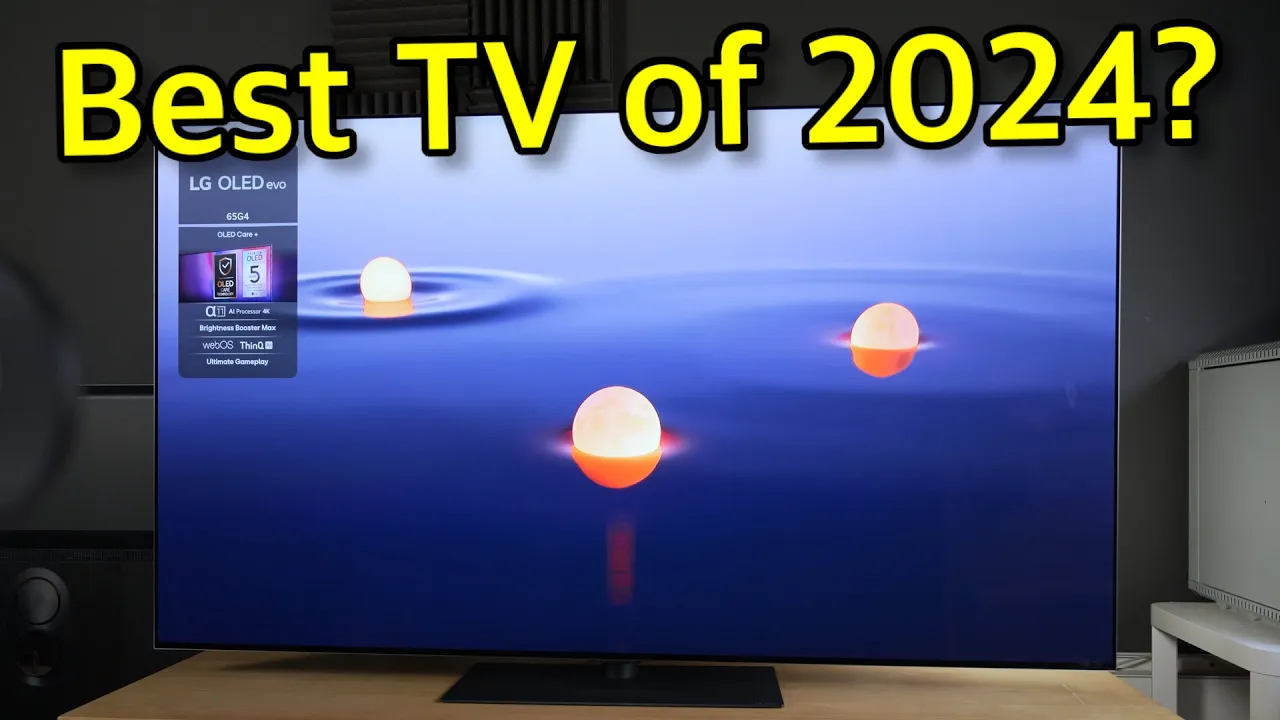
LG G4 OLED TV Review (vs G3 & Sony A95L)
LG G4 vs. Sony a95 L QD OLED: A Comprehensive Comparison
Peak Brightness and Display Technology
- The LG G4's peak brightness measured 1500 nits on a 10% window after calibration, with full-field brightness at 210 nits, similar to the previous year's LG G3.
- The G4 utilizes a 2300 nit version of LG's second-generation MLA OLED panel, rather than the higher-end 3000 nit variant.
- Despite modest peak brightness improvements, color luminance has increased overall due to LG's Dynamic Color Boosting technology, enhancing color saturation.
HDR Performance and Gaming Features
- The dynamic HDR color boosting algorithm is now available in Game Optimizer mode on the G4, allowing vibrant colors while maintaining low latency for gaming.
- Input lag measures at 13 milliseconds at 60 FPS; it can drop below 5 milliseconds at 120 FPS with boost mode enabled, making it one of the fastest consumer TVs recorded.
Near Black Chrominance Handling
- The G4 shows improved suppression of near black chrominance overshoot compared to the G3, resulting in fewer flashing artifacts during dark scenes.
- However, heavier deterring was used for this improvement, causing some dark sequences to appear noisier than on the G3 or Sony HX 3110 reference monitor.
Calibration and Color Accuracy
- The LG G4 offers more granular calibration controls that allow closer matching to professional monitors like the Sony HX 3110 in terms of near black luminance.
- Unlike the Sony a95 L QD OLED, the G4 does not suffer from color desaturation in low light sequences.
Motion Interpolation and Video Processing Enhancements
- Improvements were noted in how the true motion interpolation algorithm handles broadcast material (50 Hz), reducing visible motion artifacts compared to the G3.
- While there are still mild micro stutter issues during hand gestures with true motion enabled on both TVs, these are less pronounced on the G4.
New Chipset and Processing Capabilities
- Equipped with a new chipset (O24), the LG G4 applies always-active microcontrast enhancement and localized gamma manipulation even when sharpening controls are disabled.
- This results in sharper native UHD video but may introduce overprocessing artifacts in densely packed detail scenes.
Cinematic Movement Settings
- The cinematic movement setting analyzes motion and contrast levels to balance smoothness and cinematic reproduction effectively.
- Engaging this feature incurs fewer interpolation artifacts than seen on last year’s model but may introduce slight soap opera effect (SOE).
Gradation Issues
LG G4 Review: Key Features and Improvements
Smooth Gradation and Low Light Performance
- The LG G4's smooth gradation algorithm may struggle in low light, causing luminous fluctuations. Users experiencing flicker should consider turning off the smooth gradation feature.
- The G4 effectively suppresses jaggies for video-based interlaced material and accurately detects 32 and 22 cadences in film-based content with Real Cinema engaged by default.
Display Quality and HDR Performance
- The review unit of the LG G4 exhibited good uniformity with minimal bending or dirty screen effects, although some pink tinting was noted on full-field gray lights.
- Accurate PQ UTF tracking to the ST 2084 standard was achieved, preserving highlight detail in high dynamic range (HDR) content. Manual adjustments for HDR tone mapping are available but recommended only for knowledgeable users.
Dynamic Tone Mapping and Color Coverage
- For 2024 models, dynamic tone mapping is disabled by default to maintain creative intent without over-brightening HDR presentations.
- DC3 color gamut coverage measured at 99% in UV terms, while Rec 2020 coverage reached 75%, aligning with other OLED displays reviewed recently.
Gaming Features and VRR Support
- The new Dolby Vision filmmaker mode disables unnecessary processing features out of the box. However, luminance fluctuations were observed during gaming in Dolby Vision mode on Xbox Series X.
- Users are advised to disable Dolby Vision for gaming to utilize HDR10 with correctly set source-based tone mapping.
Refresh Rate and HDMI Capabilities
- The LG G4 supports a refresh rate of up to 144 Hz when activated through the user menu. It also supports all mainstream VR formats including HDMI Forum VRR, AMD FreeSync, and Nvidia G-Sync.
- Despite some unavoidable flicker in certain VR games, improvements have been noted due to potential low-level gamma compensation on second-generation MLA OLED panels.
Design Features and Audio Quality
- Available sizes include 55" and 65", featuring a tabletop stand that allows an upright position; larger models will have a similar stand design from previous years.
- Improved audio quality over last year's model includes better dialogue clarity and bass extension when using Dolby Atmos content.
Summary of Improvements Over Previous Models
- While not revolutionary compared to the LG G3, key enhancements such as reduced chrominance overshoot during black scenes make it appealing for current owners considering an upgrade.
TV Comparison: LG G4 vs. QD OLED
Overview of TV Technologies
- The native 10-bit gradation and color luminance of QD OLED TVs are superior to those found on other models, such as the Sony A95L, which will not be replaced this year.
- The LG G4 features a second-generation MLA OLED panel, praised for its outstanding color fidelity and black luminance accuracy post-calibration.
- The LG G4 is recognized for its class-leading Dolby Vision presentation and excellent gaming capabilities, including four HDMI 2.1 ports and low input lag.
Recommendations for Consumers
- Choosing the best TV depends on individual requirements; Richer Sounds is recommended as a reliable retailer offering expert advice.