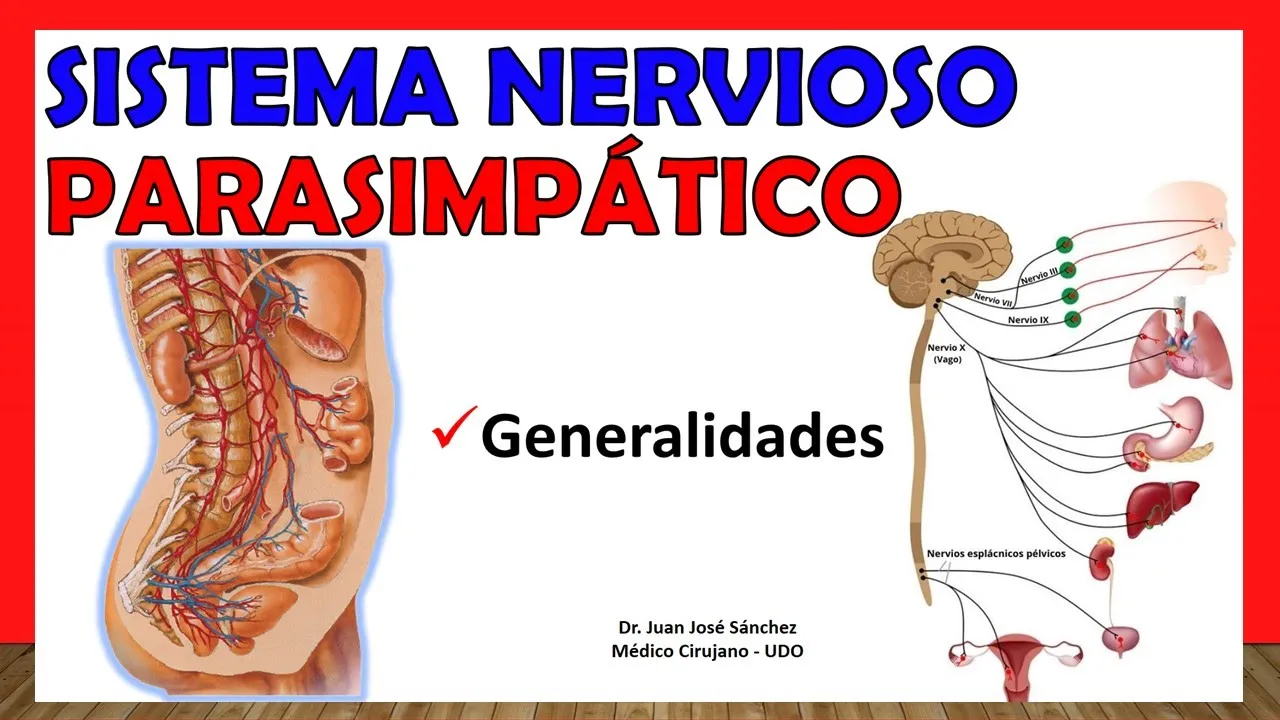
🥇 SISTEMA NERVIOSO PARASIMPÁTICO , Generalidades. ¡Explicación Sencilla!
Anatomy of the Parasympathetic Nervous System
In this video, the speaker discusses the anatomy of the parasympathetic nervous system, highlighting its components and functions within the broader context of the autonomic nervous system.
Generalities of the Parasympathetic Nervous System
- The parasympathetic nervous system is intricately linked with cranial nerves and sacral nerves.
- It consists of cranial pairs and sacrococcygeal nerves known as pelvic splanchnic nerves.
- The nervous system is divided into central and peripheral components.
- The central nervous system comprises the brain and spinal cord, while the peripheral includes somatic and autonomic systems.
- The autonomic division further divides into sympathetic and parasympathetic branches.
- Sympathetic involves rapid nerves, while parasympathetic coordinates with cranial nerves for involuntary actions.
Functions of the Parasympathetic Nervous System
- The parasympathetic system controls involuntary bodily functions.
- It complements voluntary actions by regulating activities like pupil constriction, gland secretions, heart rate modulation, and bronchial muscle relaxation.
- While typically opposing sympathetic effects, both systems can synergize at times for coordinated responses.
- Acetylcholine serves as a primary neurotransmitter in the parasympathetic system, contrasting with adrenaline in sympathetic pathways.
Anatomy and Relationship with Central Nervous System
- Parasymapthetic fibers primarily originate from motor sources with minimal sensory input.
Explanation of Cranial Parasympathetic Division
In this section, the speaker explains the cranial division of the parasympathetic nervous system and its role in innervating various structures in the head, neck, thorax, and abdomen.
Cranial Parasympathetic Division
- The cranial division of the parasympathetic nervous system innervates a wide range of structures including those in the head, neck, thorax, and abdomen.
- The left colic flexure is considered the final point of innervation for the cranial parasympathetic system before it transitions to the sacral division.
- The cranial parasympathetic system originates in nuclei that travel with cranial nerves known as the parasympathetic cranial nerves. These include the third (oculomotor), seventh (facial), ninth (glossopharyngeal), and tenth (vagus) cranial nerves.
Nuclei and Pathways
- The parasympathetic centers originate in nuclei associated with specific cranial nerves located in different regions compared to sympathetic centers.
- The pathway from bottom to top involves several nuclei such as the dorsal nucleus of vagus at the lower level near the medulla oblongata.
Nuclei Involved in Parasympathetic System
This part delves into specific nuclei involved in the parasympathetic system's pathways and their locations within the brainstem.
Nuclei Description
- Nuclei like dorsal nucleus of vagus are situated at different levels within the brainstem; for instance, inferior salivatory nucleus is closer to pontine level.
- Superior salivatory nucleus is found at a higher level near pons and gives rise to intermediate nerve fibers forming part of facial nerve.
Functions of Vagus Nerve
Here, details about how vagus nerve functions are explained along with its significance in innervating various structures within neck, thorax, and upper abdomen.
Vagus Nerve Functions
- Vagus nerve plays a crucial role by carrying sensory information from lower brainstem nuclei to structures like plexus pulmonalis and plexus cardiacus.
General Overview
In this section, the speaker discusses the nuclei involved in salivary gland innervation and their functions.
Nuclei Involved in Salivary Gland Innervation
- The inferior salivary nucleus sends fibers to the parotid gland for saliva secretion.
- The superior salivary nucleus contributes to the facial nerve and connects with the submandibular and sublingual ganglia for sympathetic fibers towards the submaxillary and sublingual glands.
- The lacrimal nucleus of the facial nerve is crucial for tear production.
- The Edinger-Westphal nucleus, a famous motor nucleus, is associated with cranial nerve III (oculomotor nerve).
- Parasynaptic fibers from the lacrimal nucleus reach the pterygopalatine ganglion.
Parasympathetic Nervous System Functions
This part delves into the functions of parasympathetic nuclei in various bodily systems.
Parasympathetic Nervous System Functions
- The visceral nucleus fibers reach ganglia near target organs like those controlling pupil constriction.
- The visceral motor nucleus in mesencephalon controls pupillary constriction, explaining why pupils dilate in brain death.
- Sacral parasympathetic nerves originate from lower spinal segments for pelvic organ innervation.
Role of Parasympathetic System
This segment explores how parasympathetic nerves influence different bodily functions.
Role of Parasympathetic System
- Pelvic splanchnic nerves connect to pelvic organs via pre-ganglionic fibers, affecting genital and urinary systems.
- Parasympathetic actions include lowering heart rate and bronchoconstriction while dilating eye pupils.
Parasymapthetic Effects on Digestive System
Focuses on how parasympathetic activity impacts digestive processes.
Parasymapthetic Effects on Digestive System