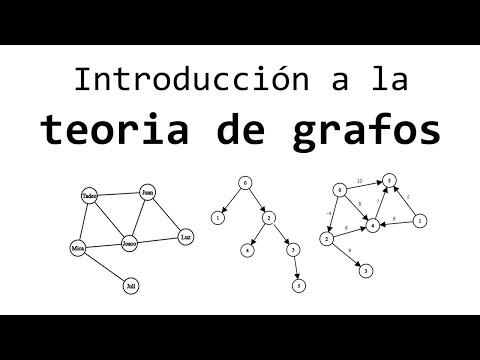
Teoría de GRAFOS en INFORMÁTICA: Que es un grafo, Tipos de Grafos, como representarlos y ejemplos
Introduction to Graph Theory
In this section, the speaker introduces the topic of graph theory and its relevance in computer science. The discussion covers the basics of graph theory and its applications in modeling relationships between data sets.
What is Graph Theory?
- Graph theory is a fundamental concept in computer science that aims to represent and model relationships between data sets.
- It can be used to model a wide range of diverse problems by representing connections between various entities.
Real-Life Application of Graph Theory
- Graph theory can be applied to real-life scenarios, such as modeling social networks.
- For instance, a social network where individuals are interconnected represents a graph. This allows for analyzing direct friendships or degrees of separation between people.
Components of a Graph
- Vertices: Fundamental elements of a graph represented by nodes or circles.
- Vertices serve as the building blocks of graphs, each denoting an entity like a person in a social network.
- Edges: Lines connecting vertices, illustrating relationships between entities.
- Edges are crucial as they define how vertices are connected within the graph structure.
Types of Graphs
This section delves into different types of graphs commonly encountered in practice, including undirected graphs, directed graphs, and weighted graphs.
Undirected Graphs
- Undirected graphs have edges without specific orientations; edges V-U and U-V are considered identical.
- Understanding undirected graphs is essential for grasping basic graph concepts before moving on to more complex structures.
Directed Graphs
- Directed graphs feature edges with defined directions from one vertex to another.
- Contrary to undirected graphs, directed graphs distinguish between V-U and U-V connections based on their directional flow.
Weighted Graphs
- Weighted graphs assign specific weights to edges connecting vertices, influencing various computations like distances or significance within the context.
- These weights can be utilized differently based on the application context where the graph is employed.
Special Types of Graphs
This part explores specialized types of graphs beyond basic structures like trees with roots and acyclic directed graphs with practical applications.
Trees and Rooted Trees
- Trees represent non-directed acyclic structures while rooted trees extend this concept with a central vertex enabling access to all other vertices in the tree.
- Rooted trees play a significant role in various algorithms due to their hierarchical organization facilitating efficient data processing.
Acyclic Directed Graphs
- Acyclic directed graphs lack cycles or loops within their directional connections, making them valuable for problem modeling with numerous practical applications.
Graph Theory Fundamentals
In this section, the speaker introduces the concept of bipartite graphs and discusses how to represent graphs using adjacency matrices and adjacency lists.
Bipartite Graphs
- Two vertices from different groups never directly connect in a bipartite graph.
- A graph becomes bipartite when vertices of one group only connect to vertices of the other group, not within their own group.
Representing Graphs with Adjacency Matrices
- The most common method is using an adjacency matrix where rows and columns represent graph vertices, storing arc weights.
- Demonstrates creating an adjacency matrix step by step for a simple graph.
Understanding Adjacency Matrices
- Calculate costs between vertices in the matrix based on arc weights.
- Continue filling the matrix for all vertex pairs to obtain a complete representation.
Alternative Graph Representation: Adjacency Lists
This part explores representing graphs through adjacency lists as another common method besides adjacency matrices.
Using Adjacency Lists
- Each vertex has a list storing tuples of destination vertex and arc weight.
- Process each vertex to create its corresponding list by determining connected vertices and their weights.
Completing Adjacency Lists
- Repeat the process for all graph vertices to form complete adjacency lists.
Conclusion and Invitation
The speaker concludes by encouraging viewers to engage with the video content at their own pace, subscribe for future videos on graph theory, and explore additional resources provided in the video description.
Wrapping Up
- Invites viewers to subscribe for upcoming videos on graph theory topics.
Turn any video into a summary like this
YouTube links, meetings, lectures. With transcripts, search, and chat.