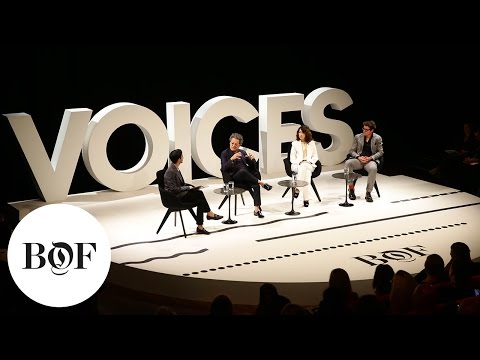
How will stores of the future captivate the consumer? | The Business of Fashion
Introduction
The moderator introduces the topic of the panel discussion on the future of retail and introduces the three panelists.
Panelists' Background
- The three panelists are Armand Hadida, founder of L'Eclaireur in Paris; Kim Bui Kollar, director of fashion and special products for Lane Crawford in Hong Kong; and Michael O'Keefe, CEO of Aesop.
- Armand Hadida founded L'Eclaireur in 1980 in Paris. It became an international destination pioneering the retail concept of mixing interior design furniture and fashion.
- Kim Bui Kollar is director of fashion and special products for projects for Footwear accessories and handbags at Blitz and Lane Crawford, a leading retailer and distributor of luxury goods in Greater China.
- Michael O'Keefe joined Aesop in 2003 as CEO and has led the transition of the skincare company from a wholesaler into a global retailer launching its standalone signature concept in Melbourne.
Future of Retail
The moderator asks the panelists about their thoughts on what retail will look like in the future.
Armand Hadida's Perspective
- Armand believes that physical stores need to be different from competitors to deserve visits from consumers. He emphasizes creativity over commercial approach by mixing fashion with other things such as interior design.
- Armand thinks that physical stores need to change because consumers today don't want to follow old rules. He believes it's important to supply young consumers with something made especially for them.
- Armand shares his experience with a space called "A Clever" in Paris, where they surprised people by presenting something totally different from what was expected. They used new technology to build a bridge between the classic and modern.
Kim Bui Kollar's Perspective
- Kim believes that retail is moving towards more personalized experiences and customization. She thinks that retailers need to be able to provide unique experiences for customers.
- Kim talks about how Lane Crawford has been experimenting with pop-up stores and collaborations with artists and designers to create unique experiences for customers.
Michael O'Keefe's Perspective
- Michael believes that retail needs to focus on creating an emotional connection with customers. He thinks that storytelling is important in creating this connection.
- Michael talks about how Aesop creates unique store designs that reflect the local culture of the area. He also emphasizes the importance of sustainability in their business practices.
Conclusion
The moderator concludes the panel discussion by thanking the panelists for their insights on the future of retail.
Key Takeaways
- Retail is moving towards more personalized experiences and customization.
- Creativity is important in physical stores, mixing fashion with other things such as interior design.
- Emotional connections are important in creating memorable shopping experiences.
- Sustainability is becoming increasingly important in retail business practices.
Understanding the Future of Retail
In this section, the speakers discuss how to engage with younger consumers and create unique experiences in retail.
Engaging Younger Consumers
- Younger consumers need their own codes and special spaces.
- Creating a new community is important for younger consumers.
- Emotion, creativity, authenticity, and discovery are key factors in engaging with younger consumers.
Unique Experiences in Retail
- Thoughtfulness and intuition are required to create unique experiences.
- Lane Crawford has been experimenting with creating unique experiences such as live installations by artists like James Jean.
- The goal is to deepen customer relationships through conversation and personal curiosity.
Balancing Physical and Online Retail
- Physical retail isn't dead; physical and online worlds will coexist.
- The multiplicity of interactions that customers have will increase.
- Retailers must provide something special related to the cities they're present in.
The Importance of Customer Service in Retail
In this section, the speaker discusses how retailers need to shift their focus from being product-driven to service-driven. They also talk about the importance of adding value to communities and creating an immersive experience for customers.
Shifting Focus to Service-Driven Experience
- Retailers need to shift their mindset from a product-driven business to a service-driven experience.
- The pressure on retailers is greater than ever before, and they need to create an immersive experience for customers.
- Customers are looking for retailers that add value to their community, regardless of whether they are local or global brands.
Importance of Adding Value
- Too many retailers have taken their customers for granted and have not added value to their communities.
- Moving forward, it will be important for retailers to give back and connect with their customers.
- Exceptional products are necessary but not sufficient for success in retail.
Creating an Immersive Experience
- Retailers need to create an immersive experience that customers will remember.
- The concept of "retail theater" is outdated; instead, retailers should aim for an authentic mesh that reflects who they are as a brand or retailer.
- Customer engagement and exceptional service are critical components of creating an immersive experience.
Changes in the Customer Journey
In this section, the speaker talks about how the customer journey has changed due to digital advancements. They discuss how advertising and PR used to drive people into stores but now there is a more complex journey involving multiple touchpoints.
Shift in Customer Journey
- Advertising and PR used to drive people into stores through a clear direct relationship between the two things.
- Now, there is a more complex journey involving multiple touchpoints across physical and digital platforms.
Discovering Brands
- Customers might discover a brand through various touchpoints such as restaurants, sponsored events, or social media.
- The challenge for retailers is to create an authentic mesh that reflects their brand and who they are as a retailer.
Engaging with Products
- Customers engage with products in various ways such as using them at a friend's house or seeing them on Instagram.
- Retailers need to be aware of these touchpoints and create an immersive experience that customers will remember.
Making a Purchase
- The ultimate goal of the customer journey is still to make a purchase, but the journey has become more complex due to digital advancements.
Hospitality and the Changing Nature of Retail
In this section, the speakers discuss how their business has grown and evolved over time. They emphasize the importance of maintaining a clear direction while also adapting to changes in the market.
Maintaining Direction While Adapting to Change
- Hospitality and events are important aspects of their business.
- As their business grows, they must maintain a clear direction and avoid trying to be everything to everyone.
- The changing nature of retail means that businesses must adapt to new technologies and consumer behaviors.
The Evolution of Fashion Retail
- In the 80s, consumers relied on magazines and other media to discover fashion trends.
- Today, consumers can discover everything online through platforms like Instagram.
- Fast fashion brands like Zara have disrupted traditional retail models by offering smart marketing strategies and working with designers.
- However, creative fashion remains a risky business due to its high inventory risk.
Challenges for Multi-brand Stores
- Multi-brand stores face challenges in balancing commercial success with creative offerings.
- Many multi-brand stores have had difficulty adapting to changes in the market.
The Fear of Scale in Retail
In this section, the speakers discuss how retailers often struggle with scaling their businesses. They emphasize that businesses should not compromise their message or values when expanding.
The Fear of Scale
- Retailers often get scared by scale and feel they need to change their message or values.
- Businesses must maintain a clear direction and avoid trying to be everything to everyone.
Staying True to Your Message
- Retailers should not compromise their message or values when expanding.
- Creative fashion remains a risky business due to its high inventory risk, but businesses should not compromise their values in order to achieve commercial success.
The Importance of Collections in Fashion Retail
In this section, the speaker discusses the importance of collections in fashion retail and how it affects competitiveness.
Collections and Competitiveness
- Margins are slim, so the risk lies with the collections.
- Carrying only two collections a year is not competitive when big companies have 50 collections a year.
- American system with five collections a year is more competitive for retailers and consumers.
- Without enough freshness and newness on the shop floor, deep discounting occurs, which dilutes margins.
Selling Dreams Instead of Clothing
In this section, the speaker talks about how selling dreams instead of clothing is necessary to compete in high-end fashion retail.
Selling Dreams
- Expanding business to sell kitchens made with the best materials that can be personalized.
- This makes them different from other suppliers as they say yes to all requests.
- Giving cooking courses to customers helps bring people into stores and creates an emotional connection.
- Need to sell dreams because what they sell is expensive.
Creating Engagement and Excitement in Stores
In this section, the speaker discusses creating engagement and excitement in stores through projects like Blitz space at Lane Crawford.
Engagement and Excitement
- People come into stores to discover things and enrich their lives.
- Members of the community who work on environmental awareness initiatives are invited to collaborate on projects like Hello Kitty Con.
- Blitz space at Lane Crawford is used to provide engagement and excitement in the store.
The Power of Community and Retail
In this section, the speaker talks about the power of community and retail. He mentions how retailers can create a real reason for people to come into the store by inspiring and educating them.
Creating a Real Retail Experience
- The focus was on appealing to kids because they come with their parents.
- Activities included tree planting, storytelling, and giving out certificates for cool ambassadors.
- Kids learned about environmental implications and forced their parents to be more environmentally conscious.
- Inspiring and educating customers is important in creating a real retail experience.
Relevancy in Busy Cities
- Being relevant to customers is crucial in busy cities like Hong Kong.
- Customers increasingly buy items that mean more to them rather than just buying more products.
- Selectivity of items is important as we live in a surplus society where people don't need more products.
Developing Relationships within the Community
- Developing relationships within the community can get people into stores and post on social media but how does it translate into business results?
- Sales associates who understand customers can connect with them better, making it easier to sell products.
- Having relevant products that form part of customer identity is important.
The Importance of Experience in Retail
In this section, the speaker discusses how experience is crucial to the future of retail. He talks about restaurants with few dishes and how they focus on creating a unique atmosphere rather than just the food.
Experience Over Results
- The speaker apologizes for his English and explains that he learned from the streets rather than school.
- He describes a restaurant with only one table and 25 different decorations in the room, emphasizing that experiences like these make all the difference.
- The speaker argues that focusing solely on results and margins will not lead to success in retail. Passion is key.
Challenges in Finding Good People
- The speaker discusses how even if you have great recipes or products, it's not enough without good people to sell them.
- Michael agrees that finding good people is challenging, but emphasizes that retail is a fantastic career path.
- The speaker notes that many salespeople lack proper training and knowledge, which can be detrimental to a business.
Communication is Key
- The speaker emphasizes the importance of communication in retail, as one word can change an entire situation.
- He argues that good management and control of communication are essential for success in retail.
- Michael agrees that people are key to any business and emphasizes the importance of developing your employees.
Employees as Brand Advocates
- Michael notes that employees are brand advocates who represent their company every day.
- He emphasizes the importance of offering development paths for employees so they can grow and become better advocates for the brand.
Challenges of Integrating Retail
The speakers discuss the challenges of integrating retail and how internal organizations need to be interconnected. They also talk about the importance of bringing visionary presentations back into stores for customers to experience.
Silos in Retail
- Many businesses are built with silos and different functions that are responsible for their different areas.
- Internal organizations have to be interconnected, but it can be tough even for vertically integrated businesses like theirs.
Bringing Visionary Presentations into Stores
- Multi-brand retailers face the challenge of bringing visionary presentations back into stores for each brand and designer.
- Without the magic, it's just stuff. Education is needed not only for salespeople but also for fashion schools that teach outdated codes.
- Young designers need to learn to bring their own vocabulary and focus on one strong, personal product instead of creating many disconnected collections.
Technology in Retail
The speakers discuss technology in retail experiences and how it can often be a gimmick used as a PR story. They highlight inventive uses of technology in their respective stores.
Gimmicks vs. Inventive Uses of Technology
- Technology is often used as a gimmick in retail experiences.
- Inventing new uses of technology is important, but it should not be done just for show.
- One example of an inventive use of technology is using augmented reality to help customers visualize furniture placement in their homes.
Importance of Technology in Retail
In this section, the speakers discuss how technology can be used to improve customer experience and sales effectiveness in retail.
Use of iPads for International Tourists
- iPads with information and brochures are provided to international tourists in major capital cities.
- Information is available in multiple languages, including bilingual or trilingual sales associates where possible.
Sales Associate Effectiveness
- 70-80% of all transactions are registered, allowing sales associates to access customer history and recommend products.
- Sales associates can use technology to pull up information on customers' history and travel patterns to make personalized recommendations.
Importance of Subtle Technology Integration
- Technology should serve the customer better without being a gimmick or gadget.
- Technology should be integrated into the backend supply chain rather than pushed too far forward.
Importance of Software in Retail
In this section, the speaker shares a story about how software helped their retail business manage inventory and buying across multiple stores.
Importance of Custom Software
- The speaker's store was the first in France to use custom software for fashion retail in 1981.
- The store developed new software that allowed them to manage inventory and buying across six stores by sharing data through a virtual platform.
Benefits of Cloud-Based Inventory Management
In this section, the speaker discusses how cloud-based inventory management has helped their retail business share data between stores more effectively.
Virtual Platform for Inventory Management
- The speaker's store developed a virtual platform for inventory management that allowed them to share data and photos of collections across all stores.
- This software helped the business manage buying and inventory more effectively, leading to significant improvements in sales.
Convenience and Selling Tool
In this section, the speakers discuss how technology has been both convenient and helpful as a selling tool in retail.
Convenience and Consistency
- Technology has made things more convenient for in-store staff by alleviating some of their work.
- Technology has also helped keep product consistent across multiple stores, reducing errors.
Turn any video into a summary like this
YouTube links, meetings, lectures. With transcripts, search, and chat.