Avalanche Breakdown and Zener Breakdown Effect Explained
Understanding PN Junction Diodes and Breakdown Effects
Overview of PN Junction Diodes
- The video introduces the concept of PN junction diodes, explaining their operation in both forward and reverse bias conditions.
- In forward bias, current flows from the P side to the N side when voltage exceeds the threshold or barrier potential.
- In reverse bias, minimal current flows from P to N, with a small amount of reverse saturation current due to minority charge carriers.
Breakdown Region and Avalanche Effect
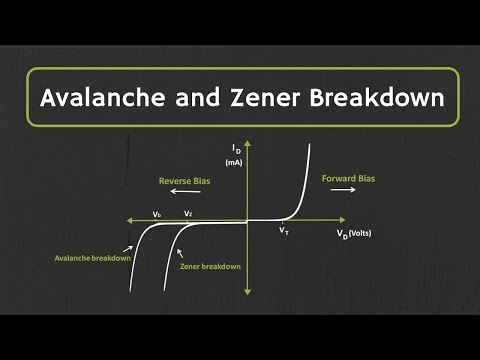
- When reverse voltage exceeds a certain limit, significant current begins to flow in the reverse direction; this is known as the breakdown region.
- The breakdown occurs due to an increase in electric field strength within the depletion region as reverse voltage increases.
- Minority charge carriers gain kinetic energy sufficient to knock off bound electrons from silicon atoms during collisions at breakdown voltage.
Impact Ionization Process
- Each collision can create additional free electrons, leading to a chain reaction where more electrons are generated rapidly.
- This phenomenon results in a drastic increase in free charge carriers within the depletion region, causing a sudden jump in reverse saturation current.
- The process is termed Avalanche breakdown effect; it should be avoided for normal diodes due to potential damage from excessive current.
Zener Diode and Zener Breakdown Effect
- Unlike standard diodes, Zener diodes are designed for operation in the breakdown region without damage; they utilize a different mechanism called Zener breakdown effect.
- Zener diodes have heavily doped P and N regions (denoted as P+ and N+) which leads to narrower depletion regions compared to normal diodes.
Mechanism of Zener Breakdown
- Heavy doping results in stronger built-in electric fields that can generate charge carriers when reverse biased beyond a specific voltage (Zener voltage).
- The narrow depletion region allows for tunneling of charge carriers under strong electric fields, facilitating increased current flow during breakdown.
Zener and Avalanche Breakdown Mechanisms
Understanding Zener Diodes as Voltage Regulators
- The Zener diode maintains a constant voltage across it even when the applied voltage exceeds the Zener voltage, leading to increased current through the diode. This property makes it ideal for use as a voltage regulator in various applications.
- Commercially available Zener diodes have breakdown voltages ranging from 2 volts to 200 volts. For breakdown voltages below 4 volts, the Zener effect is predominant, while above 6 volts, the Avalanche effect takes over.
- Between 4 and 6 volts, both breakdown mechanisms can occur. Regardless of the mechanism, all diodes used for voltage regulation are classified as Zener diodes.
Temperature Effects on Breakdown Mechanisms
- The temperature coefficient of breakdown voltage differs between the two effects: for Zener breakdown (predominant under 4V), it is negative; thus, an increase in temperature results in a decrease in breakdown voltage.
- In contrast, for Avalanche breakdown (predominant above 6V), the temperature coefficient is positive; hence, an increase in temperature leads to an increase in breakdown voltage.
Mechanisms Behind Breakdown Effects
- In Zener effect scenarios, additional charge carriers are generated by strong electric fields. As temperature rises, more electron-hole pairs form, requiring less electric field strength to generate these carriers and resulting in lower required breakdown voltage.
- Conversely, during Avalanche breakdown, charge carriers arise from impact ionization due to collisions with silicon atoms. Increased temperatures cause silicon atoms to vibrate more vigorously, reducing collision mean free paths and necessitating higher electric fields or external voltages for effective operation.
Summary of Key Differences
Turn any video into a summary like this
YouTube links, meetings, lectures — with transcripts, search, and chat.