Prueba de Fehling para Carbohidratos | Detección de Azúcares Reductores
Introduction to Reducing Sugars and Aldehydes
Overview of Previous Experiments
- The video begins with a recap of previous experiments involving the Fehling test for identifying aldehydes, which can yield positive results due to their ability to oxidize. In contrast, ketones do not react positively as they cannot be oxidized.
Current Focus: Identifying Reducing Sugars
- The current experiment aims to identify reducing sugars using the same Fehling test methodology. Reducing sugars will give a positive result, while non-reducing sugars will yield negative results.
Characteristics of Reducing vs Non-reducing Sugars
- Reducing sugars contain a hydroxyl group (OH) on their anomeric carbon (previously carbonyl), allowing them to participate in oxidation reactions. Non-reducing sugars lack this hydroxyl group on their anomeric carbon. Examples include glucose and maltose as reducing sugars, while sucrose is identified as non-reducing due to its structure.
Experimental Setup and Procedure
Sample Identification
- Various samples are prepared for testing: glucose (G), sucrose (S), maltose (M), fructose (F), and a problem sample containing lactose and other sugars (P). Each carbohydrate sample is mixed with 2 mL of solution for testing.
Preparation of Fehling's Solution
- Approximately 3 mL of copper complex solution (Fehling A and B mixed) is added to each sample. The blue color indicates the presence of copper ions, essential for the reaction that occurs in a basic medium; thus, any acidic solutions must be neutralized before adding the complex solution.
Observations During Testing
Color Change Indicators
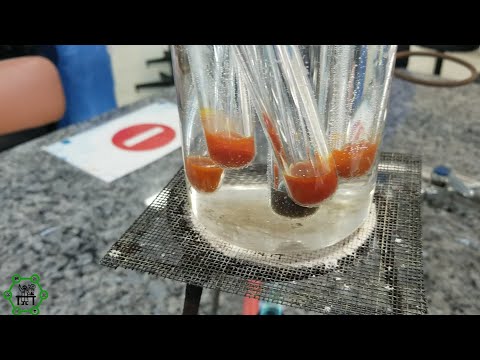
- After placing the test tubes in a water bath for one or two minutes, initial observations show that glucose starts changing color towards reddish, indicating a positive reaction early on compared to others like fructose and maltose which also begin changing but at different rates.
Results Interpretation
- As time progresses, both glucose and fructose exhibit significant color changes towards reddish hues indicative of positive tests; however, sucrose remains unchanged due to its non-reducing nature—highlighting that it does not possess the necessary hydroxyl group after glycosidic bond formation during disaccharide synthesis. This explains why it does not react positively in the Fehling test despite being part of the tested samples.
Conclusion on Test Outcomes
Summary of Findings
- The problem sample containing lactose shows some change indicating potential reactivity due to other present reducing sugars; however, sucrose remains blue throughout indicating no reaction consistent with its classification as a non-reducing sugar. This reinforces understanding regarding sugar classifications based on structural properties affecting reactivity in oxidation tests like Fehling's test.
Future Directions
- The video concludes by mentioning future analyses related to carbohydrates will continue exploring additional reactions such as those involving Trommer’s reagent, suggesting ongoing investigations into carbohydrate chemistry are forthcoming.