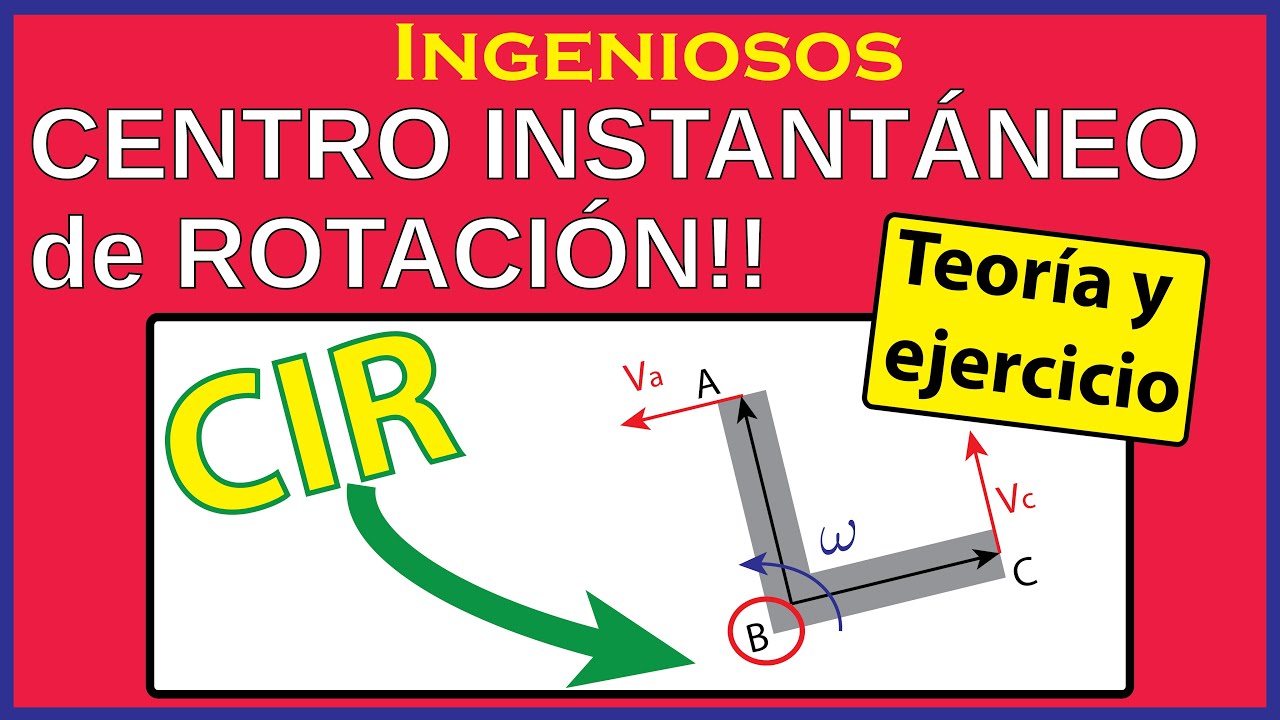
CENTRO INSTANTANEO de ROTACION 😵 Analisis de MECANISMOS
Instantaneous Center of Rotation Method
In this section, the concept of the instantaneous center of rotation method is introduced as a valuable tool for calculating velocities in solid bodies undergoing pure rotational motion.
Understanding Types of Motion
- Differentiates between translational and rotational motions in rigid bodies.
- Explains how linear velocity in a solid body during rotation is determined by angular velocity and distance from the axis of rotation.
Instantaneous Center of Rotation
- Defines the instantaneous center of rotation as a point where the motion of a solid body is purely rotational at a specific instant.
- Emphasizes that this center varies with time but aids in quickly determining velocities at a given instant.
Application: Velocity Calculation
This part delves into applying the instantaneous center of rotation method to calculate velocities in mechanisms.
Applying the Concept
- Illustrates how to find the instantaneous center for a rotating and translating solid to determine velocities.
- Describes using angular velocity and distances to calculate linear velocities in different points of a solid body.
Example: Mechanism Analysis
The example demonstrates applying analytical methods to determine linear velocity in a mechanism using the instantaneous center concept.
Problem Solving
- Introduces an exercise involving finding linear velocity using the instantaneous center for two elements in a mechanism.
New Section
In this section, the speaker discusses the vector connecting points C1 and B in relation to geometry, incorporating angular velocity and direction components.
Vector Analysis for Point B
- The vector connecting C1 with B is calculated as -0.2cos(30) in the x-direction and 0.2sin(30) in the y-direction.
- Correctly substituting coordinates and considering negative angular velocity due to opposite rotation direction yields the velocity vector of point B.
- Point B is also a part of link 2, establishing a connection with the end of this element to determine the angular velocity of element 2.
New Section
This segment focuses on relating point B as part of link 2 to derive the angular velocity of element 2 through vector multiplication.
Linking Point B to Element 2
- Point B belongs to link 2, necessitating its association with the end of this element for calculating the angular velocity of element 2.
- Angular velocity for element 2 is obtained through vector multiplication between the angular velocity of element 2 and the vector from CEE2 to B at a 60-degree angle.
New Section
The discussion shifts towards deriving linear velocities by analyzing vectors and distances in different directions.
Deriving Linear Velocities
- Expressing velocities as functions of omega allows for equating velocities in both cases, leading to obtaining positive angular velocity for bar 2.
- Linear velocity analysis involves multiplying vectors originating from C2 to A vertically, resulting in only negative vertical components due to distance AH.
New Section
Exploring linear motion during pure rotational movement around point C2 while considering perpendicularity between points A and C.
Linear Motion Analysis
- Calculations reveal that only vertical components exist when analyzing linear motion around point C2 during pure rotational movement.
- The linear speed during pure rotational motion around C2 remains perpendicular to the line joining both points, resulting in horizontal speed directed positively.
New Section
Addressing limitations related to acceleration analysis using instantaneous center method and transitioning towards analytical methods if needed.
Acceleration Analysis Limitations