D Seminario 4 A Digestión y absorción de nutrientes e hidroelectrolítica UA2 FMED UBA
Digestión y Absorción de Nutrientes
Introducción a la Digestión
- Rodrigo Bilbao introduce el tema de la digestión y absorción de nutrientes, destacando que esta es la cuarta clase sobre el sistema digestivo.
- Se explica que los alimentos deben ser transformados en sus formas más simples para ser absorbidos; por ejemplo, las proteínas se convierten en aminoácidos.
Proceso de Transformación de Nutrientes
- Los polisacáridos (hidratos de carbono) se absorben como monosacáridos, mientras que los lípidos complejos se convierten en lípidos simples.
- La clase se centrará en cómo los glúcidos son digeridos y transformados desde polisacáridos hasta monosacáridos para su absorción.
Composición Dietética
- En una dieta normal, los polisacáridos constituyen entre el 45% y 60%, siendo el almidón el más común. Otros tipos incluyen disacáridos (30%-40%) como sacarosa y lactosa.
- Aunque también se pueden consumir monosacáridos directamente, la mayoría de los carbohidratos consumidos requieren un proceso digestivo para ser absorbibles.
Digestión Enzimática
- La digestión comienza con los polisacáridos que deben convertirse en monosacáridos para permitir su absorción efectiva.
- El primer nivel de digestión ocurre en la luz del tubo digestivo donde las enzimas comienzan a actuar sobre los alimentos ingeridos.
Etapas del Proceso Digestivo
- En la boca, la amilasa salival inicia la digestión de carbohidratos al transformar almidón en maltosa y otros azúcares más simples.
- Al llegar al estómago, no hay enzimas específicas para carbohidratos; solo se digieren proteínas. La función del esófago es únicamente transportar alimentos hacia el estómago.
Máxima Digestión en el Duodeno
- El duodeno es crucial para la digestión máxima debido a las secreciones pancreáticas. Aquí actúa principalmente la amilasa pancreática.
- La amilasa pancreática tiene mayor actividad que la salival, continuando con la transformación del almidón en disacáridos y oligosacáridos.
Necesidad de Monosacáridos para Absorción
- A pesar de haber generado disacáridos y oligosacáridos, estos aún no son absorbibles; necesitan ser convertidos a monosacáridos.
- Tanto la amilasa salival como pancreática actúan sobre enlaces alfa 1→4 pero no pueden romper enlaces 1→6, lo cual limita algunos productos finales.
Continuación del Proceso Digestivo
Digestive Enzymes and Absorption Mechanisms
Role of Brush Border Enzymes
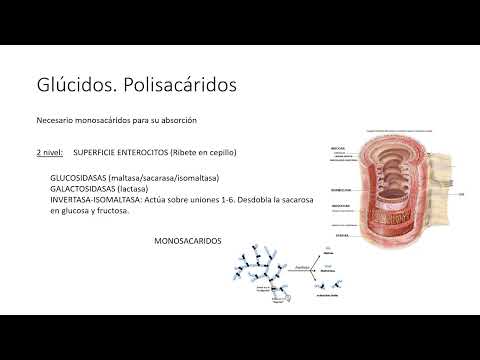
- The brush border is no longer just an enzyme that interacts with light; it plays a crucial role in digesting disaccharides and oligosaccharides at the intestinal wall.
- Specific enzymes like maltase, sucrase, isomaltase, and lactase act on these carbohydrates to break them down into monosaccharides such as glucose and fructose.
Monosaccharide Absorption Process
- Once carbohydrates are broken down into monosaccharides, they can be absorbed through the intestinal lining using secondary active transport mechanisms.
- This process requires energy but does not directly use ATP; instead, it relies on sodium gradients created by other energy-consuming processes.
Sodium-Glucose Co-Transport Mechanism
- The absorption of glucose occurs via a sodium-glucose co-transporter (SGLT1), which utilizes the sodium gradient to facilitate glucose entry into enterocytes.
- High concentrations of both glucose and sodium in the intestinal lumen drive this absorption process.
Importance of Sodium-Potassium Pump
- The sodium-potassium pump actively transports three sodium ions out of the cell while bringing two potassium ions in, creating a low intracellular sodium concentration.
- This gradient allows for efficient uptake of sodium from the lumen into enterocytes, which subsequently drives glucose absorption.
Fructose Absorption Mechanism
- Unlike glucose, fructose enters cells through a specific transporter called GLUT5 without relying on sodium gradients.
- Both glucose and fructose are ultimately transported into the bloodstream after their respective absorption processes are completed.
Summary of Carbohydrate Digestion and Absorption
- Glycogen digestion begins with salivary amylase and pancreatic amylase breaking it down into dextrins or oligosaccharides before further digestion by brush border enzymes.
Understanding Protein Digestion
The Role of Polypeptides in Digestion
- Proteins are composed of polypeptides, which are chains of amino acids linked by various bonds. Direct absorption of polypeptides is not possible; they must be broken down into simpler forms, specifically free amino acids.
Initiation of Protein Digestion
- The digestion process begins in the intestinal lumen, where specific enzymes act on polypeptides to break them down into simpler components for absorption at the enterocyte level.
Enzymatic Action in the Stomach
- Initial protein digestion occurs in the stomach with pepsinogen, an inactive enzyme that activates to pepsin at acidic pH levels (around 3.5), facilitating protein breakdown.
- Pepsin is classified as an endopeptidase, meaning it cleaves peptide bonds within the polypeptide chain, producing smaller peptides rather than free amino acids.
Activation and Functionality of Pepsin
- Pepsinogen is stimulated by aromatic amino acids and requires a high concentration of food (especially proteins) for optimal activation and function during digestion.
Progression to Duodenum and Pancreatic Enzymes
- After gastric digestion, food moves to the duodenum where pancreatic enzymes further digest proteins. These include both endopeptidases (like trypsin and chymotrypsin) and exopeptidases (like carboxypeptidase).
Further Breakdown of Peptides
- Exopeptidases can release free amino acids from peptide ends while endopeptidases continue breaking down larger peptides into smaller fragments.
Final Stages of Digestion at Brush Border
- At the brush border of enterocytes, additional enzymes such as dipeptidases and tripeptidases convert small peptides into dipeptides or tripeptides suitable for absorption.
Mechanism for Amino Acid Absorption
Digestive Mechanisms of Peptides and Lipids
Absorption of Peptides and Amino Acids
- The entry of peptides and amino acids into the enterocyte occurs through secondary active transport, similar to glucose absorption, utilizing a sodium gradient.
- Sodium ions facilitate the co-transport of dipeptides and tripeptides into the enterocyte from the intestinal lumen.
- This process relies on energy generated by the sodium-potassium ATPase pump, which maintains low intracellular sodium levels, creating a favorable gradient for sodium influx.
- Once inside the enterocyte, soluble peptidases convert dipeptides and tripeptides into free amino acids that can then be absorbed into the bloodstream.
- An alternative mechanism for amino acid absorption involves hydrogen ion co-transport, leveraging a similar kinetic process as sodium transport.
Transport Systems for Amino Acids
- There are four specific transport systems for neutral amino acids, basic amino acids, acidic amino acids, and glycine; each system is crucial for proper nutrient absorption.
- Any dysfunction in these transport channels can lead to specific diseases related to impaired amino acid absorption.
Digestion of Lipids
Initial Stages of Lipid Digestion
- Lipid digestion begins in the mouth with lingual lipase secreted by accessory glands that initiate minimal hydrolysis of triglycerides.
- Gastric lipase continues this process in the stomach but is not as effective as pancreatic lipase found in the duodenum.
Role of Pancreatic Enzymes
- The primary enzyme responsible for lipid digestion is pancreatic lipase, which digests approximately 90% of dietary lipids. Other enzymes include carboxyl ester hydrolase and phospholipase A2.
Activation Requirements for Pancreatic Lipase
- Pancreatic lipase requires an alkaline pH (around 8), typically achieved through bicarbonate secretion in the duodenum. Additionally, colipase is necessary to prevent inhibition by bile salts during lipid digestion.
Challenges in Lipid Digestion
Digestive Process of Lipids
Types of Micelles in Lipid Digestion
- The formation of micelles is categorized into three types: endogenous, exogenous, and mixed. Endogenous micelles are formed from lipids produced by the body, while exogenous micelles originate from dietary lipids. Mixed micelles combine both sources.
- Endogenous micelles contain lipids derived from bile components such as cholesterol, phospholipids, and bile salts. These lipid components play a crucial role in digestion.
Structure and Function of Micelles
- Micelles have a unique chemical structure where hydrophobic elements are oriented inward and hydrophilic elements outward. This configuration allows them to travel through soluble environments like blood or water.
- The classic example of lipid droplets can be observed when cleaning greasy surfaces with water; small lipid droplets form due to their encapsulation within the aqueous environment.
Interaction Between Endogenous and Exogenous Micelles
- Endogenous micelles release their contents in the duodenum but require motility for effective solubilization. Without proper mixing, these lipids cannot be utilized efficiently.
- Exogenous micelles consist of dietary lipids that cannot travel freely through the digestive tract; they aggregate into small balls to facilitate movement through the intestines.
Formation of Mixed Micelles
- When exogenous micelles reach the duodenum, they combine with endogenous ones to form mixed micelles—this process enhances lipid solubilization by combining dietary fats with bile salts.
- The combination leads to increased emulsification and solubilization of dietary lipids, allowing pancreatic lipase access for digestion.
Importance of Lipase in Digestion
- Pancreatic lipase acts on these mixed micelles to convert complex lipids into simpler forms necessary for absorption. This enzymatic action is critical for effective lipid digestion.
- If there is a failure in bile salt secretion, it results in poor lipid absorption leading to conditions like steatorrhea (fatty stools).
Absorption Mechanism Post-Digestion
- Once digested into simple lipids, they require sodium transport mechanisms for absorption across intestinal cells (enterocytes). Simple lipids can diffuse easily across cell membranes.
- Inside enterocytes, simple lipids are reassembled into complex forms (e.g., triglycerides), which then associate with proteins to form chylomicrons for transport.
Transport Pathways for Lipid Absorption
- Chylomicrons carry absorbed complex lipids via lymphatic circulation before entering portal circulation towards the liver for utilization within the body.
- A review highlights that short-chain fatty acids can be absorbed directly during stomach digestion while more complex fatty acids undergo further processing in the small intestine before reaching systemic circulation.
Digestive Processes of Lipids, Proteins, and Carbohydrates
Overview of Digestion Levels
- The digestion of lipids, proteins, and carbohydrates occurs at different levels within the body. Lipids are absorbed at the intestinal level and enter the hepatic system through microns.
- Complex lipids have a singular nominal level for digestion, making them less challenging to digest compared to other macromolecules.
Carbohydrate Digestion
- Carbohydrates undergo digestion in two distinct levels:
- The first level is nominal, which breaks down carbohydrates into disaccharides and oligosaccharides.
- The second level involves surface-level breakdown into smaller pieces to transform them into monosaccharides for absorption.
Protein Digestion
- Proteins are digested through three levels:
- The first level is nominal, where proteins are broken down into smaller peptides.
- The second level occurs at the surface where further breakdown happens.
Turn any video into a summary like this
YouTube links, meetings, lectures — with transcripts, search, and chat.