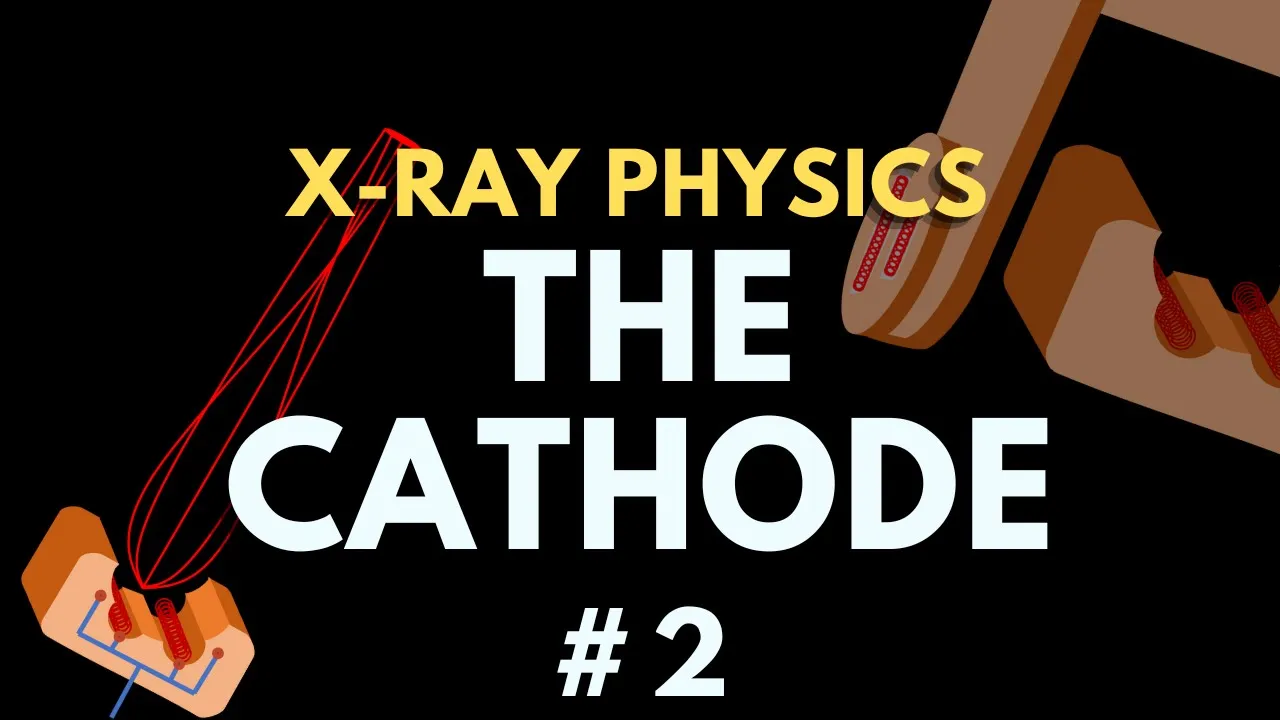
Cathode and Focusing Cup | X-ray Machine | X-ray physics #2 | Radiology Physics Course #9
Overview
In this section, the speaker delves into the detailed workings of the cathode within an X-ray tube, focusing on electron production through thermionic emission and the role of tungsten filaments.
Cathode Functionality
- The cathode is the negative electrode in an X-ray tube responsible for producing electrons via thermionic emission.
- The cathode's primary function is to generate electrons that are then accelerated towards the anode to create x-rays.
Thermionic Emission Process
- Thermionic emission occurs when a current passes through tungsten filament coils, generating heat that excites valence electrons to the surface.
- Tungsten is chosen for its ability to be machined into thin coils with high melting points and a high atomic number conducive to electron production.
Focusing Cap Mechanism
- A focusing cap made of molybdenum or nickel surrounds the tungsten coils, aiding in directing electrons towards a specific area on the anode.
- The focusing cap can be unbiased or biased, with biased caps allowing for more precise control over electron focus without increasing electron release.
Electron Acceleration and Focus
- Voltage applied across the X-ray tube accelerates electrons towards the anode; focusing caps help concentrate these electrons onto a smaller area.
- Unbiased focusing caps repel spread-out electrons towards a smaller area, while biased caps offer independent control over focus intensity.
Anode Functionality
This section will explore how the anode manages heat generated by electron impact and its crucial role in X-ray generation.
Heat Dissipation
- Electrons striking the anode produce significant heat that must be managed effectively to prevent damage.
- Understanding how different types of anodes dissipate heat is essential for maintaining X-ray tube functionality.
Detailed Explanation of Cathode Components
In this section, the speaker delves into the components of the cathode, focusing on why tungsten is used for the filament and molybdenum for the focusing cap, as well as explaining the thermionic process.
Understanding Cathode Components
- Tungsten is utilized for the filament due to its ability to produce heat or electromagnetic radiation like x-rays.
- Tungsten is a preferred material for filaments.
- Molybdenum serves as the material for the focusing cap.
- Molybdenum is chosen specifically for focusing caps.
- The speaker addresses common queries regarding cathodes, emphasizing reasons behind material choices and processes like thermionic emission.
Turn any video into a summary like this
YouTube links, meetings, lectures — with transcripts, search, and chat.