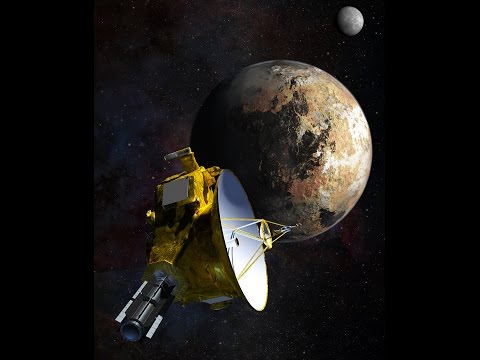
The Year of Pluto - New Horizons Documentary Brings Humanity Closer to the Edge of the Solar System
Introduction
The video introduces the mysterious zone far out in our solar system, which is a region of ice worlds. It talks about the first of these worlds and the one we'll reach in 2015, Pluto.
Journey to Pluto
- NASA's New Horizons mission began in 2006 aboard America's biggest baddest rocket.
- A very light spacecraft was built and bought a very large launch vehicle.
- In some sense, it all began in 1930 with Clyde Tombaugh, who found Pluto.
- The dream of actually getting to Pluto began with a six-year-old boy in love with science who grew up to lead a team of brilliant researchers and engineers.
- Exploring the outer solar system takes a lot of time, patience, dedication, perseverance but it's the frontier.
Arrival at Pluto
- New Horizons wakes up for the last time from hibernation on December 6th, 2014.
- Six months of approach science begins on January 27th, 2015.
- New Horizons' long journey three billion miles nine years in flight and 85 years of speculation about Pluto climaxes in one day of close approach and flyby on July 14th, 2015.
Studying Pluto
- Studying Pluto and its neighbors from Earth is one of the toughest challenges in astronomy.
- It takes time from the discovery of Pluto in 1930 to NASA approving the new horizons mission in 2001 to arriving at the planet in 2015.
- Mark Showalter used Hubble data to discover two new moons around Pluto although he was actually looking for possible rings.
Discovering Rings Around Pluto
- Showalter has found rings associated with small moons around other planets and that was kind of the motivation for checking out Pluto.
- It's easy to take artistic license to show what Pluto's rings might look like in reality it's incredibly hard to see faint objects against the dense background star field and the glare from Pluto and its large moon Carom.
- They came up with a trick where they rotate the camera 90 degrees, take more images, and if done right, all that glare cancels out.
- What they're left with is just the rings. They can think of it as a stack of images looking down so now if they start peeling off the layers and looking downward through the stack things suddenly become much cleaner.
Conclusion
- To be sure you've detected a real moon or planet you have to show it's moving unlike the background stars.
Discovering Pluto's Moons
This section discusses the discovery of Pluto's moons and how it was made possible through patience, persistence, and ingenuity.
Discovery of Hydra and Nyx
- In 2012, Mark Showalter and colleagues discovered two more moons orbiting Pluto.
- The discovery was made by analyzing three time steps of data that showed the movement of the moons in a sequence.
- The movement of Hydra and Nyx indicated that they were little moons of Pluto.
Clyde Tombaugh's Discovery
- Clyde Tombaugh discovered Pluto in 1930 through his work at Lowell Observatory in Flagstaff, Arizona.
- He grew up during hard times and built telescopes using leftover farm implements to check the accuracy of his best telescope.
- One day he used a machine known as a blink comparator to look for anything in his images that moved. On plates taken on January 23rd and 29th, he saw a small dot that did move against the fixed stars.
Charon - Pluto's Moon
- In 1978 astronomers Jim Christie and Bob Harrington analyzed new plates taken at the U.S Naval Observatory in Flagstaff.
- They noted an elongation to the north of Pluto which disappeared one month later. From this evidence, they concluded that Pluto had a moon named Charon.
- Between 1985 and 1990 astronomers captured mutual events between Pluto and Charon which allowed them to calculate their mass and size.
New Class of Objects - Ice Dwarf Planets
- Astronomers estimated that Pluto is perhaps 70% rock and 30% ice making it one of the largest of a whole new class of objects known as ice dwarf planets.
- This region is named for Gerard Kuiper, a leading mid 20th century planetary astronomer who suggested that the solar system didn't end with Neptune.
The Kuiper Belt
This section discusses the discovery of the Kuiper Belt and its importance in understanding the outer parts of our solar system.
Discovery of Kuiper Belt
- Tombaugh's work involved taking carefully registered images of a patch of sky to see if anything moves against the distant stars.
- Teams of astronomers have found around 2000 KBOs (Kuiper Belt Objects).
- Pluto was considered an odd object at the edge of our solar system until other KBOs were discovered, leading to a new classification for these objects.
- The Kuiper Belt is more like a doughnut bulging up above and down below the ecliptic where most planets move. It has hundreds of times more objects than the asteroid belt.
Five Named KBOs
- Pluto was one of the first KBOs discovered, about 1000 km in diameter, covered in water ice methane and ethane with a tiny moon.
- Eris is close in size to Pluto and made up of rock and methane ice.
- Makemake has one of the more highly inclined orbits relative to the plane of our solar system.
- Haumeo is shaped like an American football made up rock and ice with two moons orbiting it.
- Sedna has one of the strangest orbits among all KBO's known so far.
Oort Cloud
- The Oort Cloud is an immense ice box of long-period comets from 10 to 100 times more distant than the Kuiper Belt, surrounding all the known worlds of our solar system.
- It is a real record of the early history of the solar system out there in cold storage at the edge of the solar system.
New Horizons Mission
This section discusses the challenges faced by NASA's New Horizons mission to explore Pluto and its moons.
Getting to Pluto
- The New Horizons mission was approved in 1989, and it took many years of effort to design, build, and deliver it to launch on time.
- By July 2015, we will know for sure what Pluto and its moons look like, providing breakthrough information on all those other ice dwarf planets that make up the Kuiper Belt.
- The spacecraft had to travel over three billion miles through space before reaching Pluto.
- The journey took nine years with a flyby lasting only a few hours.
The Journey to Pluto
This section describes the journey of New Horizons, a spacecraft that was sent to explore Pluto and its moons. It talks about how the idea for the mission came about and the challenges faced in making it a reality.
The Birth of an Idea
- In 1989, Alan Stern, a graduate student, asked Jeff Briggs why NASA wasn't studying a mission to Pluto.
- Young grad students like Alan Stern thought differently from the scientific establishment in the 70s who weren't convinced that Pluto was interesting.
- A small band of enthusiasts became known as the "Pluto Underground" and campaigned hard to make the case for exploring this little planet with all its moons.
The Long Road to Reality
- There were many competing plans for a Pluto mission throughout the 90s but they were on then off then on then off.
- Finally, after competitive proposals were evaluated, New Horizons was selected by NASA on November 29th, 2001.
- Together, seven science instruments comprise the most powerful set of detectors ever sent on a first flyby of any world in our solar system.
The Mission Objectives
- The key objective is to get up close and personal with Pluto and Karen to answer basic questions such as what do they look like? What are they made of? How do their atmospheres behave?
- Seven science instruments will be used including long-range imager Laurie for navigation approaching Pluto and close-up views during flyby. Wide-angle camera Ralph has both visible light and infrared sensors to map Pluto and Karen's icy surfaces. Two fields and particles detectors will probe the solar wind at Pluto. The large radio antenna is an essential communications device but both REX and ALICE and ultraviolet imaging spectrometer are part of experiments to analyze Pluto's atmosphere.
Preparing for Launch
The transcript discusses the preparations that were made before launching the New Horizons spacecraft to Pluto.
Testing the Spacecraft
- Engineers at Johns Hopkins APL and NASA's Goddard Space Flight Center worked on testing the spacecraft.
- The spacecraft was tested on a vibration table to ensure it could withstand the journey.
- Young people were trained and tested as human operators for the mission plan.
Launching New Horizons
- New Horizons was launched from Cape Canaveral using America's most powerful rocket, Atlas V.
- The Department of Energy delivered an RTG that would power the Pluto mission by turning heat from radioactive decay into electricity.
- After 17 years of planning, building, and testing, New Horizons was launched successfully.
Journey to Pluto
This section covers New Horizon's journey to Pluto.
Velocity at Launch
- New Horizons traveled almost 60 times faster than a jetliner in just nine hours after launch.
Jupiter Flyby
- A slingshot gravity assist from Jupiter provided another two kilometers per second boost cutting travel time to Pluto by three full years.
- The Jupiter flyby was a scientific dress rehearsal for Pluto.
Encounter Rehearsal
This section covers an encounter rehearsal conducted in 2013.
Rehearsal Details
- A nine-day encounter rehearsal was conducted in July 2013.
- The rehearsal was designed to test the spacecraft's activities as if it were at Pluto, with everything the same except that Pluto wasn't there.
- The rehearsal involved uploading commands to New Horizons to instruct the spacecraft to run through the exact same set of observations as in 2015.
Introduction
The team is 10 million miles out from Pluto and closing in. They express gratitude for the work done so far, and it's the 2724th day of flight.
Preparing for Encounter Day
- A minute-by-minute simulation of encounter day is shown.
- Encounter day is make or break, as it involves intense activities that have been running on the spacecraft.
- New Horizons has been firing its thrusters and spinning in space identical maneuvers to those planned for 2015.
- DSS 43 should lock up on the signal within the next minute.
Expectations for Pluto
- All observations planned between last track and this track happened, giving confidence that the spacecraft has been performing all anticipated twists and turns over the last seven days.
- The team expects to learn only about Pluto during flyby, not about ground systems or spacecraft. Most everything they think they know about Pluto and its moons is up for grabs.
- No one knows exactly what Pluto looks like, but it looks exciting from images taken by Hubble Space Telescope.
Surprises Await
- Virtually every place we've sent a spacecraft on a first reconnaissance mission like this, we find out that our earth-based notions were flat wrong.
- Planetary scientists expect to be surprised when New Horizons arrives at Pluto. Paul Shank based his expectations on what was seen when Voyager 2 reached Neptune.
Triton: A Preview of What's to Come?
- Voyager was a ten-year-long exploration of the outer solar system, and every time they got to a planet, it was basically the first time anybody had really seen those bodies.
- By the time Voyager 2 reached Neptune, they were accustomed to being surprised. Triton completely blew them away with its odd patches and geysers spurting material off into space.
Enceladus and Pluto
This section discusses the characteristics of Enceladus and Pluto, including their energy sources, potential for oceans beneath their icy shells, and the possibility of seeing landscapes like those on Earth.
Characteristics of Enceladus
- Enceladus is a tiny moon about 300 miles across.
- It has huge ice volcanoes spewing out from its south pole.
- Enceladus reflects almost all the radiation that falls on it.
- It continuously gives off puffs of water vapor.
Energy Sources for Pluto
- Radioactive decay inside rock is one source of energy that powers volcanoes in the deep freeze of the outer solar system.
- If you let Pluto sit there and pump heat out of the rocks, you generate enough energy to melt a couple hundred kilometers worth of ice.
- Over billions of years, as Pluto cools, its ice shell gets thicker and thicker. This causes it to squeeze water underneath which can create fractures allowing water to get out to the surface.
Potential for Oceans Beneath Icy Shells
- It's still possible to have an ocean beneath a relatively thick icy shell.
- Erosion shapes landforms here on Earth and all across the solar system. There are these little finger-like projections that are formed by erosion where wind and water have sculpted this landscape by taking advantage of small differences in the strength of the original rock. We can anticipate that we may perhaps also see landscapes like this on Pluto and its moons.
Characteristics of Pluto
- Pluto's 248-year orbit is more eccentric than our solar system's terrestrial and gas giant planets, greatly varying its distance to the sun.
- Its highly angled polar tilt combined with its orbit produces strong seasonal effects. The seasons on Pluto are amongst the most extreme of any world that we know of orbiting the sun.
- Pluto's surface is extremely contrasty, perhaps the most intensely bright and dark place that we've seen in the solar system. This dark surface collects more heat, warming up like asphalt does on a sunny day here on Earth.
Color Clues to Surface Composition
- For planetary scientists, color can be a clue to the composition of surfaces that can't be sampled directly on Earth.
- On Pluto, there are ranges of colors from gray to bright white to yellow to red to black. These colors must be due to a completely different process than rust formation which generates similar colors from red to dark gray.
Overall, this section provides an overview of Enceladus and Pluto's characteristics including their energy sources, potential for oceans beneath their icy shells, and what we might expect to see when studying them.
Irradiating Ices on Pluto
The section discusses how irradiating ices can help interpret the close-up views of Pluto's surface that will be sent back by New Horizons. It also talks about how radiation transforms simple ices into complex and colorful organic molecules.
Radiation Transforms Simple Ices
- Irradiating ices is fairly close to what we see on Pluto.
- The material turns yellow, light brown, up through fairly dark red.
- If processed by ultraviolet light to an extreme degree, the material turns black.
- This almost resembles the color of pure carbon.
Understanding Pluto's Surface
- Color translates to the duration of exposure of these otherwise colorless ices over a year, 10,000 years or even 10 million years.
- This may tell us more about the nature and age of Pluto's surface.
New Horizons' Mission
- Dale Crookshank began observing Pluto in 1976 and now he is ready for its close-up.
- We don't know yet if it's geologically active and dynamic but that's what New Horizons is going to tell us.
- As we've passed other planetary bodies before, we had thought were totally cold dead inert worlds but found evidence for geological activity such as geysers, ice flows, cracks and more.
Exiting Hibernation
The section discusses how New Horizons exits hibernation after two-thirds of its three billion mile journey. It also talks about the benefits of hibernation and how it lowers costs.
Exiting Hibernation
- On December 6, 2014, in mission control, Alice Bowman and her team wait to get confirmation that New Horizons has exited hibernation.
- Most spacecraft systems have been turned off saving wear and tear on the science instruments.
- New Horizon sends a simple signal once a week just to say "I'm still A-OK."
- If all goes well, this will be the 18th time spacecraft and bear have woken up.
Benefits of Hibernation
- Alan explains the benefits of hibernation. It lowers our cost because we don't need to have people babysitting the spacecraft 24/7.
- Outside interest in New Horizons is building.
First Science Images
The section discusses how Hal Weaver and Andy Ching will be seeing new science images for the first time. It also talks about how Glory is used for navigation to find targets and correct trajectory.
Seeing New Science Images
- On January 27th, New Horizons has been sending back technical data and all seems fine but today is the first time Hal Weaver and Andy Ching will be seeing new science images.
- Chang is lead scientist for the LORRI camera which is used for navigation to find targets and correct trajectory so they get to the right place at the right time.
- Voltage currents temperatures all look normal no error messages this is it let's check out the very first images.
The Start of the Mission
The mission to Pluto is about discovering what the surface of Pluto looks like, how big it is, and what its orbits are. There may be delightful surprises in store for the team.
What to Expect
- The mission aims to discover what the surface of Pluto looks like, how big it is, and what its orbits are.
- The team expects delightful surprises during their mission.
Identifying Small Moons and Possible Rings
As New Horizons gets closer to the Pluto system, Lori will be able to identify small moons and possible rings that can't be seen from Earth.
Identifying Moons and Rings
- Lori will be able to identify small moons and possible rings that can't be seen from Earth as New Horizons gets closer to the Pluto system.
Unknown Hazards
John Spencer leads the UHAS campaign (Unknown Hazards). They may find new moons or even rings around Pluto. If they see anything that poses a threat to the spacecraft, they want to evaluate that hazard and determine whether they should take any evasive action.
Evaluating Threats
- John Spencer leads the UHAS campaign (Unknown Hazards).
- They want to evaluate any hazards posed by new moons or rings around Pluto.
- If there's debris that might damage or kill the spacecraft, they want to determine whether they should take any evasive action.
Protecting the Spacecraft
To protect the spacecraft from even tiny dust particles, the mission sent samples of spacecraft components to the White Sands Test Range. Technicians at White Sands set up gun tests to assess how vulnerable New Horizons' outer covers and cables might be. The team has options to take evasive action if necessary.
Protecting Against Dust Particles
- Samples of spacecraft components were sent to the White Sands Test Range.
- Technicians at White Sands set up gun tests to assess how vulnerable New Horizons' outer covers and cables might be.
- If necessary, they can orient the spacecraft so that the high gain antenna is facing forward in the ram direction, protecting it from dust particles.
Limitations on Photographing Objects
The cameras are fixed to the spacecraft, so it can only point in one direction. This limits the amount of times they can photograph objects as they go past because they can only photograph objects when they're just in the right angle that they can look at them while protecting the spacecraft with the main antenna.
Limitations on Photography
- The cameras are fixed to the spacecraft, so it can only point in one direction.
- They can only photograph objects when they're just in the right angle that they can look at them while protecting the spacecraft with the main antenna.
Backup Plans for Trajectories
Another option is to take different trajectories through Pluto's system. That's called Shabbat play. Shabbat is the best acronym in the space business. It stands for Safe Haven by Other Trajectory, and it is the word they use to represent their backup plans at Pluto.
Backup Plans
- Another option is to take different trajectories through Pluto's system.
- That's called Shabbat play.
- Shabbat stands for Safe Haven by Other Trajectory, and it is the word they use to represent their backup plans at Pluto.
Readiness Test
In February 2015, Spencer's UHAS team, including ring specialist Mark Showalter and postdoc Simon Porter, are running through a readiness test. They're on the clock and being scored for whether they can work through calculations fast enough to decide on a trajectory correction maneuver that might prevent loss of mission.
Testing Readiness
- In February 2015, Spencer's UHAS team is running through a readiness test.
- They're being scored for whether they can work through calculations fast enough to decide on a trajectory correction maneuver that might prevent loss of mission.
The Year of Pluto Begins
For the science team, the year of Pluto began with another meeting to review the latest data on the Pluto system and hear updates on how the spacecraft was performing. Mission manager Glenn Fountain summarized remaining risks; red boxes are possibilities that could kill the mission.
Reviewing Data
- The year of Pluto began with another meeting to review data on the Pluto system and hear updates on how the spacecraft was performing.
- Mission manager Glenn Fountain summarized remaining risks; red boxes are possibilities that could kill the mission.
The Making of New Horizons Mission
In this section, the speaker talks about the team's hard work and confidence in testing the sequences for the mission. They also discuss the sense of history in making this mission happen.
Team Effort
- The team is made up of talented people who have worked very hard to test the sequences inside and out.
- There was a sense of history in making this mission happen.
Coherent Team
- A coherent team is essential to operate the spacecraft and do planning.
- Younger people with the right amount of experience were selected early on in the mission to be part of it.
Planning for Pluto Encounter
In this section, the speaker discusses how important it is to have a good team for operating spacecraft and planning. They also talk about how they planned for exploring Pluto and beyond.
Mission Planning
- Having a good team is crucial because without one, you will fail.
- Planning started early on in the mission to ensure that younger people with enough experience were part of it.
Exploring Beyond Pluto
- New Horizons was recommended as a mission that might continue farther out into Kuiper Belt after exploring Pluto in 2015.
- Identifying potential targets for a more distant flyby was challenging but assigned to John Spencer, Mark Bowie, and their team using innovative search techniques using custom software.
Finding Potential Targets
In this section, the speaker talks about how they identified potential targets for a more distant flyby. They also discuss the challenges they faced and how they overcame them.
Identifying Potential Targets
- Identifying potential targets for a more distant flyby was challenging.
- John Spencer, Mark Bowie, and their team used innovative search techniques using custom software to identify potential targets.
Challenges Faced
- Earth's atmosphere is just a mess at these scales, making it difficult to identify potential targets.
- Hubble was used as a last resort to identify potential targets.
Discovering Kuiper Belt Objects
In this section, the speaker discusses how they discovered Kuiper Belt objects and the challenges they faced in doing so.
Discovering Kuiper Belt Objects
- Mark Bowie and his young collaborators came up with innovative search techniques using custom software to discover Kuiper Belt objects.
- The technique involved flipping around stars to make them appear to move while any KBO stands still right in the middle of it.
Challenges Faced
- Finding a KBO was only half the battle; it had to be located where New Horizons could reach it with available fuel.
- With more Hubble time, New Horizons got a pleasant surprise that looked like they might actually have to burn engines to miss an object which was pretty exciting concept because you wouldn't want to run into one of these things - these cold classicals are pretty much as they were 4.5 billion years ago - little fossils!
Final Thoughts
In this section, the speaker talks about their feelings of exhilaration and excitement as they prepare to explore Pluto.
Preparing for Pluto Encounter
- The team is feeling pretty exhilarated at this point, knowing that they are about to go on a thrilling ride into the unknown.
- With potential targets found at last, it was time to head towards Pluto.
New Horizons Mission: Completing the Pluto Flyby
In this section, Dr. Alan Stern talks about the completion of the New Horizons mission and how it feels to be part of a team that has been working on it for over a decade.
The Completion of the Objective
- The New Horizons mission is completing its objective by accomplishing the flyby of the Pluto system for the first time.
- This marks both an ending and a beginning - an ending in that they are completing their objective, but also a beginning of a whole new chapter for science as they explore these objects.
Delayed Gratification
- The team had to wait for four years before they could begin the encounter with Pluto.
- Having waited so long, Dr. Stern describes this moment as "showtime" and says that they are ready to go.
A Career Worthwhile
- Dr. Stern describes visiting Pluto as "putting the capstone on the initial reconnaissance of the solar system".
- He adds that it feels like something that makes a career worthwhile.
Exploring Uncharted Territory: The Kuiper Belt
In this section, Dr. Alan Stern talks about exploring uncharted territory in space and how young people can gain experience through programs like New Horizons.
Unexplored Area
- Dr. Stern explains that going to Pluto is exciting because it is part of what he calls "the most unexplored area of the entire solar system".
- He adds that this is also "the most unknown area that we as humans can reach with spacecraft".
The Next Generation of Explorers
- Dr. Stern talks about the younger scientists who have gained experience through programs like New Horizons.
- He says that these young people will be the next generation of explorers.
Conclusion
The New Horizons mission has been a long and exciting journey for Dr. Alan Stern and his team. They have accomplished their objective by completing the flyby of Pluto, which marks both an ending and a beginning for science. The Kuiper Belt is an unexplored area of space, but programs like New Horizons are helping to change that by giving young people the opportunity to gain experience and become the next generation of explorers.
Turn any video into a summary like this
YouTube links, meetings, lectures. With transcripts, search, and chat.