Cervical Flexion & Extension BIOMECHANICS
Cervical Flexion and Extension: Biomechanics Explained
Introduction to Cervical Flexion
- The video introduces the topic of cervical flexion, emphasizing its importance in anatomy and physiology.
- Cervical flexion is described as the action of bending the neck forward, akin to nodding "yes."
Anatomical Changes During Cervical Flexion
- The cervical spine's anatomy is highlighted, particularly C1 (the atlas), which lacks a spinous process and has a posterior tubercle. Spinous processes begin at C2.
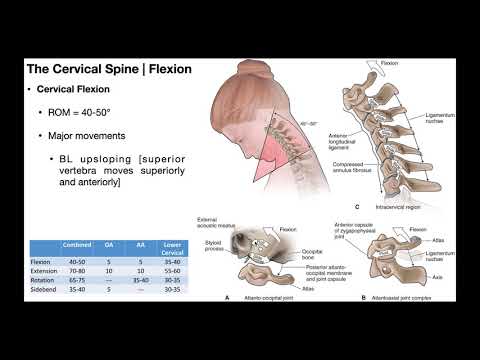
- During cervical flexion, spinous processes separate; this results in a smaller anterior surface and a larger posterior surface due to the forward bend.
- The nuchal ligament becomes taut during cervical flexion, contributing to the restriction of this movement alongside other structures.
Effects on Ligaments and Discs
- The anterior longitudinal ligament experiences laxity during cervical flexion due to reduced length on the anterior side.
- Compression occurs in the annulus fibrosis of intervertebral discs anteriorly during cervical flexion, though it is not pathological.
Facet Joints Dynamics
- Each level of the cervical spine has two facet joints that undergo upsloping during flexion; this involves superior vertebrae moving both superiorly and anteriorly relative to those below.
- Upsloping increases space within facet joints, allowing for more room between articulating surfaces.
Intervertebral Foramina Implications
- Superior movement of vertebrae also enlarges intervertebral foramina where nerve roots exit; thus, individuals with radiculopathy may prefer cervical flexion over extension for relief.
Atlanto-occipital Joint Mechanics
- Flexion occurs at atlanto-occipital joint as occipital condyles roll anteriorly while sliding posteriorly on the atlas' concave surface.
- This rolling motion maintains contact between occipital condyles and atlas through convex-concave rules.
Cervical Spine Mechanics: Flexion and Extension
Understanding Cervical Flexion
- The atlas at the atlanta axial joint exhibits an anterior pivot during flexion, separating from the axis's spinous process. This movement has implications for spinal cord disorders.
- In cervical flexion, there is bilateral up sloping of both left and right facet joints, allowing the superior vertebra to move both superiorly and anteriorly.
- The total range of motion for cervical flexion is approximately 40 to 50 degrees, with lower cervical spine levels (C2-C3 to C7-T1) contributing about 35 to 40 degrees.
- The atlanto-occipital and atlanto-axial joints each contribute five degrees to the overall range of motion in cervical flexion.
Transitioning to Cervical Extension
- In contrast to flexion, cervical extension involves bending the neck backward, leading to bilateral down sloping of the vertebrae.
- During extension, spinous processes come closer together—a phenomenon known as approximation—resulting in laxity of the nuchal ligament.
- As spinous processes approximate during extension, tension increases in the anterior longitudinal ligament, which limits further extension due to its extensibility.
Effects on Intervertebral Foramina
- With approximation during extension, intervertebral foramina narrow compared to their wider state during flexion. This narrowing can exacerbate conditions like radiculopathy by compressing nerve roots.
- The inferior movement of vertebrae during extension leads them into a close-packed position; this contrasts with the open-packed position seen in flexion.
Atlanto-occipital Joint Dynamics
- In extension at the atlanto-occipital joint, occipital condyles roll posteriorly relative to the atlas while also sliding anteriorly.
- This rolling action maintains contact between structures as they move in opposite directions during neck extension.
Understanding Atlanto-Axial Joint Movements
Mechanics of Extension and Flexion
- The atlanto-axial joint allows for pivot and extension movements occurring in the same direction, with the posterior tubercle of the atlas and spinous process of the axis coming closer together during cervical extension.
- During extension, as the atlas bends backward relative to the axis, it pivots posteriorly. This movement mirrors what occurs during flexion where an anterior pivot happens.
- The posterior pivoting of the atlas relative to the axis induces stress on the anterior joint capsule of the atlanto-axial joint.
Range of Motion Insights
- The combined range of motion for cervical extension is approximately 70 to 80 degrees, indicating a greater capacity for extension compared to flexion.
- Lower cervical spine segments (C2-C3 down to C7-T1) contribute significantly—55 to 60 degrees—to this range, while both atlanto-occipital and atlanto-axial joints each add about 10 degrees.
Contributions from Various Joints