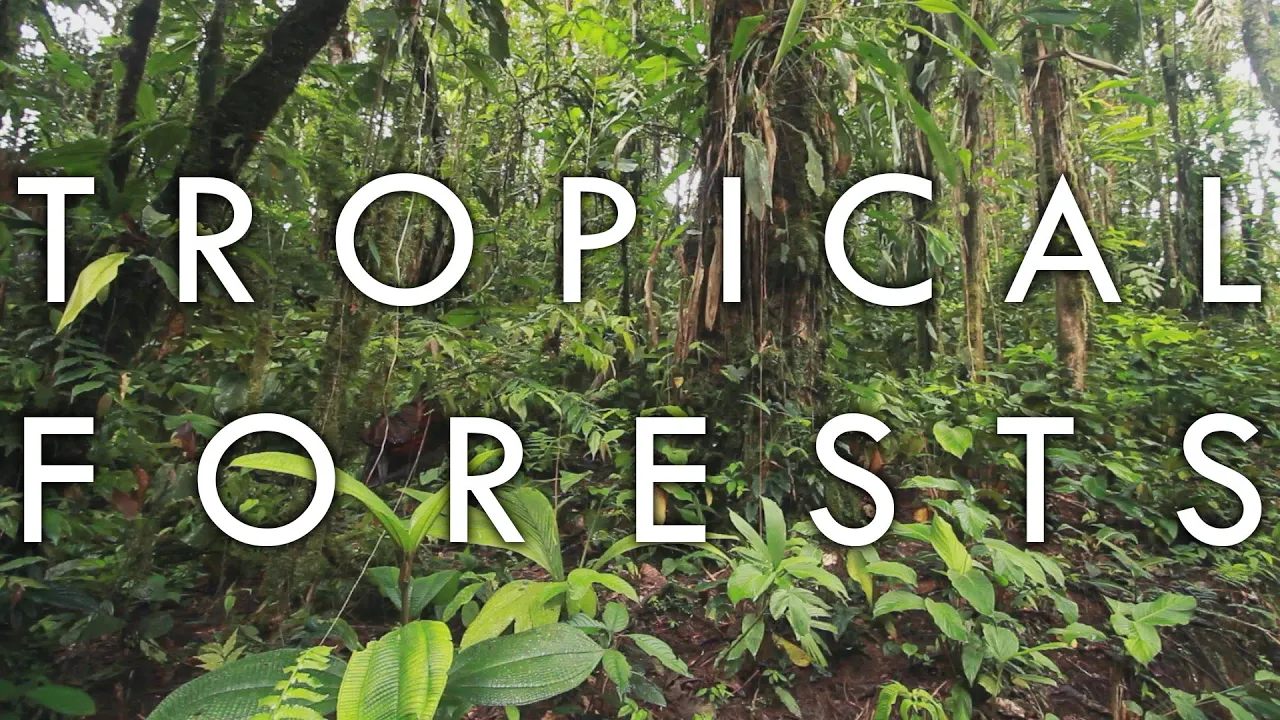
Tropical Rainforest and Tropical Seasonal Forest - Biomes#1
New Section
This section introduces the tropical rainforest biome, highlighting its significance in terms of biodiversity and its role as the "lungs of the world" due to its ability to absorb CO2 and produce oxygen.
The Tropical Rainforest Biome
- The tropical rainforest biome is characterized by constant heat and abundant rainfall, which support vigorous plant growth.
- It is the most biodiverse area on Earth, housing over half of all plant and animal species.
- The biome consists of two distinct types: evergreen forests and seasonal forests.
Characteristics of Tropical Evergreen and Seasonal Forests
- Both types have tall broadleaved hardwood trees dominating the biomass.
- The presence of evergreen or seasonal forest depends on the pattern of rainfall throughout the year.
- Evergreen forests retain their leaves and continue growing throughout the year in areas with minimal or no dry season or extensive flooding after a wet season.
- Seasonal forests shed their leaves to retain internal moisture during noticeable dry seasons without flooding.
Transition from Rainforest to Other Forest Types
- Rainforests can also exist in more temperate latitudes with cooler temperatures.
- As overall rainfall decreases in the tropical band, rainforests give way to progressively drier forests, eventually leading to tropical savannahs.
Layers of a Typical Tropical Forest
- Forest floor: Covered with fallen vegetation that rapidly decomposes due to scavenger insects. Soil is nutrient-poor due to leaching caused by heavy rainfall.
- Undergrowth: Sparse undergrowth due to limited sunlight reaching the ground. Low-lying shrubs with large leaves compete for light.
- Canopy: Dominated by tall trees that form an almost continuous layer. Absorbs over 90% of sunlight falling on the forest. Home to about half of all plant species on Earth.
- Emergent layer: Consists of very tall trees that extend beyond the main canopy. Adapted to withstand intense sunlight and strong winds.
New Section
This section explores the distribution of tropical forests and their relationship with climate zones. It also highlights some exceptions to this relationship.
Distribution of Tropical Forests
- Tropical forests occur only in the tropics, between 23 degrees north and 23 degrees south.
- Evergreen forests are closely associated with the Tropical Rainforest (Af) and Tropical Monsoon (Am) Koppen climate zones, characterized by year-round or most-year-round rainfall.
- Seasonal forests are generally found on the periphery of these climate zones, particularly within the Tropical Savannah (Aw) zone, which experiences longer or more severe dry seasons.
Exceptions to Climate Zone Relationship
- Extensive flooding from the wet season can sustain growth and leaf retention throughout the dry season, leading to exceptions in certain regions.
- Higher altitudes in some areas result in a Subtropical Highland climate type with warm temperatures year-round, allowing trees to maintain their leaves throughout the year.
The remaining part of the transcript is not included in this summary.
New Section
This section provides an overview of the tropical forests in different regions of the world.
Tropical Forests in South America
- South America has the most extensive tropical forests in the world, with the Amazon basin being the most famous.
- The Amazon basin covers an area equivalent to the continent of Europe and extends into Brazil, Guyanas, Venezuela, Colombia, Ecuador, Peru, and Bolivia.
Tropical Forests in Africa
- The Congo basin is home to the second largest contiguous rainforest in Africa.
- West Africa's coast from Nigeria to Senegal has evergreen forests that gradually transform into savannahs.
- Ethiopia and Madagascar also have evergreen and seasonal forests due to favorable climate conditions.
Tropical Forests in Asia
- The Indian Subcontinent has a large area of tropical seasonal forest influenced by wet and dry seasons brought by the Indian Monsoon.
- Southeast Asian countries like Myanmar, Thailand, Laos, Cambodia, and Vietnam have a mix of seasonal and evergreen forests depending on water drainage.
- China's southern coasts and SE Asian archipelagos have a mix of tropical forest types dominated by evergreen forests.
- Indonesia and Malaysia collectively make up the third largest rainforest in the world with dominant evergreen forest cover.
Tropical Forests in Oceania
- Northern and northwestern coasts of Australia have a narrow band of rainforest due to exposure to moist trade winds.
- Pacific islands within the tropical zone have evergreen forests due to moist trade winds.
New Section
This section highlights the biodiversity found in tropical rainforests across different kingdoms of plants and animals.
Biodiversity in Tropical Rainforests
- Tropical rainforests are known for their high biodiversity across all kingdoms of plants and animals.
- Angiosperms (flowering plants) dominate the rainforests, including famous hardwoods like mahogany, teak, ebony, and rosewood.
- Palm family species are also common in tropical rainforests.
- Coniferous trees are relatively rare in these forests.
Seasonal Forests
- Seasonal or "dry" forests have lower biodiversity compared to rainforests.
- In seasonal forests, trees lose their leaves during the dry season, and a single dominant species can be found over wide areas.
Tree Species Distribution
- Tree species distribution is divided into three subkingdoms: Neotropical, African, and Malesian.
- Central and South America have common tree species like mahogany, cedar, myrtle, laurel, palm, acacia, rosewood, and Brazil nut.
- Africa has tree species such as mahogany, ebony, limba (korina), wenge (panga-panga), agba (gossweilerodendron balsamiferum), iroko (milicia excelsa), and sapele (entandrophragma cylindricum).
- Southeast Asia has well-known teak along with dipterocarpus family trees. Other species include durian, sandalwood, and ironwood.
New Section
This section discusses the threats to tropical forests due to human activities.
Destruction of Tropical Rainforests
- Farming is now the greatest threat to tropical forests worldwide.
- Burning land illegally for cattle ranching is carried out in Bolivia and Brazil to circumvent regulations.
- Habitat destruction in Southeast Asia is driven by the demand for palm oil.
Historical Precedents
- Destruction of natural habitats has been a part of human history for thousands of years.
- Examples include the disappearance of forests in England and India or prairies in the USA.
The Future of Tropical Rainforests
- Accommodating the needs of a growing population throughout the tropics is crucial to preserving this precious biome.