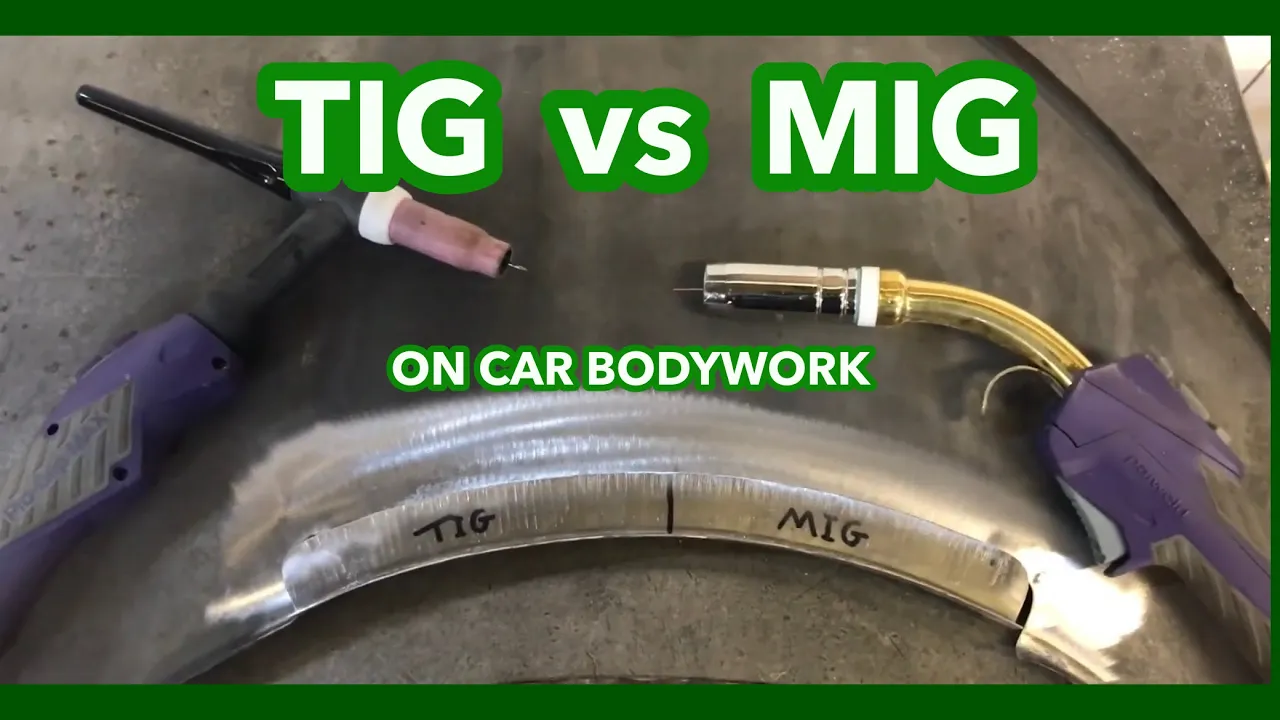
TIG VS MIG ON CAR BODYWORK - a simple guide on how to weld thin car bodywork - parweld
Introduction and Purpose of the Video
The video aims to provide a comparison between MIG and TIG welding techniques on a car body panel. The presenter will demonstrate the processes side by side, highlighting the differences, challenges, and end results.
Comparison of MIG and TIG Welding Techniques
- The video is not a tutorial but rather a comparison to give viewers an idea of what is involved in both MIG and TIG welding processes on a car body panel.
- The presenter introduces the panel that needs repair, explaining that it represents a common scenario in classic car restoration where corroded sections need replacement.
- Before starting the repairs, the presenter emphasizes the importance of preparing the panel properly by softening corners to avoid heat buildup and distortion during welding.
- The old corroded section is cut out, making way for the new panel to be installed.
- Tips are given on leaving no gap for MIG welding while ensuring sufficient penetration without distortion. Different approaches may exist, but this is how the presenter prefers to work.
- A side-by-side comparison of MIG and TIG welding techniques is explained. MIG involves pressing the trigger to feed wire through with gas shielding, creating an arc that melts wire into molten pool for welding. TIG requires precision as it involves striking an arc onto metal using a tungsten electrode and fusing materials together or adding separate filler rod depending on requirements.
- While MIG welding is more beginner-friendly, TIG welding requires more skill and precision. Both techniques have their uses in professional car body work.
- The presenter clarifies that the demonstrated method is their personal approach and not necessarily the only correct way to perform the repairs.
- Different approaches to leaving a gap or having a tight butt joint for MIG welding are discussed, with the presenter preferring a tight butt joint without a gap.
- The presenter begins by tacking the new panel into place, cooling it down after each tack to prevent distortion caused by excessive heat.
- Foreign matter on the panel is removed before proceeding with TIG welding.
Comparison of MIG and TIG Welding Results
- The presenter demonstrates TIG welding, aiming to fuse materials together using minimal filler rod unless separation occurs. Less heat is generated compared to MIG welding.
- Excessive penetration during TIG welding can cause challenges when dressing up the weld later. However, achieving a sealed joint with sufficient strength is essential.
- A comparison between excess material from MIG welding and a well-fused joint from TIG welding is shown.
The transcript provided does not contain any specific timestamps beyond 6 minutes and 2 seconds.
Foreign
The speaker mentions the word "foreign" multiple times.
Foreign
- The speaker mentions the word "foreign" at different timestamps throughout the video.
Cleaning Up with the Mig
The speaker discusses the process of cleaning up with the Mig welding technique, highlighting that more heat is generated compared to Tig welding, which can result in more distortion. However, if one can control the factors involved, they can achieve a clean finish similar to Tig welding.
Cleaning up with the Mig
- Cleaning up with the Mig welding technique generates more heat and may cause more distortion.
- By controlling various factors, it is possible to achieve a clean finish similar to Tig welding.
- Precision is required when using Mig welding for cleaning up.
- The cleaning up process with Mig welding involves very little distortion.
Comparison between TIG and MIG Welding
The speaker briefly compares TIG and MIG welding techniques, emphasizing that both processes can produce indistinguishable results on a panel. This video serves as an introduction for those interested in getting into TIG or MIG welding.
Comparison between TIG and MIG Welding
- Both TIG and MIG welding techniques can produce results that are indistinguishable from each other on a panel.
- The purpose of this video is not to provide a tutorial or specific instructions but rather to give viewers an idea of what to aim for when getting into TIG or MIG welding.
Conclusion and Call-to-action
The speaker concludes the video by thanking viewers for watching and expresses their willingness to create more videos based on viewer suggestions. They also encourage viewers to visit their Instagram channel called "metal shaper Tom."
Conclusion and Call-to-action
- The speaker thanks viewers for watching the video.
- They express their willingness to create more videos based on viewer suggestions.
- Viewers are encouraged to leave comments with ideas or suggestions.
- The speaker invites viewers to visit their Instagram channel, "metal shaper Tom."
- The video concludes with the speaker expressing gratitude and signing off.
Timestamps are provided in seconds for each section.