Glucose Transporters (GLUTs and SGLTs) - Biochemistry Lesson
Glucose Transporters Overview
In this lesson, the speaker discusses glucose transporters, their types, locations in the body, and relevance to whole-body metabolism.
Types of Glucose Transporters
Glucose is hydrophilic due to its many hydroxyl groups, necessitating transporters for cellular membrane passage.
There are two types of transporters: Gluts (14 types) and SGLTs.
Gluts are sodium and ATP independent, found ubiquitously in the body.
SGLTs are sodium-dependent, requiring ATP for glucose transportation into cells; located in the intestine, renal tubules, and blood-brain barrier.
Important Glucose Transporters
Five crucial glucose transporters exist: Glut 1, 2, 3, 4, and 5.
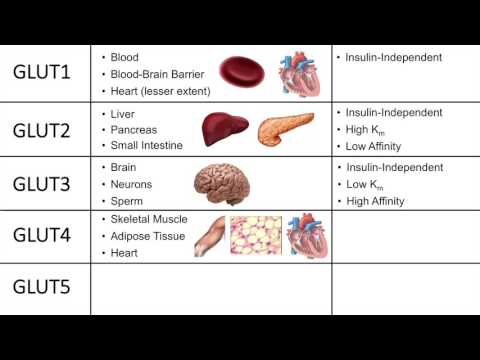
Glut 1 is insulin-independent and found in red blood cells, blood-brain barrier, and heart.
Glut 2 is insulin-independent with high Km found in liver, pancreas, and small intestine.
Glut 3 is insulin-independent with a high affinity for glucose found in the brain and neurons.
Significance of Specific Transporters
Glut 4 outnumbers Glut 1 in the heart by a three-to-one ratio; it is insulin-dependent for glucose uptake into skeletal muscle adipose tissue and heart.
Glut 5 transports fructose in enterocytes of the intestinal epithelium; it is also insulin-independent.
Sodium Dependent Glucose Transporters
SGLT1 facilitates glucose absorption in enterocytes of the intestinal epithelium while SGLT2 aids glucose retention in proximal tubules of nephrons to prevent glucose loss through urine.
Diabetes and Glucose Transporters
In this section, the discussion revolves around the role of glucose transporters, specifically SGLT2 transporters, in diabetes. The focus is on how high blood glucose levels can lead to glycosuria due to transporter saturation.
Role of SGLT2 Transporters
SGLT2 transporters play a crucial role in glucose retention.
In diabetes, high blood glucose levels can saturate these transporters.
Saturation of transporters leads to the loss of glucose in urine.
Video description
Video lesson on glucose transporters, the different types of glucose transporters such as GLUTs and sodium-dependent glucose transporters (SGLTs), where they are found in the body and their relevance in whole-body metabolism.
Hey guys! Here is a lesson on glucose transporters and physiology and location of glucose transporters. I hope you all find it helpful!
Did you find this lesson helpful and informative? If you did, please LIKE this video and SUBSCRIBE for more videos like this one!
JJ
****EXCLAIMER: The content (ex. images) used in this lesson are used in accordance with Fair Use laws and are intended for educational/teaching purposes only.****
*Subscribe for more free medical lessons* https://www.youtube.com/channel/UCFPvnkCZbHfBvV8ApBBE0vA?sub_confirmation=1
-------------------------------------------------------------------------------------------------------------
Try Audible and Get A Free Audiobook
https://www.amazon.com/dp/B00NB86OYE/?_encoding=UTF8&ref_=sv_adbl_subnav_ref1_1
For books and more information on these topics
https://www.amazon.com/shop/jjmedicine
Support future lessons (and get other cool stuff) ➜ https://www.patreon.com/jjmedicine
Follow me on Twitter! ➜ https://twitter.com/JJ_Medicine
Come join me on Facebook! ➜ https://www.facebook.com/JJ-Medicine-100642648161192/
Start your own website with BlueHost ➜ https://www.bluehost.com/track/jjmedicine/
Check out the best tool to help grow your YouTube channel (it’s helped me!)
https://www.tubebuddy.com/jjmedicine
-------------------------------------------------------------------------------------------------------------
Check out some of my other lessons.
Medical Terminology - The Basics - Lesson 1:
https://www.youtube.com/watch?v=04Wh2E9oNug
Medical Terminology - Anatomical Terms:
https://www.youtube.com/watch?v=KkXiE3NEJxw
Fatty Acid Synthesis Pathway:
https://www.youtube.com/watch?v=WuQS_LpNMzo
Wnt/B Catenin Signaling Pathway:
https://www.youtube.com/watch?v=NGVP4J9jpgs
Upper vs. Lower Motor Neuron Lesions:
https://www.youtube.com/watch?v=itNd74V53ng
Lesson on the Purine Synthesis and Salvage Pathway:
https://www.youtube.com/watch?v=e2KFVvI8Akk
Gastrulation | Formation of Germ Layers:
https://www.youtube.com/watch?v=d6Kkn0SECJ4
Introductory lesson on Autophagy (Macroautophagy):
https://www.youtube.com/watch?v=UmSVKzHc5yA
Infectious Disease Playlist
https://www.youtube.com/playlist?list=PLRjNoiRtdFwW0Bkc6c66uDACkzotaK26b
Dermatology Playlist
https://www.youtube.com/playlist?list=PLRjNoiRtdFwW3dgORRNmk_MZvnWpZx_lW
Pharmacology Playlist
https://www.youtube.com/playlist?list=PLRjNoiRtdFwWPWcV9lZTh-Qxv0gYakQXR
Hematology Playlist
https://www.youtube.com/playlist?list=PLRjNoiRtdFwW8Ajo1dmxdj4EYEKcbtGju
Rheumatology Playlist
https://www.youtube.com/playlist?list=PLRjNoiRtdFwWDvuhasXsuTFXJp05wwUle
Endocrinology Playlist
https://www.youtube.com/playlist?list=PLRjNoiRtdFwUuRSzhploohnaWVvbVZ7ZP
Nephrology Playlist
https://www.youtube.com/playlist?list=PLRjNoiRtdFwXRSwrFQK5WwWZLk1Las8v8
----------------------------------------------------------------------------------------------------
**MEDICAL DISCLAIMER**: JJ Medicine does not provide medical advice, and the information available on this channel does not offer a diagnosis or advice regarding treatment. Information presented in these lessons is for educational purposes ONLY, and information presented here is not to be used as an alternative to a healthcare professional’s diagnosis and treatment of any person/animal.
Only a physician or other licensed healthcare professional are able to determine the requirement for medical assistance to be given to a patient. Please seek the advice of your physician or other licensed healthcare provider if you have any questions regarding a medical condition.
----------------------------------------------------------------------------------------------------
*Although I try my best to present accurate information, there may be mistakes in this video. If you do see any mistakes with information in this lesson, please comment and let me know.*
I am always looking for ways to improve my lessons! Please don't hesitate to leave me feedback and comments - all of your feedback is greatly appreciated! :) And please don't hesitate to send me any messages if you need any help - I will try my best to be here to help you guys :)
Thanks for watching! If you found this video helpful, please like and subscribe!
JJ