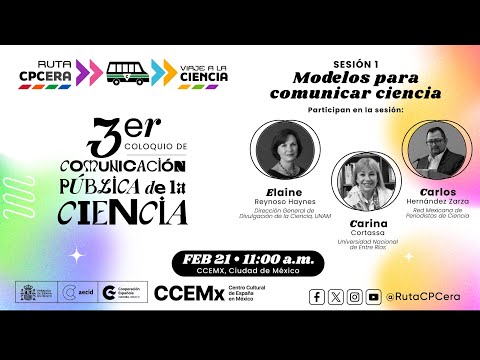
Sesión I. Modelos para comunicar ciencia
Introduction to the Event
Welcome and Safety Announcements
- The event is hosted by the Church of Jesus Christ of Latter-day Saints, with a focus on safety protocols for attendees.
- Dan introduces himself as the moderator for the first session of the third edition of the CPC Colloquium, thanking attendees for their presence.
Acknowledgments
- Special thanks are given to Centro Cultural España and individuals like Rodrigo García and Mario Ari Gonzalez from UACM for their support in organizing the event. Attendees are encouraged to applaud these contributions.
Event Dynamics and Structure
Presentation Format
- Each speaker will have 20 minutes to present, followed by a Q&A session that includes both in-person and virtual audience questions.
Networking Opportunity
- After presentations, there will be informal discussion circles called "café en corto," where speakers will participate alongside attendees to foster engagement over coffee. Participants are encouraged to bring their own cups or thermoses.
Speaker Introductions
Dr. Elaine Rainoso
- Dr. Elaine Rainoso is introduced as an expert in public communication of science (CPC), currently serving at UNAM with extensive experience in museum planning and science education. She has over 100 publications and has coordinated significant projects like the Universe Science Museum from 1993 to 1998. Her accolades include various prestigious awards in science communication.
Dr. Carina Cortaza
- Joining remotely from Argentina, Dr. Carina Cortaza specializes in science perception and public understanding of knowledge, holding multiple degrees including a doctorate from Universidad Autónoma de Madrid. She directs research initiatives related to scientific cooperation across Latin America since 2025, contributing significantly through her academic work and mentorship roles.
Carlos Hernández
- Carlos Hernández is recognized for his leadership in journalism focused on science communication, having served as director at Universidad Autónoma del Estado de México where he developed programs aimed at youth training in this field; he has received notable awards such as the Manuel Buendía Prize for his contributions to journalism between 2013 and 2021.
Introduction to Public Communication of Science
Background of the Speaker
- The speaker received the Conocid Award for Science and Technology Journalism in 2017, among other accolades.
- They have experience as a general news reporter for Milenio newspaper and Ultra 101.3M radio station in Toluca, Mexico.
- The speaker is one of the compilers of "Narrar la Ciencia," a book edited by Weimex, focusing on public communication of science (CPC).
- Currently serves as Vice President of the Mexican Network of Science Journalists and has been involved in various workshops and courses related to CPC.
Opening Remarks
- Acknowledgment and applause for Carlos; introduction to Dr. Reynoso who will discuss models for CPC.
- Emphasis on the importance of these models due to the diversity in public communication methods available today.
Understanding Public Communication of Science
Defining CPC
- Dr. Reynoso highlights that public communication of science is a multidisciplinary field merging communication with scientific knowledge.
- It is not merely a subfield but an independent area that encompasses various disciplines and knowledge systems.
Evolution Over Time
- The field has significantly evolved since post-war times (1940s onwards), reflecting changes in scientific practices and societal relationships with science.
- There has been a shift in understanding what constitutes scientific culture—what citizens need to know about science to navigate modern society effectively.
Models in Public Communication
Emergence of Models
- Models are derived from studying existing practices rather than being created from practice itself; they aim to understand how CPC has developed over time.
Terminology Variations
- Various terms exist within Latin America to describe this evolution, each with unique nuances regarding audience engagement.
Key Definitions and Framework
Notable Definition by Ana María Sánchez
- A significant definition describes CPC as a multidisciplinary effort aimed at communicating knowledge through diverse media tailored for different audiences.
Key Terms Highlighted:
- Recreating: Creating new content based on scientific information.
- Confidentiality: Ensuring information is accessible while maintaining integrity.
Theoretical Foundations
Theoretical Development
- In recent decades, efforts have been made to establish theoretical frameworks that guide planning, development, and evaluation within CPC activities.
Popular Model: AEIOU Framework
- Introduced around 2003, this model identifies five personal responses sought through CPC:
- A (Awareness): Making audiences aware of scientific topics.
- E (Enjoyment): Encouraging pleasure in learning about science.
- I (Interest): Engaging audiences' curiosity towards scientific subjects.
- O (Opinion): Providing tools for informed opinions on science-related issues.
- U (Understanding): Facilitating comprehension of complex scientific concepts.
Understanding Science Communication Models
Introduction to Science Communication
- The speaker expresses discomfort with the term "appropriation," suggesting it should be understood as a deeper comprehension of science that is meant to be shared.
- Bruce Wendstein's 2003 framework for analyzing public communication in science and technology is introduced as a pivotal reference.
Four Models of Science Communication
- Wendstein proposed four models: the deficit model, contextual model, lay public model, and public participation model.
Deficit Model
- This model posits that there is a knowledge deficit among the general population regarding scientific understanding.
- The scientific community believes they must fill this gap by determining what the public needs to know, reflecting concerns about losing credibility.
Critique of the Deficit Model
- Critics argue that this approach is vertical, moving from experts to non-experts without considering context or existing knowledge.
Contextual Model
- Emphasizes understanding the audience's prior knowledge and interests within their social and cultural contexts.
- Highlights that children are not empty vessels; their previous experiences and media influences must be considered when communicating science.
Lay Public Model
- Focuses on local or alternative knowledge systems while critiquing an overemphasis on indigenous or traditional knowledge at the expense of scientific connection.
Public Participation Model
- Aims to empower citizens by democratizing science through dialogue via forums, workshops, and citizen science initiatives.
Integration of Models
- The fusion of participation and dialogue models allows for greater involvement in decision-making processes related to science.
Project Development in Science Education
- There are no one-size-fits-all formulas for developing educational projects; context plays a crucial role in shaping approaches.
Key Elements for Effective Communication
- Successful communication relies on two pillars: scientific content and communicative value. The bridge between these pillars is narrative recreation.
Understanding Science Communication Content
The Nature of Science Content
- Science content encompasses more than just information; it includes social, cultural, and political contexts that shape scientific knowledge.
- A scientifically accurate product must also possess communicative potential and value to be effective for its intended audience.
Communicative Value in Science Products
- The communicative value of a science communication product is determined by its comprehensibility, attractiveness, and relevance to the target audience.
- The process of recreating scientific discourse involves transforming scientific concepts into relatable narratives using various tools like popular culture references.
Factors Influencing Effective Communication
- Effective science communication depends on understanding the medium's limitations and the characteristics of the target audience, including demographics and prior knowledge.
- Essential elements for successful science communication include broad content understanding beyond mere data and measurable communicative value throughout the development process.
Quality Measurement in Science Communication
- Discussions around quality in science communication are ongoing; quality must be defined clearly to ensure effective planning and evaluation.
- A notable project called Cuest provides criteria for assessing quality in science communication across six European countries, offering guidelines for enhancing public dialogue with science.
Indicators of Quality in Communication
- Three key indicators identified for measuring quality include:
- Scientific reliability and rigor,
- Presentation style related to narrative recreation,
- Connection with societal relevance reflecting communicative potential.
Transitioning to Practical Applications
Importance of Contextualizing Models
- Emphasizing theoretical discussions is crucial as practical applications may differ from original models due to evolving contexts over time.
Introduction to Current Models
- Dr. Cortaza will discuss contemporary models applied within specific scenarios, particularly focusing on safety investigations related to species publication.
Challenges in Communication
- Technical issues can arise during presentations; ensuring clear audio reception is vital for effective communication among participants.
This structured summary captures key insights from the transcript while providing timestamps for easy reference.
Understanding the Dynamics of Science Communication
The Shift in Professional Roles in Science Communication
- The field of science communication in Argentina is experiencing a transformation due to changes in public policy that have fostered the establishment of scientific communication structures within universities and research institutions.
Analyzing Public Communication Models
- A model for analyzing public communication of sciences has been developed, focusing on how scientific communities interact with communication practices and their cultural habits. This analysis considers institutional frameworks and community behaviors.
Two Models of Communication Dynamics
- Two models are proposed:
- Model 1 (Top Down): Institutional factors influence the effectiveness of science communication.
- Model 2 (Bottom Up): Scientific communities shape the viability of institutional initiatives based on their perceptions and engagement levels.
Hypotheses Based on Institutional Engagement
- In the top-down model, if institutions actively promote a culture of engagement, it enhances individual participation; conversely, a neutral stance from institutions leads to minimal action from individuals.
- The bottom-up model suggests that an informed and proactive scientific community can strengthen institutional initiatives or even replace them when necessary. A lack of engagement from scientists can hinder institutional efforts.
Scenarios Derived from Interaction Models
- Four scenarios emerge based on the interaction between proactive and neutral positions:
- Optimal Scenario: Complete alignment between positive institutional conditions and active community support for external communication.
- Intermediate Scenario: Strong institutional drive encourages community involvement while maintaining some neutrality.
- Critical Mass Scenario: A significant number of engaged individuals push for better communication without strong institutional backing.
- Pessimistic Scenario: Absence of both supportive structural conditions and an active scientific community leads to ineffective science communication efforts.
Practical Tips for Science Communicators
- It is crucial for practitioners to assess their specific context before applying learned strategies, as different environments require tailored approaches based on available resources and community dynamics. Understanding these nuances is essential for effective science communication practice.
Analysis of Institutional Communication Strategies
Scenario 1: Favorable Conditions
- The first scenario presents an ideal situation where both the institution and the scientific community are supportive, allowing for effective communication strategies.
- The main challenge is to maintain momentum and prevent setbacks, emphasizing the need for communicators to focus on sustaining progress rather than just growth.
- It’s crucial to institutionalize communication practices within internal regulations to ensure stability and continuity in scientific information dissemination.
- Avoid complacency; proactive measures must be taken to ensure that communication efforts do not solely rely on current favorable conditions.
- Highlighting tangible benefits for researchers can enhance engagement with communication initiatives, making them more relevant and appealing.
Scenario 2: Reticent Community
- In this scenario, while institutional conditions are good, there is a reluctance within the scientific community. Effective strategies should focus on demonstrating practical benefits of communication efforts.
- Propose integrating a dedicated line for scientific communication in funding calls to increase awareness and support among researchers.
- Emphasizing visibility through successful case studies can motivate researchers by showcasing peer achievements and fostering a sense of community collaboration.
- Building connections with neighboring research projects can serve as motivation; sharing success stories from local peers enhances credibility and interest in collaborative efforts.
Scenario 3: Engaged Community but Limited Institutional Support
- This scenario involves a highly engaged scientific community that lacks recognition from the institution. Documenting successes becomes essential for advocating further support and resources.
- The focus should be on creating strategic evidence that highlights successful collaborations, which can help secure additional funding or institutional backing.
- Forming alliances with external stakeholders may provide leverage; targeting broader audiences rather than just institutional leaders could yield better results in promoting initiatives.
Conclusion: Navigating Challenges
- Overall, it’s vital to adapt strategies based on specific scenarios faced by institutions. Emphasizing urgency around relevant topics (e.g., AI advancements), can help align communications with current interests and needs.
Modelo de Inserción de la Comunicación Pública de la Ciencia
Introducción a la Comunicación Pública de la Ciencia
- Se discute el modelo de inserción de la comunicación pública de la ciencia en diversas instituciones y contextos, enfatizando que las estrategias y diseños son diferentes según el escenario.
- La importancia del periodismo científico se destaca como un sector particular dentro de la comunicación pública, con directrices bien establecidas que lo diferencian.
Perspectiva del Periodismo Científico
- Carlos introduce su perspectiva sobre el periodismo científico, agradeciendo al Centro Cultural España y a la Red Mexicana de Periodistas de Ciencia por facilitar este diálogo.
- Se menciona el décimo aniversario de la Red Mexicana, recordando sus inicios con 29 personas en Ciudad de México que imaginaron una red para periodistas científicos.
Esquema Propuesto para el Periodismo Científico
- Carlos propone un esquema práctico en lugar de un modelo teórico, utilizando una representación gráfica para ilustrar los formatos utilizados por los periodistas científicos en México.
- Utiliza una cebolla como metáfora para representar las capas y complejidades del periodismo científico, sugiriendo que hay múltiples dimensiones en cómo se presenta esta información.
Identificación de Tensiones en Recursos
- El esquema busca identificar tensiones entre recursos materiales e inmateriales que afectan la profundidad y calidad del trabajo periodístico.
- Este enfoque está dirigido tanto a colegas periodistas como a investigadores y al público general interesado en comprender mejor el periodismo científico.
Preguntas Clave en el Periodismo Científico
- Se establece que el periodismo científico implica responder preguntas fundamentales; mejores respuestas conducen a mejor calidad informativa.
- La elaboración inicial de preguntas define tanto el enfoque subjetivo del periodista como su postura editorial durante todo el proceso informativo.
Resultados Relevantes sobre Temas Abordados
- Se presentan datos obtenidos a partir de una encuesta realizada por la Red Mexicana, donde se identifican temas abordados por los periodistas científicos.
- Los resultados muestran un interés significativo por incluir sectores específicos (mujeres, grupos indígenas, infancias), reflejando enfoques diversos e inclusivos dentro del periodismo científico.
Examples of Journalistic Work on Health and Disability
Coverage of Health Issues in Children
- The transcript discusses journalistic notes focusing on children's health, highlighting Nelly Toche's article about vaccination concerns regarding measles, which notably lacks mention of children with disabilities.
Addressing Sexuality in Disability
- A project titled "Coger en Discapacidad" uses storytelling to shed light on the often-overlooked topic of sexuality among people with disabilities.
Intersection of Science Communication and Gender Perspective
Promoting Women in Science
- The integration of scientific developments with gender perspectives is emphasized as a means to promote public communication projects, exemplified by initiatives at UMX that reported on female scientists' research.
Community Engagement in Scientific Narratives
Fieldwork and Storytelling
- Geraldín Castro's fieldwork illustrates how journalists can engage with communities over several weeks to uncover stories that intertwine science and local narratives, such as youth involvement in environmental conservation efforts.
Challenges Faced by Journalists
Resource Allocation and Time Management
- The speaker reflects on the dual challenges faced by journalists: managing resources (technical, financial, material) and time for conducting interviews, reading papers, consulting data, and developing texts.
Balancing Resources and Time in Journalism
Ideal Conditions for Reporting
- An ideal scenario for journalists would involve ample resources and time; however, this is often not the case. The speaker questions whether more time and resources lead to deeper journalism.
Importance of Time in Quality Journalism
Depth vs. Quantity
- Drawing from eight years of experience leading a news department, the speaker asserts that having more time significantly enhances story quality but emphasizes that it’s not just about duration—it's also about enriching journalistic practices.
Enhancing Journalistic Practices
Layering Stories for Depth
- The metaphorical use of an onion illustrates different reporting formats; daily reporting offers surface-level insights while investigative journalism delves deeper into complex issues.
Humanizing Scientific Stories
Diversifying Sources
- By reducing daily workload pressures, journalists were able to focus on comprehensive stories that humanize scientific topics through diverse sources and personal testimonies addressing social issues intertwined with scientific analysis.
Outcomes from Enhanced Journalistic Focus
Publication Recognition
- This focused approach led to the publication "Narrar la Ciencia," which compiles award-winning works showcasing high-quality science journalism recognized at various levels.
Understanding the Structure of Science Journalism
The Vegetable Analogy in Journalism
- The left side of the diagram represents a "vegetable" that integrates into a quadrant composed of personal journalism axes, with deeper layers symbolizing ideal journalistic qualities due to more resources and time for story development.
- The lower part of the quadrant illustrates characteristics typical of daily journalism, such as basic news notes and quick interviews, emphasizing that this framework does not judge practices but rather identifies differences in quality based on resource availability.
Identifying Qualities in Journalistic Formats
- This framework aims to help non-journalists or those new to science journalism appreciate the diversity of formats available for storytelling while recognizing essential qualities needed in their work.
- Each layer closer to the center of the vegetable metaphorically represents better journalistic practices, suggesting that deeper engagement leads to richer stories.
Resource Allocation and Quality Outcomes
- The positioning of various journalistic formats within the quadrant highlights contrasts in information treatment, delivery time, format type, source quantity, and potential audience relationships; more resources equate to higher quality outputs.
- For instance, an informative note often relies on a single source; however, if reporters are given more time for research, they could produce richer content with multiple sources and testimonies that resonate more with audiences.
Implications for Newsroom Practices
- Some newsrooms may benefit from requesting fewer articles per day from journalists but allowing ample time for thorough development; this is not yet common practice across all media outlets.
- Deeper layers of journalism yield better audience engagement and broader reach by utilizing additional resources effectively over time compared to standard daily reporting styles.
Exploring New Formats and Technologies
- A discussion point raised involves whether AI-generated content can be considered journalistic products; this prompts reflection on how emerging technologies might influence traditional journalism practices.
- Questions posed include comparing outcomes between quickly produced materials using extensive AI resources versus well-researched pieces developed over sufficient time with minimal AI assistance—inviting critical dialogue about future directions in journalism.
Conclusion: The Role of Science Journalism
- Specialized science journalism encompasses diverse formats addressing topics like environment, health, scientific innovations, and social issues involving marginalized voices—highlighting its importance in public discourse.
- Ultimately, science journalism equips journalists with tools for professional growth while providing platforms for sources to amplify emerging social messages and offering critical insights into public decision-making processes through evidence-based reporting.
Tips for Engaging in Science Journalism
Essential Questions for Science Reporting
- The speaker introduces a series of 15 questions designed to guide those interested in science journalism and developing journalistic stories.
- Key questions include whether the story requires scientific content and what specific science is involved, which helps shape the journalistic piece.
- Emphasizes the importance of maintaining relationships with sources when reporting from diverse communities, ensuring they have access to the work produced.
The Role of Different Models in Science Communication
Critique of Traditional Models
- A question arises regarding the deficit model, which suggests a top-down approach where scientists are seen as authorities who must inform others.
- The speaker critiques this model, noting that while it has its uses, it often overlooks public engagement and understanding.
Contextual Understanding
- Discusses the contextual model that focuses on understanding audiences better—what they know, their interests, and how they interpret scientific knowledge.
- Introduces dialogue models that promote an exchange of knowledge between scientists and communities rather than a one-sided communication.
Citizen Science and Local Knowledge Integration
Importance of Community Engagement
- Highlights citizen science projects that incorporate local knowledge into scientific research, emphasizing community needs and cultural contexts.
- Discusses various strategies used to facilitate dialogue among citizens and scientists through workshops or discussion groups.
Bridging Gaps Between Scientific Knowledge and Local Practices
- Critiques traditional approaches where ecological studies fail to consider local contexts; advocates for integrating local experiences into scientific solutions.
- Suggests removing intermediaries like science communicators can enhance direct dialogue between scientists and community members.
Understanding the Role of Science in Community Projects
The Essence of Scientific Engagement
- A key figure is described as someone who comprehends the essence of science, identifying what scientific knowledge is necessary for community projects and facilitating dialogue between scientific understanding and local cultural contexts.
- This individual plays a crucial role in co-creating solutions with communities, emphasizing that while science leads the conversation, local knowledge and practices are equally important in developing new initiatives.
Communication Challenges in Science
- Martín Montfil raises concerns about the use of English terms like "storytelling" instead of Spanish equivalents such as "narrativa," highlighting a broader discussion on language's role in scientific communication.
- He comments on Luhenstein's deficit model, which categorizes four ways to communicate science but warns against viewing any model as inherently superior or inferior.
Misconceptions About Deficit Models
- The speaker critiques the misconception that deficit models should always be avoided, arguing that their appropriateness depends on various factors and contexts rather than being universally negative.
- They assert that equating public communication of science solely with deficit models is not only false but also harmful to understanding effective science communication strategies.
Evolution of Science Communication
- The historical context reveals that early science communication was rooted in deficit models from the 1960s, where scientists dictated what the public needed to know.
- There’s an acknowledgment that definitions and perceptions around "dissemination" have evolved over time, reflecting changes in how science communicates with society.
Diverse Perspectives on Popularization
- The speaker emphasizes differing interpretations of popularization between Anglo-American contexts (often seen as making content entertaining online) versus Latin American perspectives (focused on reaching marginalized populations).
- They argue for recognizing these nuanced differences to avoid labeling educational efforts negatively; evolution does not imply improvement but adaptation to changing circumstances.
Humanizing Journalism and Storytelling
- A call for humanizing news reporting highlights the importance of incorporating diverse voices and testimonies into journalism, enriching narratives beyond mere facts.
- The preference for terms like "humanize journalism" over "storytelling" reflects a deeper commitment to capturing authentic experiences within media narratives.
Challenges of AI in Public Communication of Science
Introduction to the Discussion
- The session begins with a question from Jessica Hernández Gerónimo regarding the challenges posed by the recent mass use of artificial intelligence (AI) in public communication of science, specifically directed towards Dr. Cortaza.
Regulatory Considerations
- Dr. Cortaza emphasizes the need for potential regulations concerning AI usage, hinting at an upcoming discussion on this topic later in the event. She acknowledges that AI is part of a larger transition within communication practices.
Historical Context and Evolution
- Reflecting on past discussions about technology's impact on journalism, Dr. Cortaza recalls how 25 years ago, there were concerns about Google's influence on science journalism and how digital processes have evolved since then. She notes that these changes are part of a broader historical context in media evolution.
Current Landscape and Challenges
- The emergence of social media and citizen journalism has transformed public engagement with science, creating new dynamics that require adaptation from traditional methods to more interactive forms of communication. Dr. Cortaza suggests that these shifts necessitate rapid responses from communicators to stay relevant amidst ongoing changes influenced by events like the pandemic.
Need for Educational Regulation
- There is a call for more regulatory frameworks at educational levels to adapt effectively to these technological advancements while ensuring responsible use and understanding among audiences, particularly students and educators alike. This includes recognizing the pervasive nature of AI in society today.
Models for Science Communication in Schools
Distinction Between Education and Outreach
- A question posed by Jesús Abram Sasueta leads Dr. Elaine to clarify that while both education and outreach complement each other, they serve different objectives: education aims for learning outcomes whereas outreach focuses on raising awareness without necessarily prioritizing learning as its primary goal.
Integration of Experiences
- Dr. Elaine shares insights from her experience working in museums where collaboration with schools enhances mutual understanding between educators and communicators about how students engage with scientific concepts through various activities designed for outreach purposes but applicable within educational settings too.
Participatory Approaches in Science Communication
Importance of Dialogue
- Silvia Olvera discusses her research project focused on air quality in Mexico City involving workshops with vulnerable populations, emphasizing the significance of participatory dialogue between scientists, journalists, and communities as essential for effective science communication strategies tailored to local contexts.
Limited Examples in Mexico
- In response to inquiries about participatory models similar to those mentioned by Silvia, it is noted that while there are few examples available across Mexico—such as initiatives led by Planeteando—there remains an opportunity for expanding such efforts into broader activism within science communication practices throughout the country.
Communication of Science and Community Engagement
Importance of Science Communication
- The speaker emphasizes the growing movement towards effective science communication, highlighting its role in establishing dialogue to seek joint solutions for community issues.
- It is crucial not only to understand scientific concepts but also to consider the cultural context and specific needs of the population when addressing problems.
Local Project Example
- A project in Villagrero focuses on flower production, which raises concerns about waste management due to excessive packaging materials like cellophane.
- The local community faces significant waste issues despite their successful flower export business, leading to environmental and health challenges.
Community Involvement in Solutions
- Efforts are underway to educate primary school children of producers about recycling and composting, aiming to address local waste problems effectively.
- Collaboration with universities is being sought to develop better composting methods from the mixed waste generated by flower production.
Collaborative Approaches
- The project illustrates a model where local communities, particularly producers and their families, work together with researchers to find sustainable solutions for waste management.
Institutional Role in Science Communication
- A question directed at Dr. Cortaza addresses how public higher education institutions can prioritize decisions that go beyond mere cultural diffusion or didactic approaches.
- Dr. Cortaza suggests that institutions should act as interfaces between science and society, facilitating public engagement with scientific knowledge.
Enhancing Public Understanding of Science
- Institutions must create spaces for interaction between scientists and the public, ensuring that scientific discourse is accessible outside major urban centers.
- Emphasizing regional engagement allows institutions to leverage their capabilities while addressing local societal needs through tailored communication strategies.
Broadening Perspectives on Communication
- There’s a call for universities and research centers to embrace diverse forms of science communication beyond traditional journalism or institutional narratives.
- The discussion highlights the potential for innovative outreach activities aimed at enhancing public understanding of science within various community contexts.
Access to Science as a Human Right
Importance of Access to Science
- The speaker emphasizes that access to science is a fundamental human right and should be considered a public good.
- It is highlighted that society has a basic responsibility to facilitate this access through various available tools.
Closing Remarks and Announcements
- Dr. Cortaza concludes the Q&A session, transitioning into an announcement about the upcoming SPC Congress.
- A change in schedule for a session originally set for March 21 is announced; it will now take place on March 14 in "el espacio X."
Acknowledgments and Farewells
- Dr. Cortaza expresses gratitude for the opportunity to share experiences with colleagues and friends during the event.
- She acknowledges her appreciation for the attendees, including those present both physically and virtually.
Recognition of Contributions
- The speaker mentions sending recognition materials via express delivery to Argentina, thanking Carlos Hernández Arza for his participation.
Gifts and Final Moments
- A small gift from RUP is presented, along with a light-hearted comment regarding journalism, followed by a group photo opportunity with Dr. Cádiz.