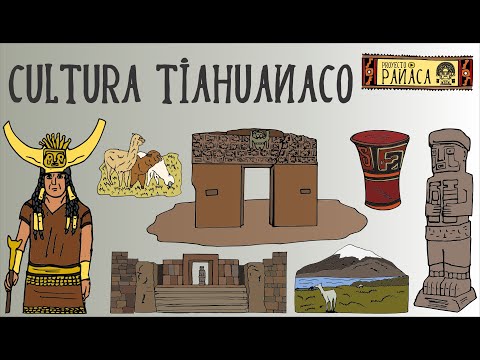
La cultura Tiahuanaco en 9 minutos | Culturas Preincas
Overview of the Tiahuanaco Culture
Historical Context and Development
- The Tiahuanaco culture, also known as Tiwanaku, was studied by notable archaeologists including Max Uhle, Carlos Ponce, and Alan Kolata. Early references to its existence were made by Spanish chronicler Pedro Cieza de León in the 16th century.
- This culture thrived during the Early Intermediate period and declined towards the end of the Middle Horizon (approximately 250 BC to 1100 AD), coexisting with the Wari culture.
Geographic Distribution
- Tiahuanaco developed around Lake Titicaca on the border of modern-day Peru and Bolivia, extending into parts of northern Chile, northwestern Argentina, and eastern Bolivia.
- Historians have identified various phases of this long-lived culture; Wendell Bennett categorized it into three periods: early, classic, and decadent.
Agricultural Practices
- Despite high altitudes (nearly 4,000 meters above sea level), Tiahuanaco farmers successfully cultivated crops such as potatoes, quinoa, corn, cassava, and oca. They also raised llamas and alpacas for livestock.
- To enhance agricultural productivity amidst harsh conditions, they constructed waru waru ridges to protect crops from night frosts.
Economic Structure
- The society was classist and theocratic; power was held by an elite that integrated various ethnic groups through alliances and colonization.
- Their economy relied on agriculture, livestock raising, crafts production, and bartering with neighboring regions. Archaeologist Carlos Ponce noted at least 49 rulers based on historical texts.
Religious Beliefs and Practices
Polytheism in Tiahuanaco
- The Tiahuanaco people practiced polytheism with Wiracocha or "the Staff" as their principal deity. Some researchers suggest he is akin to a god worshiped by later Incas.
- Other significant deities included Chachapuma (a feline-masked god associated with sacrifice), Amaru (aquatic role), and Mallku (agricultural role).
Ritualistic Offerings
- Excavations at Akapana revealed human burials alongside dismembered camelids—indicating sacrificial practices involving both animals and humans.
- In 2019 findings from underwater excavations on Lake Titicaca's Island of the Sun suggested that offerings were made to deities between 500–1100 AD.
Cultural Contributions
Architectural Achievements
- The Tiahuanaco civilization is noted for its impressive urban centers beyond Tiwanaku itself; Khonkho Wankane served as an administrative hub featuring monolith constructions.
Notable Structures
- Key architectural features include terraces at Pumapunku and Kalasasaya temple which functioned possibly as a solar observatory marking seasonal changes.
Tiahuanaco: Culture and Decline
Cultural Achievements of Tiahuanaco
- The Tiahuanaco civilization had an astronomical calendar, with ancient Aymara legends suggesting that a significant door holds a hidden secret that may aid humanity in the future.
- They were skilled in metallurgy, particularly bronze for tools and weapons, while their gold and silver work was more rustic compared to their lithic art precision.
- Monumental sculptures have been discovered, including the Frayle (god of water) and Bennett, which some researchers believe may represent a powerful female figure. Both are crafted from sandstone.
- Textiles were produced using llama and alpaca wool, featuring geometric designs depicting animals and deities like Wiracocha; these textiles adorned clothing, tapestries, and temple walls.
Pottery and Ceramics
- Tiahuanaco pottery is noted for its intricate technical skills and iconography; it featured incised polychrome designs in red, orange, brown, and white with animal representations such as condors and snakes.
- Key ceramic items included the kero (a vessel for drinking chicha used in rituals) and cauldrons (incense burners used in temples).
Decline of Tiahuanaco
- The decline began around 950 AD when Tiahuanaco lost political control over peripheral territories like Azapa Valley (Chile) and Moquegua (Peru), leading to abandonment by its inhabitants.
- Small family groups started settling on the Collao plateau during this period of decline.