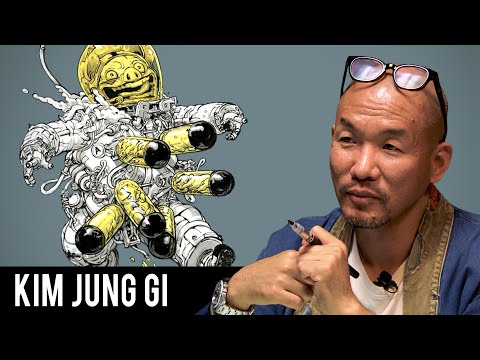
How to Draw like Kim Jung Gi
Disposal and Thinking
The speaker discusses the importance of disposal and not overthinking in drawing.
Disposal as a Mindset
- Disposal means there is no need to think too much while drawing.
Training the Mind
- The speaker trained their mind to compare everything they draw without looking at reference material.
- This changed the way they think, allowing them to see reference material more transparently.
- Studying perspective theory in college helped them understand the math behind it.
- Observing and understanding the subject matter helps in remembering and drawing accurately.
Understanding Perspective Intuitively
- Understanding perspective intuitively is crucial in drawing.
- Learning theories helped, but understanding what you're drawing is more important.
- It's important to draw a lot and apply your own design skills.
Learning Theory vs Natural Observation
The speaker discusses the balance between learning theory and relying on natural observation when drawing.
Learning Theory
- Learning theory can be helpful in doodling and combining existing knowledge with spontaneous creativity.
- Applying new theories can provide a foundational basis for commissioned projects.
Natural Observation
- Sometimes, information shared during each project may differ from what was previously known or thought of.
- Before starting a project, it's essential to understand what goes through one's mind when drawing, like considering perspective and angles of subjects.
Cross Contour Lines for Depth and Perspective
The speaker explains how cross contour lines can add depth and perspective to drawings.
Cross Contour Lines
- Cross contour lines are used to visualize and draw things in three dimensions.
- They define the angle and perspective of objects, allowing for more accurate representation.
Drawing What You See vs What You Have Seen
- Drawing what you have seen is a concept that may be difficult to put into practice.
- Inexperienced artists tend to draw objects from a single angle, but drawing from different angles adds depth and realism.
Floating on the Image
The speaker discusses floating on the image and experimenting with different angles when drawing.
Floating on the Image
- When drawing, try to float on the image in your mind and turn it to different angles.
- Experimenting with different angles helps make drawings look more dynamic and interesting.
Three Axes: Height, Width, Depth
- Every object has height, width, and depth when drawn in three dimensions.
- Understanding perspective theory helps in visualizing these axes while drawing.
Understanding Cross Contour Lines in Drawing
In this section, the speaker discusses the concept of cross contour lines and how they can be used to add depth and dimension to drawings.
Cross Contour Lines for Depth Perception
- Cross contour lines are used to create a sense of depth in drawings.
- By drawing contour lines that follow the shape and form of an object, artists can convey its three-dimensional nature.
- The speaker explains that when drawing a coffee shop, for example, using flat contour lines would result in a two-dimensional representation. However, by incorporating cross contour lines, one can depict the left, middle, and right sides of the coffee shop with different angles and depths.
- The use of cross contour lines helps create a fisheye structure that adds complexity and realism to the drawing.
Applying Cross Contour Lines Practically
- While understanding the concept of cross contour lines is relatively easy, applying it effectively in practice can be challenging.
- With practice and repetition, artists can train their hands to naturally incorporate cross contours into their drawings.
- The speaker mentions that even after extensive practice, more complex subjects may still require additional effort to accurately represent with cross contour lines.
- Cross contours can be applied to various areas such as screen compositions or depicting depth in pockets or fabric wrinkles.
- By observing objects from different angles and understanding their cross contours, artists gain an intuitive understanding of how to draw them realistically.
Utilizing Three Axes and Fish Eye Perspective
In this section, the speaker explores the use of three axes and fish eye perspective in drawing.
Three Axes for Perspective
- When drawing a scene or object, it is essential to consider its height, width, and depth as represented by three axes.
- By imagining a perspective well enough to draw it from above or any angle desired, artists can effectively utilize three axes.
- The speaker emphasizes the importance of understanding fish eye perspective, which allows for a more dynamic and engaging representation of objects.
Modifying Objects with Perspective
- Artists have the freedom to modify or remove objects in a scene to serve their storytelling purposes.
- By combining perspective, composition, and personal artistic choices, artists can create visually compelling drawings.
- The speaker mentions the significance of practicing and developing a visual library to enhance one's ability to draw from imagination.
Understanding Human Anatomy and Exercise
- The speaker highlights the importance of studying human anatomy for character design.
- By observing body parts from different angles, artists can understand how they appear from various perspectives.
- Having a good grasp of human anatomy enables artists to accurately depict body proportions and movements.
Visualizing Perspectives and Utilizing Guidelines
In this section, the speaker discusses the process of visualizing perspectives and utilizing guidelines in drawing.
Visualizing Perspectives as You Draw
- When drawing an object or scene, it is crucial to visualize its angles and perspectives as you go along.
- By referencing lines that define eye level and overall perspective, artists can maintain consistency in their drawings.
Guidelines as Perspective References
- Drawing guidelines or perspective lines are essential tools for accurately representing objects from any angle.
- Before starting a drawing, it is helpful to establish a mental grid or reference points based on the desired perspective.
- Artists should constantly refer back to these guidelines while drawing to ensure accurate proportions and perspectives.
Incorporating Personal Choices into Drawings
- While referencing guidelines is important for maintaining accuracy, artists should also feel free to make creative choices during the drawing process.
- The speaker emphasizes that every stroke made during drawing is influenced by both referencing guidelines and personal visualization.
Conclusion
In this transcript summary, we explored two main topics: understanding cross contour lines in drawing for depth perception and utilizing three axes and fish eye perspective. We also discussed the importance of visualizing perspectives, utilizing guidelines, and incorporating personal choices into drawings. By applying these techniques, artists can create more dynamic and realistic drawings.
Drawing in Three Dimensions
In this section, the speaker discusses the importance of visualizing and drawing in three dimensions. They explain how extending the box on all three axes helps in designing unique elements and improving perspective drawing skills.
Visualizing Three-Dimensional Forms
- Visualize and draw in three dimensions, not just to the helmet but to the whole forms from your imagination.
- Extending the box on all three axes makes it easier to design unique elements.
- This trains perspective drawing skills and helps memorize the shape of objects.
Understanding Perspective
- Parallel lines follow specific angles within the box.
- Not everything is parallel; some objects have their own set of angles.
- Building a visual library by studying different perspectives accelerates progress.
Using References for Study
- Collect resources like books, movies, YouTube, or Google Image Search to study various perspectives.
- Fisheye structure is a useful technique for perceiving objects in three dimensions.
- Visualization and observation are key pillars for creating accurate drawings.
Fully Immersing into Drawings
The speaker emphasizes fully immersing oneself into drawings by visualizing scenes from different angles. They discuss how this practice helps create more realistic and detailed artwork.
Perceiving Objects from All Angles
- Perceive every object in three dimensions and imagine it as if it were real.
- Train your mind to see scenes linearly or through a fisheye structure.
- Squeeze everything into one frame while translating it onto paper.
Visualization Techniques
- Imagine scenes before drawing them, fully immersing yourself into whatever you're drawing.
- Visualization works similarly to green screens used in computer graphics during movie production.
Observing People and Objects
The speaker talks about observing people and objects to understand their structure and draw them accurately from different angles.
Observing People
- Understand the chain of thoughts and intuitive understanding when observing people.
- Draw a person from any angle by perceiving their structure in three dimensions.
Drawing Objects
- Practice drawing objects you've never observed using references and visualization techniques.
- Fully immerse yourself into the drawing, even imagining the smell of the object.
Applying Visualization Techniques
The speaker explains how visualization techniques can be applied to various areas, such as computer graphics and screen compositions during movie production.
Applying Visualization Skills
- Apply visualization skills to different areas like computer graphics or screen compositions.
- Visualization helps understand objects from all angles and create accurate representations.
Contrary to popular belief, he doesn't need a lot of resources to study
The speaker explains that contrary to what many believe, he doesn't require a lot of resources to study.
Resources for studying
- Contrary to popular belief, the speaker doesn't need a lot of resources to study.
- He mentions that books, movies, YouTube, and Google are not necessary for his studies.
- Instead of relying on external sources, he emphasizes the importance of visualization and observation.
Graphite pencil allows for pressure-free drawing
The speaker discusses the benefits of using a graphite pencil for drawing.
Benefits of using a graphite pencil
- Using a graphite pencil allows for pressure-free drawing.
- It eliminates the fear of making mistakes and helps in building wrist strength.
- The speaker suggests visualizing the drawing before putting it on paper.
- Practicing with different mediums can help improve visualization skills.
Drawing inspiration from anime and manga
The speaker talks about being inspired by anime and manga in his early years.
Inspiration from anime and manga
- The speaker was inspired by anime and manga when he was young.
- He would imagine things as if they were real and fully immerse himself in them.
- This helped him develop his own style of drawing that gravitated towards realistic representations.
Visualizing drawings before starting
The importance of visualizing drawings before starting is discussed.
Importance of visualization
- Before starting a drawing, it is important to visualize it in your mind.
- This helps in perceiving every object in three dimensions and translating it into lines on paper.
- Visualization becomes intuitive with enough practice and experience.
Focusing on details and storytelling in drawings
The speaker emphasizes the importance of focusing on details and storytelling in drawings.
Details and storytelling in drawings
- Focusing on details can help communicate specific characteristics of an object or subject matter.
- The speaker gives an example of drawing headphones, where different designs and details can convey information about their manufacturing process.
- Storytelling through drawings allows for more creative freedom and exploration.
Exploring different design possibilities
The speaker discusses exploring different design possibilities in drawings.
Exploring design possibilities
- When drawing, it is important to explore different design possibilities.
- Starting with one element or idea and seeing where it takes you can lead to interesting results.
- Details such as screws, bolts, or background elements can suggest a timeline or add depth to the drawing.
These are the main points from the given transcript.
Simplifying Complex Drawings
In this section, the speaker discusses a simple approach to designing and drawing complex objects. They emphasize the importance of paying attention to details such as pockets, wrinkles, and stitching in clothing to create more realistic drawings.
Key Points:
- When drawing something more complicated than a simple mannequin with obvious cross contours, look for opportunities to incorporate details like pockets and fabric wrinkles.
- Utilize the stitching of clothing as an indication of folds and cross contour lines on the body.
The Three Axes in Drawing
This section focuses on understanding the three axes (height, width, and depth) when starting a drawing. The speaker suggests imagining a perspective grid or box that contains the object being drawn to establish proper proportions.
Key Points:
- Everything in a drawing has height, width, and depth.
- Imagine a perspective grid or box that encompasses the object being drawn.
- The first stroke made should define the eye level and overall perspective.
- Pay attention to angles in perspective when making strokes.
Fisheye Perspective
Here, the speaker discusses fisheye perspective as a technique for including multiple viewpoints within one scene. They explain how practicing this style can improve one's ability to draw from different angles and perspectives.
Key Points:
- Fisheye structure is created by including as much as possible within one frame.
- By observing objects from different angles and visualizing them in three-dimensional forms, it becomes easier to draw them from any angle.
- Fisheye perspective can be applied to various areas such as screen compositions.
- Building a visual library through practice and observation is essential for mastering fisheye perspective.
Drawing from Imagination
In this section, the speaker emphasizes the importance of being able to draw objects from different angles and perspectives without relying on references. They discuss how practicing drawing various objects can expand one's ability to design unique elements.
Key Points:
- Practice drawing objects from different angles to improve visualization and drawing skills.
- Being able to draw in three-dimensional forms from imagination aids in designing unique elements.
- Building a visual library through observation and practice helps memorize objects and enhances creativity.
- Drawing familiar objects like bicycles can serve as a foundation for drawing more complex subjects.
The transcript provided does not cover the entire video, so the summary is based on the available content.
New Section
Portuguese transcript summary.
Three-Dimensional Forms
- Three-dimensional forms are discussed in the transcript.