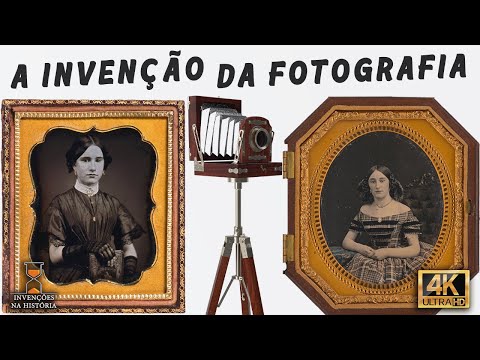
Quem Inventou a Fotografia? Como a Imagem é Capturada?
The Origins of Photography
The Concept of Photography
- Photography is perceived differently by individuals; for some, it serves as a nostalgic window to the past, while for others, it is a means of financial survival.
- The inception of photography is rooted in two key principles: image projection through a dark chamber and the discovery of light-sensitive substances.
Historical Background
- References to the camera obscura date back to ancient texts from China (400 BC) and Aristotle's writings (330 BC), indicating its long-standing significance.
- Persian scholar Alhazém (circa 1000 AD) utilized the camera obscura to demonstrate that light travels in straight lines, explaining why images appear inverted.
Advancements in Optical Devices
- By the 1600s, high-quality lenses were invented, allowing artists and engineers to use the camera obscura for more precise drawings without losing image clarity.
- The invention of magic lanterns emerged from these optical principles, projecting images onto walls using glass slides—an early form of entertainment.
Early Experiments with Light Sensitivity
- Prior to permanent image capture, drawings were the only method for recording visuals. Johann Heinrich Schulze began experimenting with light-sensitive chemicals around 1724.
- Schulze discovered that silver nitrate darkened when exposed to light but did not create permanent images due to continued exposure effects.
The First Photograph
- Joseph Nicephore Niepce captured the first photograph in 1826 using a dark chamber. His lack of drawing skills motivated him to find a way to fix images permanently.
- After numerous experiments starting in 1816 with silver chloride paper, he finally succeeded using a tin plate coated with bitumen dissolved in lavender oil.
Process Development and Collaboration
- Bitumen hardened upon light exposure allowed Niepce’s process to differentiate between light and dark areas after an eight-hour exposure time.
- Despite its primitive quality compared to modern photographs, Niepce's work marked a significant milestone in visual documentation.
Daguerre's Contribution
- Louis Daguerre partnered with Niepce in 1829 but faced challenges after Niepce's death in 1833. Their collaboration led to advancements in photographic processes.
- In 1839, Daguerre introduced the daguerreotype process which reduced exposure times significantly and enabled clearer portraits through innovative techniques involving polished copper plates.
The Evolution of Early Photography Techniques
The Daguerreotype Process
- The initial step involved using a black cloth to enhance visibility, followed by exposing the plate in a dark camera for 10 to 30 minutes depending on light conditions.
- After exposure, the plate was revealed using heated mercury vapor, which made the previously invisible image visible but posed health risks to photographers.
- An example from 1838 shows a busy Paris street captured with impressive quality; however, due to over 10 minutes of exposure, moving objects did not appear in the photo.
- The resulting images could be both positive and negative based on lighting and viewing angles; lighter areas appeared white while shadows displayed various shades of gray.
- A later photograph taken between 1846 and 1852 showcased detailed lunar features after multiple exposures, contributing to Daguerre's international fame.
Popularity and Limitations of Daguerreotypes
- By August 1839, Daguerre received a pension from the French government in exchange for presenting his invention as France's gift to the world; this led to over 70 photography studios in New York by 1850.
- Despite its popularity, daguerreotypes had drawbacks such as toxic mercury use and the inability to replicate images—each photo was unique.
Talbot's Innovations
- William Henry Fox Talbot worked concurrently on photographic processes and only learned about Daguerre’s work in 1839 when it became publicized.
- Talbot experimented with silver salts starting in 1834 aiming to fix images onto paper, leading him towards what would become known as "salted paper" process.
Development of Negative Processes
- His method involved coating paper with sodium chloride solution before applying silver nitrate, creating a light-sensitive surface that produced negatives through prolonged exposure.
- Talbot’s innovation allowed for multiple copies from one negative by placing it over another piece of photo paper exposed to sunlight.
Advancements in Photography Technology
- In parallel developments around 1840, Max Petzval improved lens technology significantly enhancing light capture compared to earlier lenses used by Daguerre.
- Petzval's lens increased light intake by approximately 22 times which reduced exposure time dramatically but still faced competition from Talbot’s slower processes.
- In response to challenges with image quality and speed, Talbot refined his technique in 1841 replacing chemicals for better sensitivity leading to faster exposures termed "Calotype."
Transitioning Towards Practical Solutions
- Despite improvements under Calotype methods being marketed as superior, many found them inferior due to graininess caused during positive transfers from negatives.
- A significant shift occurred around 1879 with dry gelatine plates allowing photographers greater convenience without needing hazardous chemicals or immediate development post-capture.
History of Photography and Innovations
Early Developments in Photography
- The introduction of silver nitrate in emulsion allowed for more stable and detailed negatives, requiring only a few seconds of exposure.
- Photographers could now use dry plates, enabling them to take photos and develop them later with the help of technicians, making photography more accessible.
- The process using silver gelatin was not limited to dry plates; it also became prevalent in photographic paper and films, dominating black-and-white photography in the 20th century.
George Eastman's Revolution
- In 1888, George Eastman registered the Kodak brand, introducing roll film and the Kodak camera that democratized photography for the masses.
- The flexible roll film developed by Eastman replaced fragile glass plates, allowing multiple negatives to be stored conveniently.
- This innovation enabled photographers to easily enlarge negatives into larger prints while maintaining image quality.
The Kodak Camera's Impact
- Eastman's patented camera was designed to promote roll film sales with a simple motto: "You press the button, we do the rest."
- For $25 at that time, amateurs could buy a camera capable of taking 100 photos; after finishing the film, they would send it back for processing and printing.
- By 1900, Kodak launched the Brownie camera aimed at children and young people for just $1. Its popularity led to high demand.
Origins of Photography Terminology
- The term "photography" was coined by Brazilian inventor Antoine Hercules Romuald Florence in 1833 from Greek words meaning "drawing with light."
- Florence's early attempts at capturing images occurred around 1832 using silver chloride sensitized paper before other notable inventors like Daguerre.