Cartesian Substance Dualism
Philosophy of Mind: Descartes and Cartesian Dualism
In this lecture, Professor Matt McCormick introduces Descartes' foundational work in philosophy of mind, emphasizing the significance of Cartesian dualism and its enduring impact on modern philosophical discourse.
Descartes' Meditations and Impact on Philosophy
- Descartes' 1641 meditations marked the beginning of modern philosophy, shaping the discourse on the nature of the mind for over 400 years.
- The influence of Descartes extends to contemporary philosophy of mind, neuroscience, and cognitive science, underscoring his enduring relevance in shaping philosophical inquiry.
Quest for Certainty in Knowledge
- Descartes embarks on a quest for absolute certainty in knowledge, rejecting any belief that admits doubt. This pursuit sets the foundation for his global skepticism.
- Knowledge, according to Descartes, necessitates absolute certainty as a justification for beliefs. His stringent criteria lead to widespread skepticism where very little withstands scrutiny.
Global Skepticism and Doubt Examinations
- Through various scenarios including dream hypotheses and malevolent deceptions by powerful entities like demons or gods, Descartes explores layers of doubt regarding sensory experiences and reality.
- Modern parallels to Descartes' global skepticism can be seen in popular culture such as "The Matrix," highlighting the enduring relevance and impact of his skeptical inquiries.
Cogito Argument: Existence of Mind
- The cogito argument emerges as a pivotal moment where Descartes asserts provisional conclusions about the existence and nature of the mind amidst radical skepticism.
- Known as the cogito argument, this reasoning establishes a foundational basis for affirming one's existence despite pervasive doubts raised by global skepticism.
Descartes' Second Meditation: Existence and Substance
Descartes explores the concept of existence through the lens of skepticism, contemplating the nature of deception and certainty in his own thinking.
Descartes' Dilemma: Deception or Certainty
- Descartes considers the possibility of being deceived by an evil demon, leading to doubts about the reality of the external world.
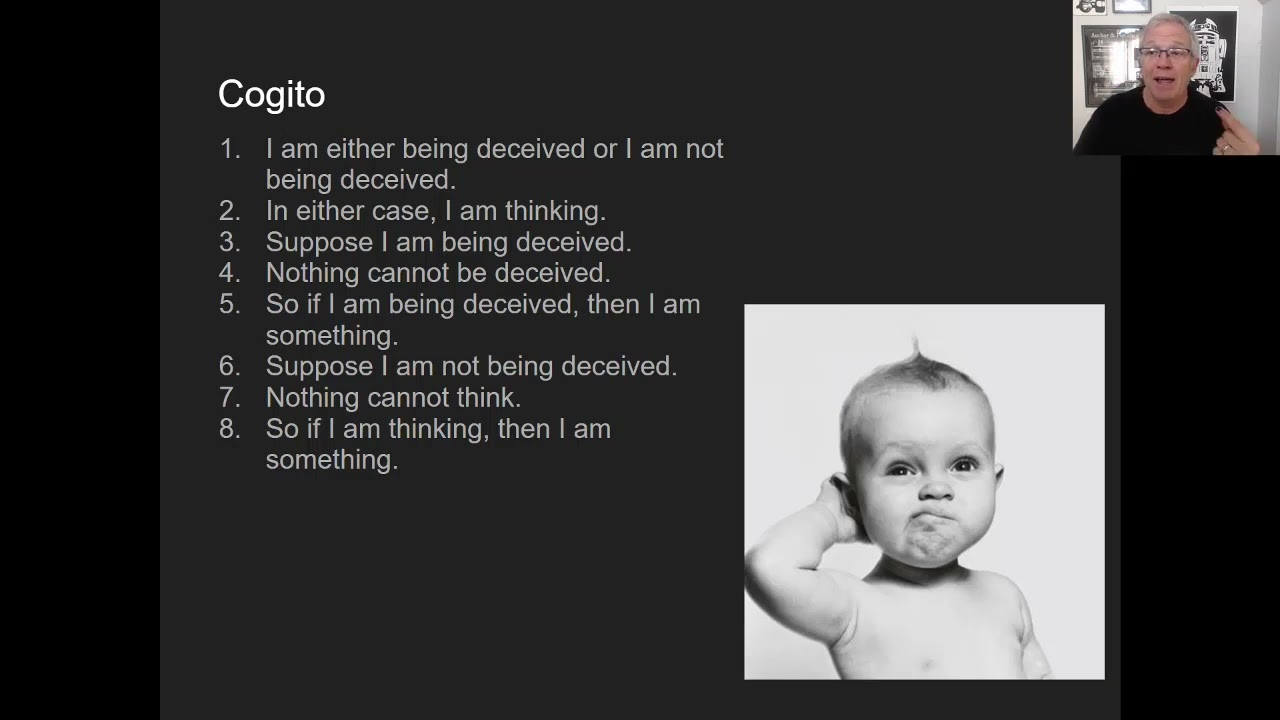
- Reflecting on being deceived, Descartes emphasizes that even under deceit, his act of thinking remains indubitable.
- Thinking and existence are inseparable for Descartes; even under deception, one's existence is affirmed through the act of thinking.
The Cogito Argument: Thinking as Existence
- If being deceived implies existence, then one must be something to be deceived; existence is tied to being a recipient of deceit.
- The cogito argument asserts that doubting one's existence while thinking is self-defeating; thinking necessitates existing.
- Whether deceived or not, thinking signifies existence for Descartes; this foundational principle leads to "I think, therefore I am."
Certainty in Existence
- Thinking equates to existing in Descartes' philosophy; certainty in one's existence arises from the immediate connection between thought and being.
- The proposition "I am" is incorrigible and immediate for Descartes, serving as a foundational truth from which knowledge can be built.
Exploring Substance Dualism
Delving into Cartesian substance dualism, Descartes questions the essence of his own existence and distinguishes mental substance from physical matter.
Nature of Self: Beyond Physicality
- Having established his own existence, Descartes ponders the nature of this "I," questioning if it pertains solely to physical matter.
- The essential aspect of self lies in thought rather than bodily presence for Descartes; he separates mental substance from material body.
DesCartes' Substance Dualism
In this section, the discussion revolves around Descartes' concept of substance dualism, highlighting the distinction between corporeal and incorporeal substances.
Descartes' Concept of Substance Dualism
- Descartes believes that the mind can exist independently from the body, rejecting the idea that the body is necessary for the mind to exist.
- Cartesian dualism posits two types of substances: corporeal (physical substances) and incorporeal (mental substances), emphasizing their essential differences.
- Descartes argues that mental substances (minds) are fundamentally distinct from material bodies due to their indivisibility compared to divisible matter.
- While physical matter can be divided spatially and temporally, minds are indivisible entities, leading to the conclusion that minds and bodies can exist separately.
- Descartes asserts that minds and bodies are not essentially tied together as they can be conceived to exist independently, giving rise to substance dualism.
Descartes' Methodological Approaches
This part delves into Descartes' methodological principles in his arguments, focusing on cognitive transparency and introspective incorrigibility.
Methodological Principles in Descartes' Arguments
- Cognitive transparency is a key principle where Descartes believes that if something is in his mind, he is aware of it, emphasizing introspection as a tool for self-awareness.
- Introspective incorrigibility suggests that one cannot be mistaken about their own thoughts or mental states when engaging in introspection.
Descartes' Epistemology and Cartesian Dualism
In this section, the discussion revolves around Descartes' epistemological views, focusing on the incorrigibility of mental states and his foundationalist approach to knowledge. Additionally, Cartesian dualism is introduced as a key concept, highlighting the interaction problem between minds and bodies.
Descartes' Foundationalist Approach
- Descartes emphasizes the incorrigibility of mental states, asserting that individuals cannot be mistaken about their own feelings or mental states. This forms the basis of certainty in knowledge.
Foundationalism in Knowledge
- Descartes is portrayed as a foundationalist who believes in justifying knowledge through absolute certainty in some foundational beliefs. He employs logic to deduce implications and build upon these certainties like a pyramid structure.
Building a Foundation for Knowledge
- The meditations serve as an exercise for Descartes to establish a solid foundation for human knowledge by proving previously held beliefs with certainty through a deliberate conscious process. This process aims to refine understanding and ensure certainty in knowledge claims.
Ontology and Epistemology in Descartes' Philosophy
This segment delves into Descartes' perspectives on ontology (the study of existence) and epistemology (the study of knowledge). It explores how Descartes defines the nature of the mind, his conclusions about its existence, and how he believes we can know our minds.
Understanding Ontology and Epistemology
- Descartes provides answers regarding what exists (ontology) and how we can know it (epistemology), offering insights into both realms of philosophical inquiry. His philosophy encompasses explanations about the nature of reality and how we can attain knowledge about it.
Nature of the Mind
Descartes' Philosophical Concepts
In this section, the discussion revolves around key philosophical concepts introduced by Descartes and their implications.
Cartesian Dualism and Cartesian Theater
- Descartes posits that Cartesian minds cannot interact with Cartesian bodies, leading to a problem for those adhering to Cartesian dualism.
- The concept of the "Cartesian theater" emerges, where individuals envision themselves as observers of events unfolding in their minds like an audience watching a mental stage.
Homuncular Regress and Conceivability vs. Logical Possibility
- Descartes' notion of the homunculus leads to the infinite homuncular regress problem, questioning how the observer within one's mind functions.
- Descartes equates conceivability with logical possibility, suggesting that if something can be imagined or conceived without logical contradiction, it is logically possible.
Logical Impossibility and Inconceivability
- According to Descartes, logically impossible scenarios are inconceivable, such as a married bachelor or a square triangle.
- The view that if something is conceivable, it is logically possible stems from medieval logic principles like the law of non-contradiction but poses challenges in understanding phenomena like blindsight.
Challenges with Cartesian Substance and Mind-Body Interaction
- Descartes' lack of clear interaction rules between immaterial substances (mind) and physical substance (body) raises questions about how they connect and govern each other.
- Neuroscience presents arguments against brainless minds, indicating that mental functions are intricately linked to brain function through evidence from brain damage cases.
New Section
In this section, the speaker discusses the existence of immoral souls and the relationship between the soul and the body.
Existence of Immoral Souls
- The speaker points to an article discussing the existence of immoral souls and whether a soul can exist independently of the body.
New Section
This part delves into Descartes' infinite homuncular regress problem and its implications.
Infinite Homuncular Regress Problem
- Descartes' infinite homuncular regress problem is introduced, highlighting a challenge in his philosophy.
- A depiction of the homuncular regress is mentioned in relation to Cartesian theater view.
New Section
The discussion continues on the concept of homuncular regress and its implications for understanding thinking processes.
Understanding Homuncular Regress
- Delving deeper into the concept, it's explained that if thinking is performed by a homunculus, it leads to an infinite regression.
- The issue of how mental states occur and what constitutes the essence of mind is raised.
New Section
Cartesian dualism is explored further, focusing on minds as non-spatial immaterial entities.
Cartesian Dualism Exploration
- Cartesian dualism posits that minds are essentially non-spatial immaterial entities distinct from bodies.
- Descartes' claims about knowing minds through introspection are challenged, hinting at major problems like interaction issues and brainless minds dilemma.