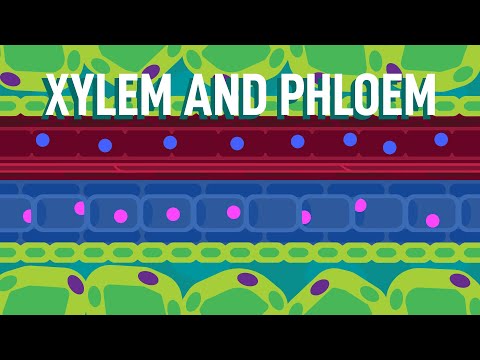
Xylem and Phloem - Transport in Plants | Biology | FreeAnimatedEducation
Transport in Plants
Overview of Plant Transport Systems
- Every cell in the body requires substances like glucose and oxygen, which are transported via the circulatory system. In plants, vital substances such as water and minerals are absorbed through roots from the soil, while glucose is produced in leaves during photosynthesis. The vascular tissue facilitates movement between different parts of the plant.
Vascular Tissues: Xylem and Phloem
- The two main types of vascular tissues in plants are xylem and phloem. Observing a fallen tree reveals that most radial contents consist of xylem (heartwood and sapwood), while phloem is found in the inner bark.
Xylem Functionality
- Xylem is responsible for transporting water and minerals from roots to other parts of the plant. Some xylem components lack protoplasms or cell walls, allowing easier passage for water and minerals. It consists of tracheids, vessels, fibers, and parenchyma cells.
- Water flow through tracheids is not continuous; they connect roots to leaves via pitted walls. In contrast, xylem vessels are long hollow tubes that run continuously from roots to leaves. Fiber cells provide structural support while parenchyma aids food storage within xylem tissues.
Phloem Functionality
- Phloem transports manufactured foods like sucrose and amino acids from green parts (leaves) to other areas of the plant through a process called translocation. It comprises sieve tubes, companion cells, fibers, and parenchyma cells. Sieve tubes have elongated thin-walled cells with perforated walls resembling a sieve for efficient transport of nutrients.
- Mature sieve tube cells contain minimal cytoplasm for conducting food but rely on companion cells for essential functions due to their degenerated protoplasm; companion cells possess abundant cytoplasm and nuclei necessary for survival processes within sieve tubes. Fiber cells offer structural support while parenchyma stores food in phloem tissues; notably, fiber cells here are dead unlike those in xylem tissues.
Arrangement of Vascular Tissue
- The arrangement varies across different plant parts; in herbaceous dicot roots, xylem forms an 'X' shape centrally surrounded by phloem tissue—this distinct organization supports effective nutrient transport throughout the plant structure as it grows and develops further into stems where arrangements differ again based on function requirements.