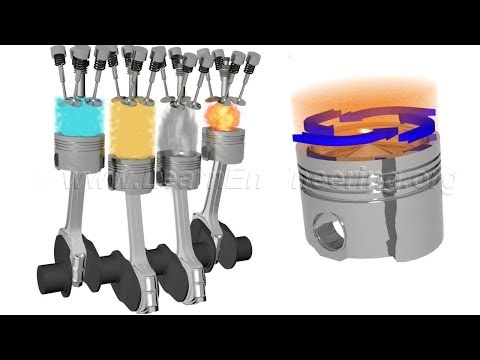
Diesel Engine, How it works ?
New Section
This section provides an overview of how an internal combustion engine works, specifically focusing on diesel engines and their operation.
Internal Combustion Engine Basics
- An internal combustion engine transforms the chemical energy in fuel into mechanical energy.
- Diesel engines are versatile and economical, serving mankind for over a century.
- To release the chemical energy effectively, atomized fuel is made to contact high temperature and high pressure air.
- The energy is transferred as mechanical rotational energy.
Diesel Engine Operation
- A diesel engine operates by continuously producing high temperature and high pressure air.
- The piston, connecting rod, crank, and cylinder form a mechanism called a slider crank mechanism. It transforms the linear motion of the piston into rotary motion at the crank.
- The mechanism is properly supported in an engine block, with the cylinder head, valves, and fuel injector fitted above it.
- During the suction stroke, inlet valves open and fresh air from outside is sucked in. During the compression stroke, the air inside the cylinder gets compressed.
- Atomized diesel fuel is injected into this compressed air. The fuel evaporates and undergoes an uncontrolled spontaneous explosion due to its self-ignition value being higher than the temperature and pressure of the compressed air.
- The resulting high-energy fluid pushes the piston downwards during the power stroke. The hot air does work on the piston, converting fluid energy to mechanical energy.
Four-stroke Cycle
- The four strokes of a diesel engine are suction stroke (inlet valves open), compression stroke (inlet/exhaust valves closed), power stroke (exhaust valves closed), and exhaust stroke (exhaust valves open).
- This cycle is repeated continuously for continuous power production.
Design Considerations
- A bowl on top of the diesel engine piston helps produce rapidly swirling air during compression. This ensures effective mixing of the injected fuel with the air.
- Diesel engines require a rugged structural design due to their non-uniform and smooth combustion process, which leads to more vibration and noise compared to petrol engines.
- Single-cylinder engines have high force non-uniformity during the power stroke. Multiple cylinders can overcome this issue, resulting in better force and power uniformity.
- A heavy flywheel acts as a power reservoir, smoothing out non-uniformity of power.
- Counterweights on the crank side negate the unbalanced force caused by excessive mass at the connecting rod side.
- Valves are accurately controlled by a pair of camshafts, which derive motion from the engine.
Conclusion
Diesel engines operate by producing high temperature and high pressure air continuously. The four-stroke cycle allows for continuous power production. Design considerations such as cylinder configuration, flywheel, counterweights, and camshafts help optimize engine performance.
Timestamps are provided in seconds (s) format.