Лекція 4 "Педагогічна спадщина Г. Сковороди і П. Юркевича" від 17.04.2024
Discussion on the Development of Personality in the Legacy of Hryhoriy Skovoroda
The discussion focuses on the development of personality within the context of Hryhoriy Skovoroda's legacy and cordocentrism in the psychological-pedagogical views of Pamfil Yurkevych, two prominent Ukrainian educators.
Hryhoriy Savych Skovoroda
- Hryhoriy Savych Skovoroda, a renowned Ukrainian educator, philosopher, writer, and poet, was born in Poltava. He studied at Kyiv-Mohyla Academy and held various teaching positions focusing on poetry, ethics, syntax, Greek language, and rhetoric.
- Skovoroda's significant professional period was at Kharkiv Collegium where he excelled as a teacher and educator. His strong connection to Kharkiv influenced his pedagogical approach significantly.
- A monument dedicated to Skovoroda stands near the central entrance of the university building on Valentynivska Street. Despite its current appearance differing from the slide image shown, there is hope for its restoration post-Ukraine's victory.
Teaching Approach and Influence
- Skovoroda continued voluntary teaching sessions with students in monastery gardens post his formal teaching career. He traveled extensively across Left-Bank Ukraine and Kharkiv region, garnering admiration from diligent and talented students who sought his guidance.
- Students admired Skovoroda for instilling respect for their nation, love for their land, honesty, industriousness while discouraging materialistic desires or high social status pursuits.
Concept of Srodnost Pratsia (Cordocentrism) by Hryhoriy Skovoroda
The concept delves into "Srodnost Pratsia" or cordocentrism proposed by Hryhoriy Skovoroda emphasizing work aligned with one's natural inclinations and bringing joy through both process and results.
Srodnost Pratsia Philosophy
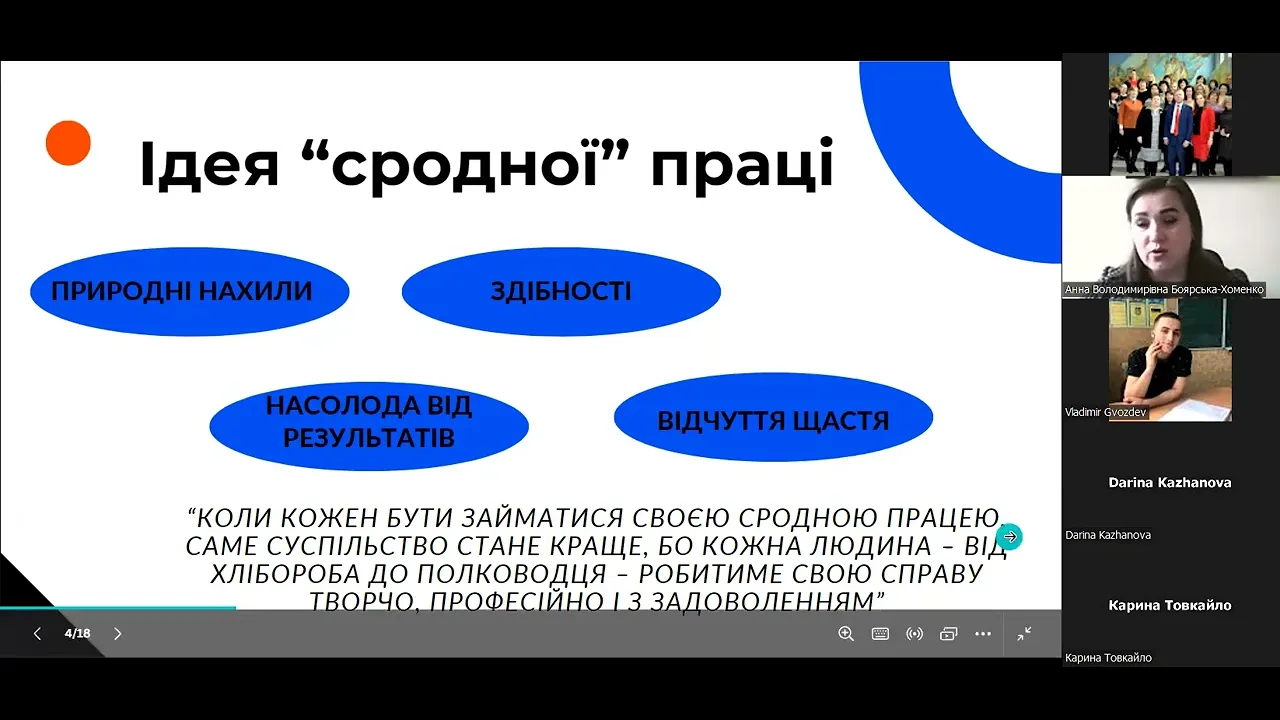
- Srodnost pratsia refers to work that considers an individual's natural abilities, skills, inclinations towards specific activities. It emphasizes deriving pleasure from both the process and outcomes of work.
- According to Skovoroda's teachings, work should bring happiness through its results and process. It should align with one's natural talents and interests to be fulfilling.
- Every person should engage in srodnost pratsia from childhood to adulthood based on their inherent abilities. Parents should not impose career choices but allow children to discover their natural inclinations without hindrances.
Influence on Child Development
The discussion explores how parents' influence can impact children's career choices negatively if not aligned with their innate talents or interests.
Impact of External Influences
- Children often choose professions influenced by trends rather than personal inclination due to parental pressure or societal norms. This can lead them away from paths that truly resonate with their abilities.
- Historical shifts in popular professions reflect societal trends; currently aspiring towards roles like bloggers or gamers may not always match individuals' true passions compared to past preferences for engineering or law careers.
New Section
In this section, the speaker discusses the importance of identifying a child's inclinations and interests to guide them towards success in their chosen profession.
Identifying Child's Inclinations
- Educators should identify a child's inclinations and talents by observing their engagement in various activities.
- Encouraging children to explore different fields such as gardening, music, art, etc., helps them discover their preferences.
- Through exploration, children can determine what activities they enjoy and excel at, aiding educators in guiding them effectively.
New Section
The speaker delves into Grigoriy Savych Skovoroda's concept of engaging in suitable work to achieve success and improve society.
Engaging in Suitable Work
- Skovoroda emphasized that individuals should engage in work that aligns with their abilities to contribute positively to society.
- If everyone pursues tasks suited to their skills creatively and professionally, society will benefit collectively.
New Section
The discussion transitions to the three worlds according to Grigoriy Savych Skovoroda: macrocosm, artificial intelligence-generated images, and the significance of spiritual elements.
Three Worlds Concept
- Skovoroda categorized three worlds: macrocosm (surroundings), AI-generated images reflecting his ideas persisting today.
- Macrocosm represents everything surrounding us materially and spiritually.
New Section
Exploring Grigoriy Savych Skovoroda's views on human nature comprising eternal and transient aspects.
Human Nature Duality
- Skovoroda discussed human duality - eternal (spiritual/moral aspect) and transient (material achievements).
- Emphasized prioritizing spiritual development over material gains for true human essence.
New Section
Delving into the third world of symbols around us as per Grigoriy Savych Skovoroda's teachings.
World of Symbols
- Skovoroda highlighted the world of symbols encompassing religious influences intertwined with education and personal development.
Understanding Personal Development and Self-Improvement
In this section, the speaker discusses the importance of recognizing individual uniqueness and talents, emphasizing the role of teachers in helping children understand their distinctiveness and potential across various domains.
Recognizing Individual Uniqueness
- The speaker highlights the significance of acknowledging one's unique gifts, inclinations, and abilities.
- Individuals engage with society not only through their professional roles but also through their social contributions and interactions.
- Mental and emotional development take precedence over physical and aesthetic growth, followed by acquiring social experiences and a profession.
Stages of Personal Development
This part delves into Grigoriy Savich's four stages of personal development, focusing on self-awareness, talent exploration, self-improvement, and spiritual-moral growth.
Grigoriy Savich's Four Stages
- The first stage involves self-discovery to understand one's values, identity, and purpose.
- Self-determination characterizes the second stage as individuals seek to identify their talents for career choices.
- The third stage centers on self-development once a suitable profession is chosen.
- Self-improvement marks the fourth stage where individuals refine their spiritual-moral sphere for personal growth.
Emphasizing Spiritual-Moral Development
This segment underscores the value of spiritual-moral evolution in personal growth compared to professional or physical advancements.
Spiritual-Moral Growth
- Spiritual-moral development is deemed as the pinnacle of personal progress according to Grigoriy Savich.
- Eastern philosophers prioritize spiritual-moral elevation over other forms of realization like professional or social achievements.
Continuous Self-reflection for Personal Growth
Here, the importance of constant self-reflection for enhancing intellectual and moral capacities is discussed as a crucial aspect of personal development.
Continuous Self-reflection
Grigoriy Skovoroda's Views on Education
Grigoriy Skovoroda emphasizes the importance of self-awareness, continuous self-improvement, and the role of educators in nurturing students' natural abilities while maintaining their freedom.
Grigoriy Skovoroda's Philosophy on Self-Reflection and Development
- Skovoroda advocates for critical self-assessment, urging individuals to evaluate their talents and weaknesses. He highlights the need to motivate oneself while critically analyzing one's beliefs and actions.
- He discusses the concept of "сродності" (innate predisposition), emphasizing that it reveals both strengths and weaknesses.
The Pitfalls of Following a Single Path
- Skovoroda warns against blindly following a predetermined path based on innate predispositions as it can limit personal growth and restrict individuals to a singular type of activity throughout life.
- He suggests that true development lies in spiritual and moral growth beyond innate predispositions, encouraging individuals to explore diverse interests.
Educator's Role in Fostering Freedom and Responsibility
- Educators should guide students without restricting their freedom, ensuring they understand the consequences of their actions.
- Skovoroda stresses the crucial role of teachers in recognizing and nurturing students' natural inclinations across various fields of knowledge, surpassing parental influence due to extended time spent with students.
The Significance of Teaching Profession According to Grigoriy Skovoroda
Grigoriy Skovoroda values teaching as a noble profession requiring love for children, passion for education, and dedication to fostering students' growth.
Teacher as a Gardener
- Drawing an analogy between teachers and gardeners, he likens caring for students' development without imposing artificial constraints to tending plants with care but allowing them to grow naturally.
Importance of Teacher's Passion
Learning and Development Philosophies
The section discusses the ideas of Grigory Savich Skovoroda on personal development and the role of teachers in shaping individuals, contrasting them with the pedagogy of Pamphil Yurkevich.
Grigory Savich Skovoroda's Ideas
- Skovoroda emphasizes continuous self-improvement and learning as crucial for personal growth.
- His philosophy focuses on the development of individuals and the significant role teachers play in this process.
Pamphil Yurkevich's Pedagogy
- Yurkevich's views align with Skovoroda's, considering education vital for nurturing individuals.
- He highlights that teaching is a creative endeavor requiring inspiration and love, unlike mechanical tasks.
Pedagogical Approach of Pamphil Yurkevich
This part delves into Pamphil Yurkevich's background, emphasizing his contributions to education and his unique approach to teaching.
Background of Pamphil Yurkevich
- Yurkevich was initially a mathematician and philosopher before transitioning to pedagogy.
- He excelled as a lecturer at Kyiv Spiritual Academy, known for his expertise in mathematics, philosophy, and languages.
Teaching Philosophy
- Yurkevich advocated for making pedagogy a mandatory subject for aspiring educators.
- His teachings underscored the importance of educators having comprehensive knowledge beyond their subject expertise.
Core Concept: Cordocentrism
Exploring the concept of cordocentrism as discussed in relation to educational philosophies by highlighting its significance in understanding human perception.
Understanding Cordocentrism
- Cordocentrism involves perceiving the world not just through intellect but also through emotions and heart-centered feelings.
- It emphasizes that true comprehension comes from experiencing knowledge through one's heart rather than mere intellectual understanding.
Philosophy of Heart-Centered Education
Delving into how heart-centered education aligns with Pamphil Yurkevich's beliefs on valuing individuality and responsibility in learning processes.
Heart-Centered Learning
- Heart-centered education asserts that children grasp knowledge effectively when infused with emotions and experiences.
Understanding the Importance of Education and Upbringing
The speaker discusses the significance of education and upbringing in shaping individuals and society, emphasizing the role of emotions before intellect in learning.
Emotions as Foundation for Learning
- Emphasizes that understanding the world starts with emotions before engaging intellect.
- Suggests that education should prioritize emotional connection before analytical thinking.
- Highlights the importance of emotional engagement in knowledge acquisition.
Role of Education in Society
- States that education is crucial for societal existence and advancement.
- Stresses the powerful impact of upbringing on individual development and societal progress.
The Role of Education in State Development
The discussion focuses on how education plays a vital role in advancing states, societies, and individuals.
Significance of Continuous Education
- States that continuous education is essential for societal enlightenment.
- Views education as a fundamental factor determining a nation's progress.
Educational Values for State Advancement
- Emphasizes that constant development and nurturing of young generations are key to societal evolution.
Education as a Pillar for National Progress
The speaker elaborates on how education serves as a cornerstone for national growth and prosperity.
Educational Foundations for State Stability
- Discusses how historical significance transitions to economic power before focusing on educational values.
Essentiality of Education
- Stresses that education is indispensable for realizing national potential.
Challenges Faced by Modern Education Systems
The challenges encountered by modern educational systems are highlighted, particularly the shift away from core educational values.
Diminished Focus on Education
- Notes a decline in emphasis on education compared to material wealth or war efforts.
Neglecting Educational Ideals
- Points out a deviation from foundational educational principles towards materialistic pursuits.
Critique on Idealized Educational Standards
Criticism is directed towards idealized educational standards, advocating against forcing unrealistic expectations onto individuals.
Unrealistic Expectations
- Warns against imposing unattainable ideals onto students or teachers.
Undesirable Outcomes
New Section
In this section, the speaker discusses the role of educators in utilizing a set of recipes from pedagogy and methodology when working with children. However, it is emphasized that teachers should prioritize understanding and connecting with students on a personal level.
Educator's Role and Approach
- An educator is described as someone who uses a specific set of recipes from pedagogy and methodology in interactions with children.
- The primary duty of an educator is to love and appreciate each individual student for their uniqueness, fostering a free spirit within the school environment.
- Emphasis is placed on nurturing each child's personality and freedom within the educational system, highlighting the dynamic interaction between students, teachers, and parents.
New Section
This part delves into the reciprocal learning process between teachers and students, emphasizing how both parties enrich each other through communication, understanding, and continuous learning.
Reciprocal Learning Process
- Teachers not only educate students but also learn from them, constantly evolving their teaching methods through interactions with children.
- The importance of developing human connections between teachers and students is highlighted as crucial for successful education.
New Section
The discussion shifts towards teaching abstract concepts effectively by starting with tangible experiences before progressing to more complex ideas. Additionally, the significance of heart-centered learning for both teachers and students is underscored.
Teaching Abstract Concepts
- Prioritizing concrete understanding before introducing abstract concepts aids in effective learning processes.
- Heart-centered learning philosophy emphasizes that both teachers and students should engage emotionally in the educational journey for optimal outcomes.
New Section
The speaker introduces an interactive game-based learning activity using Kahoot to reinforce key concepts discussed earlier in the session.
Interactive Learning Activity
- Introduction of Kahoot game-based learning platform to engage participants in reinforcing learned concepts interactively.
- Encouragement for participants to join the Kahoot game session using provided links or QR codes for active participation.
New Section
Participants are invited to join an interactive quiz session using Kahoot to assess comprehension of discussed topics through gamified learning.
Interactive Quiz Session
- Instructions given for participants to join the quiz session via provided links or QR codes for real-time engagement.
Concept of Cordocentrism and Development of Personality
The discussion revolves around the concept of cordocentrism and its impact on the development of personality, emphasizing the role of education in societal progress.
Cordocentrism Philosophy
- Elena mentions that the concept of cordocentrism shifts the focus towards education as a key factor in societal advancement.
- Lisa highlights the importance of effective education for the development and progress of a state.
- Reference is made to four stages in personal development: self-awareness, self-determination, self-improvement, and overall personality growth attributed to Skovoroda, Comenius, Montessori, and Yurkevich.
- Cordocentrism philosophy stresses respect for individual characteristics in children, emphasizing the interplay between education and learning through repetition.
This section delves into how cordocentrism shapes educational philosophies and influences personal growth through tailored approaches to learning.
Impact of Education on Societal Progress
The conversation explores how education serves as a catalyst for societal advancement by nurturing individuals' potential.
Educational Influence
- Effective education is identified as a prerequisite for national development.
- The four stages of personal development are linked to prominent educators like Skovoroda, Comenius, Montessori, and Yurkevich.