Understanding Spectrum! | ICT #6
New Section
This section introduces the concept of the electromagnetic frequency range and its value as a resource. It also mentions the U.S. government's revenue from a spectrum auction.
The Value of the Electromagnetic Frequency Range
- In 2008, the U.S. government earned 19 billion dollars through a spectrum auction.
- Mobile phones use invisible electromagnetic waves for internet use and voice calls.
- Cellular communication divides geographical areas into different cells.
- Each user in a cell area requires a unique frequency to transmit signals.
New Section
This section uses an analogy to explain how cellular communication ensures each user has a unique frequency.
Analogy of Balls and Cups
- An analogy is used with balls of different colors being ejected from a toy fountain.
- Assigning sizes to specific colors ensures each ball reaches its corresponding cup.
- Cellular communication applies this concept by assigning unique frequencies to users.
New Section
This section explains how mobile phones filter out unwanted frequency signals and the need for each active user to have a unique frequency range.
Filtering Signals and Unique Frequency Ranges
- Mobile phones only accept signals with their assigned frequencies, rejecting all others.
- s Each active user must have a unique frequency range to avoid overhearing someone else's signal.
New Section
This section discusses the use of frequency bands, modulation techniques, and encryption for cellular communication.
Frequency Bands and Modulation Techniques
- Antennas transmit signals within a frequency range or band.
- Frequency modulation requires two frequencies to transmit signals.
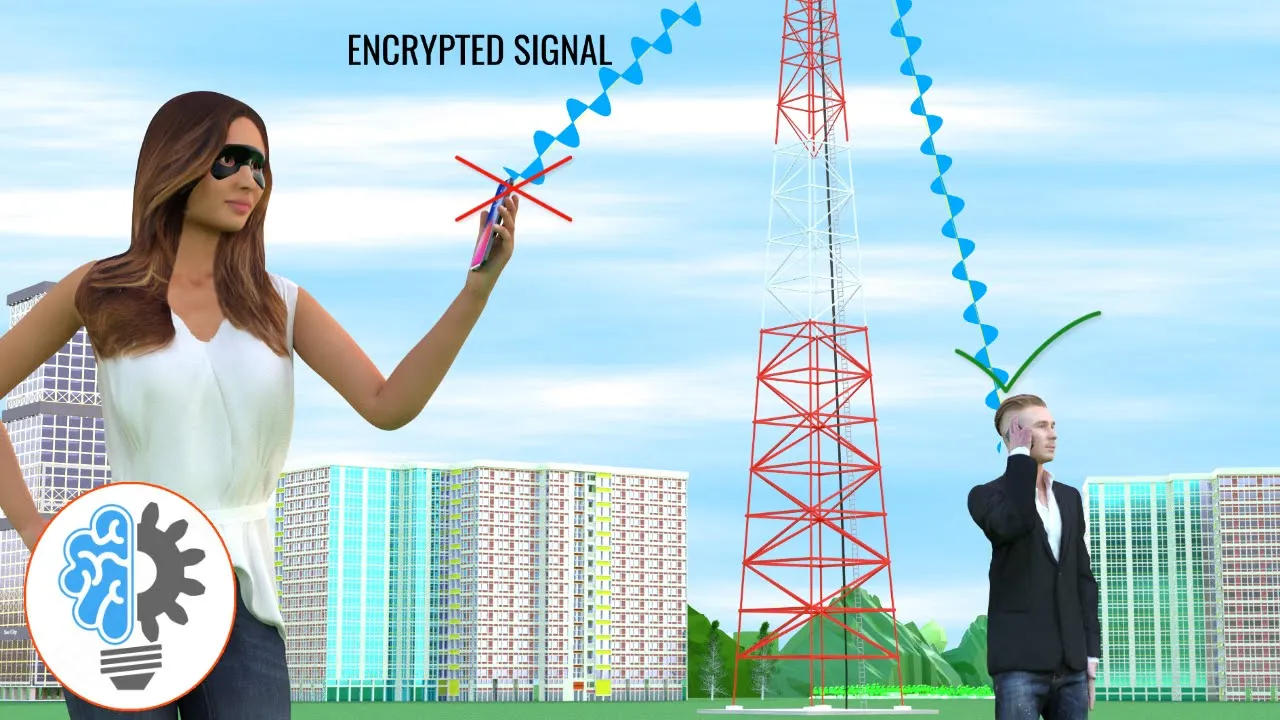
- Signals sent over frequencies are protected using encryption.
New Section
This section highlights the limited availability of the electromagnetic spectrum for cellular communication and how it is managed by government bodies.
Limited Spectrum Availability and Management
- Only a small portion of the electromagnetic spectrum is useful for cellular communication.
- Governments manage the spectrum through auctions or lottery systems.
- s The FCC, NTIA, CEPT, and ITU are involved in managing the radio spectrum globally.
New Section
This section explains the evolution of modulation techniques from 1G to 4G and introduces QAM as a more efficient technique.
Evolution of Modulation Techniques
- Frequency modulation used in 1G is now obsolete.
- QAM (Quadrature Amplitude Modulation) allows sending more bits at a time.
New Section
This section emphasizes the need to efficiently use limited frequency ranges in cellular communication by dividing them into slots distributed among towers.
Efficient Use of Frequency Ranges
- Cellular systems divide the available frequency range into slots.
- These frequency slots are distributed among multiple towers.
Frequency Slot Distribution
This section discusses frequency slot distribution in cellular communication and how it allows for seamless handover between neighboring cells without call dropping.
Frequency Slot Distribution
- Frequency slot distribution refers to the allocation of different frequencies to cell areas in cellular communication.
- During a call, when a user moves into a neighboring cell, they are allocated a different frequency from the neighboring cell tower to ensure uninterrupted communication.
Multiple Access Techniques
This section explains the concept of multiple access techniques used in cellular communication to manage active users within a cell area simultaneously.
Analogy with Musicians Recording a Song
- Multiple access techniques in cellular communication can be understood using an analogy of 100 musicians recording a song.
- Just like musicians can record in different rooms, at different times, or in different languages, multiple users and the cell tower can share information over different frequency slots, time slots, or using different encoding techniques.
Efficient Spectrum Utilization
- Each generation of cellular communication has introduced different multiple access techniques with the main focus being efficient utilization of the available spectrum.
- For example, 4G introduced Orthogonal Frequency Division Multiple Access (OFDMA), where the available frequency range is split into smaller ranges called sub-carriers that are mathematically orthogonal to each other. Each sub-carrier is modulated individually.
Turn any video into a summary like this
YouTube links, meetings, lectures — with transcripts, search, and chat.