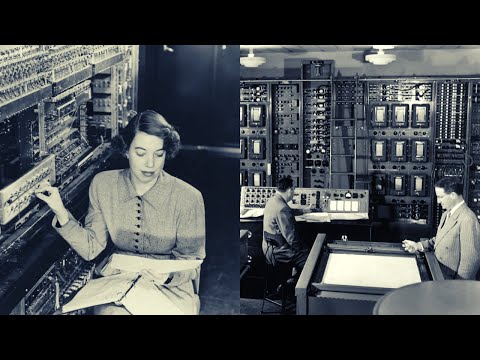
La PRIMERA GENERACIÓN DE COMPUTADORAS: origen, hardware, software, modelos🖥️
The Evolution of First Generation Computers
Overview of First Generation Computers
- The first generation of computers spanned from 1940 to 1956, utilizing vacuum tube technology for calculations and storage.
- These early machines were massive, often occupying entire rooms, and had significant limitations in functionality.
Operational Characteristics
- Operations were performed using machine language, the most basic programming language understood by computers, which could only solve one problem at a time.
- Input was managed through punched cards while output was provided via printouts; setting up these systems required extensive wiring that could take days or weeks.
Historical Context
- The Atanasoff-Berry Computer is noted as an early electronic computer developed by John Atanasoff in 1937 with support from Clifford Berry.
- World War II accelerated the development of electronic computers due to military needs for complex calculations and substantial funding.
Key Innovations
- The ENIAC was the first electronic computer recognized for its programmable capabilities, although programs were not stored internally initially.
- John von Neumann significantly influenced computing by proposing the concept of stored-program architecture, leading to practical implementations by 1951.
Features of First Generation Computers
Problem-Solving Capabilities
- These computers could only solve one problem at a time with specific operating instructions tailored for designated tasks.
Technology Utilized
- Vacuum tubes served as CPU circuitry while magnetic drums were used for data storage; input devices included paper tapes and punch cards.
Performance Limitations
- Processing speeds were low and inefficient due to reliance on vacuum tubes, resulting in unreliable performance primarily limited to simple numerical calculations.
Cost Implications
- Operating these large machines was expensive; they consumed considerable electricity and generated heat that often led to malfunctions.
Programming Language Constraints
- Early computers operated using machine language (binary), making programming cumbersome and accessible only to experts. Assembly language emerged later but was still rudimentary compared to modern standards.
Software Development Challenges
Programming Interface
- Interaction with first-generation computers involved manual wiring connections without any operating system software or assembly languages available at that time.
Batch Processing Systems
The Evolution of Early Computers
The Birth of Software and Stored-Program Computers
- The concept of software emerged with the Manchester Experimental Machine, which was the first to execute a program from memory, marking the birth of stored-program computers in 1948.
- This machine executed a 17-instruction program in fifty-two minutes, showcasing early computational capabilities.
First Generation Hardware: Vacuum Tubes
- First generation computers (1940-1956) relied heavily on vacuum tubes for signal amplification and switching, resulting in large computing facilities that occupied entire rooms.
- Vacuum tubes were glass receptacles invented by Lee De Forest in 1906, crucial for various electronic devices including televisions and radars.
Input and Output Mechanisms
- Input and output operations utilized punch cards, magnetic drums, typewriters, and punch card readers; initially done manually before automation took over.
Notable First Generation Computers
ENIAC
- ENIAC (Electronic Numerical Integrator And Computer), built between 1943 and 1945, was the first general-purpose operational electronic computer using 18,000 vacuum tubes.
- It could perform calculations at a rate of 1,900 additions per second but was slow to reprogram. Designed by John Mauchly and Presper Eckert at the University of Pennsylvania.
EDSAC
- Developed in Great Britain as the first non-experimental stored-program computer in 1949; it utilized mercury delay line memory.
ACE Pilot Model
- Completed by Alan Turing in 1950 as a test computer; it operated normally for five years despite being primarily experimental.
UNIVAC