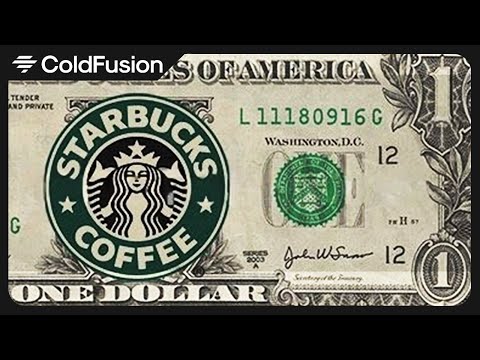
Starbucks is Secretly a Massive Bank
The Blurry Boundaries of Business Sectors
In this section, we explore how the boundaries between business sectors are becoming increasingly blurred in our consumer-driven world.
The Shifting Landscape
- IBM shifted from hardware manufacturing to investing in software.
- Lego expanded into the film and video game market.
Unconventional Players in the Financial Sector
- Companies like Apple and Starbucks have entered the financial sector.
- Starbucks has used customer funds to launch an investment scheme without their knowledge or providing returns.
The Clever Plan Behind Starbucks' Rewards System
This section delves into Starbucks' rewards system and how it functions as a quasi-banking operation.
My Starbucks Rewards System
- Customers earn digital currency called Stars with every purchase.
- Stars can be exchanged for free food, drinks, or merchandise.
- Starbucks invests customer funds loaded onto the rewards system in low-risk ventures, earning interest on their money.
The Lucrative Arrangement of Starbucks' Loyalty Program
Here we explore the scale and value of Starbucks' loyalty program and its inadvertent banking operations.
Scale and Value of the Loyalty Program
- There are 29 million Starbucks reward members worldwide.
- Estimates suggest that over $10 billion flows through the loyalty program annually.
- If Starbucks were a traditional bank, it would rank in the top two percent of U.S. banks by deposit size.
Skillful Obscurity Behind Starbucks' Banking Operations
This section uncovers how Starbucks skillfully obscures its banking operations behind customer service and convenience.
Customer Satisfaction vs. Free Loan
- Customers who leave money in their Starbucks rewards account essentially provide the company with an interest-free loan.
- The system is obscured behind customer service and convenience, leaving customers satisfied but unaware of the financial arrangement.
The Rise of Other Companies in the Business of Money
We explore how other companies like Amazon, Apple, Walmart, Target, and Costco are entering the business of money.
Strong Consumer Base and Brand Identity
- Companies like Apple and Walmart leverage their strong consumer base and brand identity to offer financial services.
- Examples include Apple Pay, the Apple Card, Walmart Money Card, and Walmart2Walmart.
Conclusion
In this video transcript summary, we examined how Starbucks cleverly utilizes its rewards system as a quasi-banking operation. By investing customer funds loaded onto the system in low-risk ventures, Starbucks earns interest on their money while providing customers with incentives through digital currency called Stars. This model has proven highly lucrative for Starbucks, attracting millions of reward members worldwide. Furthermore, we explored how other companies are following suit by entering the business of money to capitalize on their established consumer base and brand identity.
The Need for Regulation in Financial Services
This section discusses the increasing need for regulations in financial services, both in the United States and globally.
Proposed Rules in the United States
- The United States is proposing new rules that require companies offering certain financial services to register and comply with user protection laws.
- Some states, like New York, are pushing for these companies to obtain a license for providing such services.
Global Recognition of the Hybrid Model
- Countries worldwide are recognizing the implications of this hybrid model in financial services.
- In the European Union, new rules are proposed that require companies offering specific financial services to be licensed by the European Central Bank.
- The United Kingdom now necessitates such businesses to register with the Financial Conduct Authority.
- In Australia, they must obtain a license from the Australian Securities and Investments Commission.
Uncertainty and Effectiveness of Regulations
- As traditional business sectors blur boundaries, there is uncertainty regarding the effectiveness of these regulatory efforts.
- Even something as simple as a coffee shop rewards program can morph into interest-free financial services without customers noticing.
- It is peculiar that a coffee corporation can act like a bank without regulations.
Discussion on Transparency and Laws
- Starbucks, as an example, acts like a bank without regulations but remains under increased scrutiny from authorities.
- Should Starbucks be more transparent about what they do with consumer funds?
- Do laws need to be changed or is what they're doing acceptable as long as customers are happy?
Conclusion and Collaboration Announcement
This section concludes the video and announces a collaboration with another channel on AI.
Wrapping Up Thoughts
- The topic discussed raises interesting questions about this murky gray area between traditional business sectors and financial services.
- Viewers are invited to share their thoughts on whether Starbucks should be more transparent or if laws need to be changed.
Collaboration Announcement
- The video creator has collaborated with the Australian Broadcasting Corporation's channel for a three-part series on AI.
- The first episode will be released within 24 hours, and a link to it is provided below the video.
End of Video
[Music]