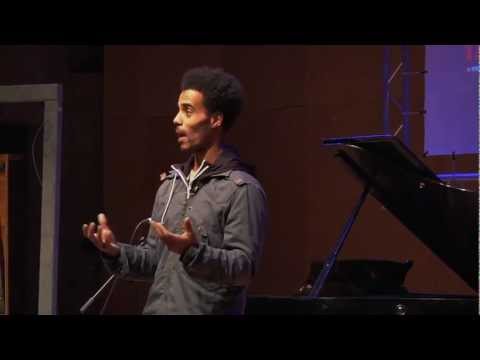
Hip-Hop & Shakespeare? Akala at TEDxAldeburgh
New Section
In this section, Akala from the Hip Hop Shakespeare Company introduces the concept of hip hop and Shakespeare and challenges the audience to a pop quiz to determine whether certain quotes are from hip hop songs or Shakespearean plays.
Pop Quiz on Hip Hop vs. Shakespeare
- Akala presents a pop quiz where he shares one-line quotes and asks the audience to guess whether they are from hip hop songs or Shakespearean plays.
- The first quote, "To destroy the beauty from which one came," is revealed to be from Jay-Z's song "Can I live?"
- The quote "Maybe it's hatred I spew, maybe it's food for the spirit" is identified as being from Eminem's track "Renegade."
- The quote "Men would rather use their broken weapons than their bare hands" is correctly recognized as being from Shakespeare's play "Othello."
- The line "I was not born under a rhyming planet" is revealed to be from Shakespeare's play "Much Ado about Nothing."
- The quote "The most benevolent king communicates through your dreams" is attributed to RZA of Wu-Tang Clan.
- The final quote, "Socrates, philosophies and hypotheses can't define," is correctly identified as being from Wu-Tang Clan's song "Triumph."
New Section
In this section, Akala discusses how language and perception can make it challenging to distinguish between hip hop and Shakespeare. He shares that even senior professors at respected Shakespearean institutions have struggled with the pop quiz.
- Akala highlights how language, subjects, and context can make it difficult to differentiate between hip hop and Shakespeare.
- One of the main similarities between hip hop and Shakespeare is rhythm, specifically iambic pentameter.
- Akala demonstrates how iambic pentameter can be used in hip hop by reciting a modified version of Shakespeare's Sonnet 18 in a rhythmic manner.
New Section
In this section, Akala concludes his presentation by emphasizing the shared rhythm between hip hop and Shakespeare and the difficulty of writing lyrics that fit different beats.
- Akala explains the challenge of adapting lyrics written for one beat to fit another beat with a different tempo.
- He concludes by highlighting that despite the differences in language and perception, there are significant parallels between hip hop and Shakespeare.
The transcript provided does not cover the entire video.
The Power of Rhythm
In this section, the speaker discusses the power of rhythm in music and how it can be applied to different styles and tempos. The consistent rhythm allows lyrics to fit seamlessly into various beats.
Exploring Different Beats
- Different styles and tempos of beats can still accommodate the same lyrics due to the consistent rhythm.
- The speaker demonstrates this by performing a different style of beat while using the same lyric from Shakespeare's sonnet.
Rhythm as a Reflection of Life
This section delves into how rhythm in music imitates the rhythm of life and serves as a mnemonic device for remembering lyrics. The speaker emphasizes that rhythm helps us understand and communicate emotions effectively.
Music as Imitation of Life
- Music imitates the sounds and rhythms of life, including the heartbeat.
- Iambic pentameter, a simple but intrinsic rhythm, is found in various forms of music worldwide.
- Different cultures have their own unique rhythms, such as West-African rhythms based on triplets.
Rhythm as Communication Tool
- The consistent rhythm in music acts as a mnemonic device for young people to remember lyrics.
- Rhythm helps us understand and convey emotions effectively.
- In hip hop, tonality, mood, and rhythm are equally important in conveying meaning.
Challenging Perceptions about Shakespeare
This section focuses on challenging common misconceptions about William Shakespeare. The speaker highlights that many beliefs surrounding Shakespeare's language, background, and intelligence are inaccurate or exaggerated.
Misconceptions about Shakespeare
- Many people hold false beliefs about Shakespeare's language, assuming he spoke posh or received pronunciation English.
- In reality, Shakespeare spoke a mix of Yorkshire and Cornwall accents, pronouncing words differently.
- The perception of Shakespeare as an elitist figure is questioned, considering that the majority of his audience at the time couldn't read or write.
Hip Hop and Misunderstandings
This section addresses common misunderstandings about hip hop. The speaker emphasizes the importance of understanding the true origins and elements of hip hop before forming opinions about it.
Lack of Knowledge about Hip Hop
- Many people who have opinions about hip hop actually know very little about it.
- The term "hip hop" originates from the Wolof word "hipi," meaning "to open one's eyes and see."
- Hip hop consists of five elements: DJing, MCing, break dancing, graffiti art, and intelligent movement.
Conclusion
The transcript provides insights into the power of rhythm in music and challenges misconceptions surrounding both Shakespeare and hip hop. It highlights how rhythm serves as a universal language in music, imitating life's rhythms and aiding in communication.
New Section
This section discusses the role of griots in Malian culture and how their musical oral traditions influenced various genres of music, including jazz, blues, funk, and hip hop.
The Role of Griots
- Griots are rhythmic oral poets, singers, musicians, and custodians of history and spiritual traditions in Mali.
Influence on Music
- The musical oral cultural traditions of griots manifested in complex ways in the Americas and influenced genres such as jazz, blues, funk, and hip hop.
- Understanding the historical context of New York City in the late 1970s and early 1980s is crucial to understanding hip hop as a culture.
- Hip hop was influenced by various factors such as post-civil rights era aesthetics, literature by Amiri Baraka and James Baldwin, and the funk music of James Brown.
- James Brown's drum loops became the basis for all hip hop music.
Hip Hop as a Culture
- Hip hop culture emerged from a post-civil rights era aesthetic influenced by literature and music. It was about being custodians of knowledge and transmitting it through music.
- The Wu-Tang Clan played a significant role in uniting people from different musical backgrounds with their album "Wu-Tang Forever." It showcased openly proud intellectual discourse that appealed to a wide audience.
Example: RZA's "Twelve Jewels"
- The RZA's poem "Twelve Jewels" exemplifies the boastful intellect often found in hip hop lyrics. It demonstrates how hip hop carries power similar to Shakespearean works in questioning the world around us.
Custodians of Knowledge
- The work of the Hip Hop Shakespeare Company aims to be custodians of knowledge in the 21st century, particularly in post-industrial societies.
The Importance of Education and Aspiration
In this section, the speaker discusses the significance of education and how it shapes society. They question whether we are training individuals to reach their full potential or if we are still adhering to old ways of thinking.
Education and Society
- The success or failure of a society is increasingly dependent on the ideas and minds of its people.
- Are we encouraging individuals to aspire to be the best they can be and reach their full potential?
- Do we still adhere to old, stratified ways of thinking where people have predetermined stations in life?
Unity in Human Culture
- By combining seemingly disparate art forms and worlds, we can demonstrate a unity in human culture.
- This unity extends to the ideas pursued by humans in various activities.
- The goal is to inspire people towards their own artistic, literary, cultural, and societal achievements.
Blending Shakespeare with Hip Hop
The speaker shares an example that combines Shakespearean plays with hip hop music as a way to bridge two seemingly different art forms.
Freestyle Challenge
- The speaker was challenged by a DJ on Radio 1 Extra to fit 27 Shakespeare plays into a freestyle rap.
- Although it wasn't a true freestyle due to time constraints, they managed to create a track incorporating the plays.
- The resulting piece titled "Comedy, Tragedy, History" includes 27 Shakespeare plays and 16 famous quotes interwoven.
Rap Incorporating Shakespeare's Plays and Quotes
The speaker performs a rap that incorporates references to various Shakespearean plays and quotes.
Rap Performance
- The rap begins with references to specific Shakespearean plays such as "Comedy of Errors" and "Othello."
- The speaker uses wordplay to highlight their own skills and dismiss the abilities of others.
- Each line references a different play or quote, showcasing the breadth of Shakespeare's work.
More Quotes from Shakespeare
The speaker continues their rap performance, incorporating additional famous quotes from Shakespeare.
Additional Quotes
- The rap includes 16 famous quotes from Shakespeare's works.
- These quotes touch on various themes such as wisdom, temptation, ambition, and self-awareness.
- The speaker cleverly weaves these quotes into their rap verses.
Skillful Rapping and Wordplay
The speaker showcases their rapping skills by using wordplay and clever lyrics inspired by Shakespearean language.
Skillful Rapping
- The speaker demonstrates their ability to use daggers, hammers, and military-like patterns in their rap delivery.
- They emphasize their passion for rapping and the impact it has on listeners.
- Wordplay is a key element in their verses, showcasing creativity and linguistic prowess.
Conclusion of Rap Performance
The speaker concludes their rap performance with powerful lines that showcase their talent.
Powerful Conclusion
- The speaker asserts themselves as a formidable rapper who surpasses others in skill.
- They use metaphors and references to assert dominance over lesser rappers.
- Their final lines convey confidence and assertiveness.