The Bell Curve (Normal/Gaussian Distribution) Explained in One Minute: From Definition to Examples
Understanding the Bell Curve
Overview of the Bell Curve
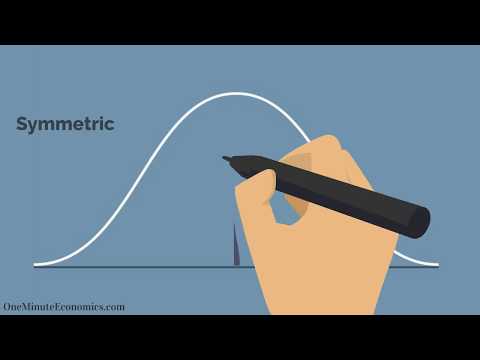
The bell curve, also known as normal distribution or Gaussian distribution, represents how data is typically distributed in a "normal" manner. The graph resembles a bell shape.
This distribution is commonly observed in various aspects of daily life, such as measuring the heights of local university students, where most individuals cluster around an average height.
Characteristics of the Bell Curve
At both extremes of the bell curve are individuals who are either very tall or very short, illustrating that while most values are centered around the mean, there are outliers on either end.
When data follows this distribution pattern, key statistical measures—mean (average), median, and mode—are equal; thus, the bell curve has one mode and is symmetric in nature.
Video description
If we measure people's height and display the results graphically, we'll notice that in most cases, we'll end up with something that looks like... you've guessed it, a bell.
The bell curve or Gaussian distribution is remarkably common when measuring anything from people's shoe size or even their IQ.
But what's the definition of the bell curve?
The term "Gaussian distribution" may sound misleadingly complicated at first, but fortunately, understanding the basics is not complicated at all.
I've explained the bell curve by, on the one hand, defining it and on the other hand, by illustrating everything through easy-to-understand Gaussian distribution examples.
After watching this video, you'll go from "kind of, sort of" knowing what this "Gauss curve thingy" is to meaningfully understanding Gaussian distribution.
Whether people refer to it as simply the bell curve or use the more sophisticated Gaussian distribution terminology, the bottom line is this: there's just no way to wrap your head around statistics without understanding the bell curve.
To support the channel, give me a minute (see what I did there?) of your time by visiting OneMinuteEconomics.com and reading my message.
Bitcoin donations can be sent to 1AFYgM8Cmiiu5HjcXaP5aS1fEBJ5n3VDck and PayPal donations to oneminuteeconomics@gmail.com, any and all support is greatly appreciated!
Oh and I've also started playing around with Patreon, my link is:
https://www.patreon.com/oneminuteeconomics
Interested in reading a good book?
My first book, Wealth Management 2.0 (through which I do my best to help people manage their wealth properly, whether we're talking about someone who has a huge amount of money at his disposal or someone who is still living paycheck to paycheck), can be bought using the links below:
Amazon - https://www.amazon.com/Wealth-Management-2-0-Financial-Professionals-ebook/dp/B01I1WA2BK
Barnes & Noble - http://www.barnesandnoble.com/w/wealth-management-20-andrei-polgar/1124435282?ean=2940153328942
iBooks (Apple) - https://itun.es/us/wYSveb.l
Kobo - https://store.kobobooks.com/en-us/ebook/wealth-management-2-0
My second book, the Wall Street Journal and USA Today bestseller The Age of Anomaly (through which I help people prepare for financial calamities and become more financially resilient in general), can be bought using the links below.
Amazon - https://www.amazon.com/Age-Anomaly-Spotting-Financial-Uncertainty-ebook/dp/B078SYL5YS
Barnes & Noble - https://www.barnesandnoble.com/w/the-age-of-anomaly-andrei-polgar/1127084693?ean=2940155383970
iBooks (Apple) - https://itunes.apple.com/us/book/age-anomaly-spotting-financial-storms-in-sea-uncertainty/id1331704265
Kobo - https://www.kobo.com/ww/en/ebook/the-age-of-anomaly-spotting-financial-storms-in-a-sea-of-uncertainty
Last but not least, if you'd like to follow me on social media, use one of the links below:
https://www.facebook.com/oneminuteeconomics
https://twitter.com/andreipolgar
https://ro.linkedin.com/in/andrei-polgar-9a11a561