Can art amend history? | Titus Kaphar
I Love Museums
The speaker expresses their love for museums and asks if the audience has been to the Natural History Museum in New York City.
Going to the Natural History Museum
- The speaker takes their kids to the Natural History Museum.
- They mention their two sons, Sabian and Dabith.
- There is a sculpture of Teddy Roosevelt at the front entrance of the museum, with a Native American and an African-American walking beside him.
Questioning Fairness
The speaker's son questions why Teddy Roosevelt gets to ride while others have to walk, leading to a reflection on fairness and representation in public sculptures.
Unfairness of Sculpture Representation
- The son questions why Teddy Roosevelt gets to ride while others have to walk.
- This question raises concerns about fairness and representation in public sculptures.
- The speaker ponders if there is a way to amend national monuments without erasing them.
Discovering Art History
The speaker shares how they got into art history due to a personal motivation and how it became their strategy for understanding various subjects.
Personal Motivation for Art History
- The speaker got into art history because they wanted to impress someone they were interested in romantically.
- They enrolled in art history classes at a junior college without knowing much about the subject.
- Art history became their strategy for learning visually and understanding other subjects better.
Visual Intelligence Required
The speaker highlights how taking an art history class required them to use their visual intelligence, which was a new experience for them academically.
Using Visual Intelligence
- In an art history class, the speaker's visual intelligence was required for the first time.
- They were able to identify artists and artworks visually, such as recognizing Van Gogh's paintings.
- This experience was significant for them, especially considering their previous academic struggles.
Inadequate Representation in Art History
The speaker discusses a disappointing experience with the representation of black people in art history classes.
Lack of Representation
- In a survey art history class, there was only a small section dedicated to black people in painting.
- The section included poorly curated representations of black people in paintings and black artists.
- The speaker expresses excitement about finally having a conversation about this topic, but it gets skipped due to time constraints.
Skipping Representation Discussion
The speaker shares their disappointment when the professor decides to skip the discussion on representation due to lack of time.
Skipped Chapter on Representation
- On the day designated for discussing representations of black people in art history, the professor announces that they will skip it due to time constraints.
Are we going to go over it at any point?
The speaker, Titus Kaphar, expresses his desire to understand a significant aspect of history that is being skipped over.
- Titus asks if they will discuss the topic.
- The other person dismisses Titus and says there is no time.
- Titus insists on understanding and mentions that the author finds it important.
- Despite apologizing, Titus still wants an explanation for skipping over the topic.
When can we talk, because we need to talk.
Titus recalls his attempt to discuss the topic with someone in authority.
- Titus went to the professor's office hours but got kicked out.
- He sought help from the dean but was told that he couldn't force the professor to teach anything.
- Realizing he had to take matters into his own hands, Titus decided to figure out the history himself.
Painting as a Language
Titus discusses how he taught himself art history and painting by studying images in museums.
- He learned how to paint by looking at paintings in museums like Frans Hals' work.
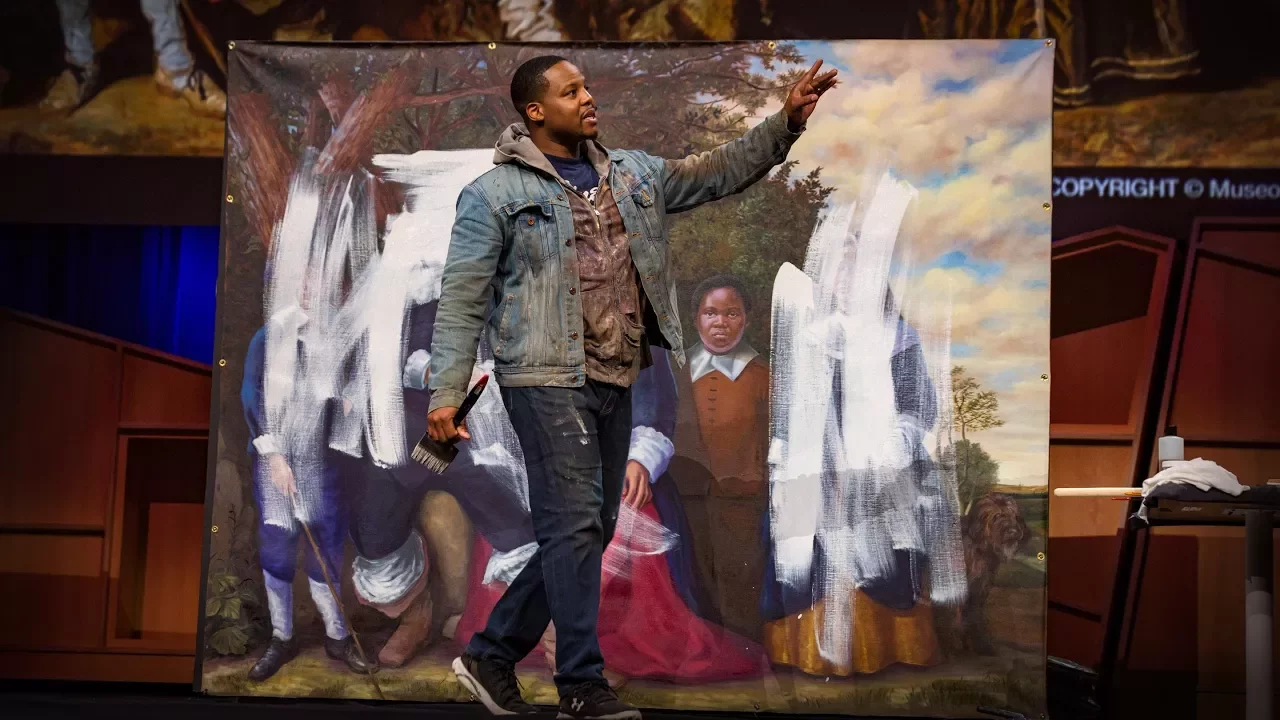
- Titus created his own painting inspired by Hals' style with some alterations.
- Through studying art history, he realized that painting is a visual language where everything holds meaning and is coded.
The Importance of Details in Paintings
Titus explains how details in paintings convey messages about economic status and societal roles.
- The positioning of figures and objects within a painting carries significance.
- The gold necklace and silk depicted in paintings indicate wealth and social status.
- Art history often focuses more on trivial details like lace manufacturers rather than exploring the lives and aspirations of marginalized characters.
Shifting Perspectives
Titus encourages viewers to shift their perspective and question the impact of art on society.
- Titus demonstrates how he alters his painting over time to reveal hidden faces, symbolizing the need for a different viewpoint.
- He urges people to consider why some individuals are marginalized and the effect of traditional artworks on vulnerable communities.
- Titus emphasizes that acknowledging history is essential but suggests adding amendments, like the American Constitution, to reflect progress and diversity.
Conclusion
Titus concludes by emphasizing the importance of creating honest artworks that address past struggles while celebrating present advancements.
- Eradicating history is not the goal; understanding and learning from it is crucial.
- The speaker compares his approach to an old-school camera, adjusting focus to bring different elements into view.
- Titus aims to make paintings and sculptures that grapple with past challenges while representing diversity and progress.
Turn any video into a summary like this
YouTube links, meetings, lectures. With transcripts, search, and chat.