Lecture 12: Projections of Points | Types of Planes | Exam Cheat Codes #EGD #engineeringdrawing
Projection of Points in Engineering Graphics
Introduction to Projection of Points
- The session introduces the concept of projection of points, essential for understanding engineering graphics and design.
Understanding Axes and Planes
- There are three axes: X, Y, and Z; however, typically only the X and Y axes are used in practical applications. The plane formed by these two is referred to as the XY plane.
- Two planes are introduced: the Horizontal Plane (HP) which is horizontal, and a Vertical Plane (VP) that intersects with HP at a line called the XY line. Both planes are perpendicular to each other.
Quadrants and Point Location
- Points can be located in any of the four quadrants relative to HP and VP:
- First Quadrant: Above HP and in front of VP.
- Second Quadrant: Above HP but behind VP.
- Third Quadrant: Below HP and behind VP.
- Fourth Quadrant: Below HP but in front of VP.
Terminology for Point Positioning
- Key terms include:
- "Above" or "Below" for reference to Horizontal Plane (HP).
- "In Front" or "Behind" for reference to Vertical Plane (VP).
- Example positions:
- Point A is above HP and in front of VP.
- Point B is above HP but behind VP.
Practical Example of Projection
- An example illustrates how to draw the projection of point A, which is specified as being 30 mm above HP and 20 mm in front of VP:
- The location is marked on an XY line with dimensions clearly indicated.
- The drawing process involves plotting points based on their distances from both planes.
Types of Planes Used
- Primary planes consist of three types:
- Horizontal Plane (HP)
- Vertical Plane (VP)
- Profile Plane
- Secondary planes include auxiliary inclined planes making specific angles with primary ones, aiding in complex projections. This distinction helps clarify how different views relate spatially within engineering graphics contexts.
Understanding Projection of Points in 3D Space
Introduction to Angles and Planes
- The discussion begins with the definition of angles (theta) formed between horizontal plane (HP) and vertical plane (VP), emphasizing that these angles are not perpendicular to any other planes.
Numbering Methodology for Projections
- Different numbering systems are introduced for various planes:
- Horizontal Plane (HP): A, B, C...
- Vertical Plane (VP): A', B', C'...
- Profile Plane: A'', B'', C''...
Front and Top Views of Points
- When observing from the front, projections on VP will be represented using dash notation. For example, point P's projection will appear as P' on VP.
- The top view of points is always plotted on HP, maintaining a consistent numbering system.
Problem Solving with Point Projections
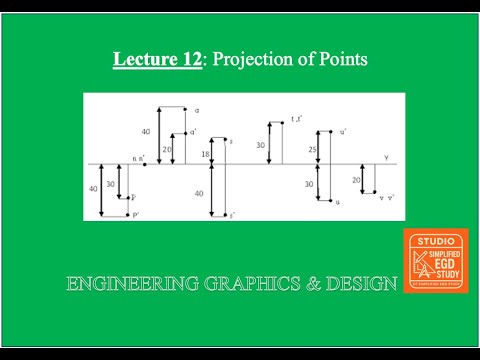
- Multiple points are analyzed for their projections along a single XY line. Points A through H are marked accordingly.
Example Calculations for Specific Points
- Point A:
- Located 25 mm above HP and 30 mm behind VP; its projection is noted as A'.
- Point B:
- Positioned at 30 mm below HP and 20 mm in front of VP; projected as B' on VP.
- Point C:
- Found at 22 mm above HP and 26 mm in front of VP; represented as C' when viewed from the front.
- Point D:
- Situated at 32 mm behind VP and 30 mm below HP; its projection is noted as D'.
- Point E:
- Lies directly on the XY line, meaning both E and E' coincide at this position.
Additional Points Analysis
- Point F:
- Located on VP but also noted to be above HP by a distance of 25 mm; projected onto XY line as F'.
- Point G:
- Found on HP at a distance of 20 mm in front of VP; its representation follows similar conventions established earlier.
Understanding Projections and Point Plotting in Geometry
Plotting Points on the XY Line
- The G point is positioned below the XY line, specifically at a distance of 20 mm. The F point is measured at 25 mm.
- Point A H lies on both planes, indicating that it is also located on the XY line from both front and top views.
Projection Techniques
- Both points H and H dash are situated on the XY line, demonstrating how to plot projections effectively.
Cheat Codes for Exam Success
- A method for understanding projections involves recognizing terms like "above" or "behind," which indicate that points should be plotted above the XY line.
- Conversely, if a point is described as "below" and "in front," it should be drawn below the XY line. Points mentioned as being "on plane" or "on XY line" must be placed directly on the XY line.
- For numbering points above and below horizontal planes, use designations such as a dash, b dash, c dash, etc., to differentiate their positions accurately.