Leyes de los Exponentes | Todas las Leyes
Understanding Exponents and Their Laws
In this section, the concept of exponents is introduced, emphasizing the base and exponent relationship and the importance of correctly identifying the base in expressions involving exponents.
Base and Exponent Relationship
- An exponent is represented by a base number with a smaller number above it, indicating how many times the base should be multiplied by itself.
- Incorrectly identifying the base in an expression with an exponent can lead to errors. It's crucial to distinguish the base, especially in cases like negative bases.
- Proper use of grouping symbols is essential when dealing with negative signs within bases to ensure accurate calculations.
Application Across Mathematics
- The principles of working with exponents extend beyond basic arithmetic to various mathematical branches like algebra and trigonometry.
- Understanding how exponents work lays the foundation for applying exponent laws effectively in different contexts.
Exponent Laws: Zero and Negative Exponents
This section delves into specific exponent laws concerning zero and negative exponents, highlighting their significance in simplifying expressions.
Exponent Zero Law
- Any non-zero base raised to the power of zero results in 1, provided that the base itself is not zero. This rule holds true across mathematical operations.
- Applying this law allows for simplification of expressions involving zero as an exponent, aiding in problem-solving efficiency.
Negative Exponent Rule
- When a base with a negative exponent is encountered, taking its reciprocal while changing the sign of the exponent yields a positive result.
- Demonstrating examples helps clarify misconceptions about handling negative exponents without altering other aspects of the expression.
Practical Applications
- Understanding how to manipulate expressions with negative exponents proves valuable when dealing with complex calculations or fractions.
New Section
In this section, the speaker explains how exponents work when dealing with bases that are the same. They provide examples and discuss the rules for adding exponents in such cases.
Understanding Exponent Rules
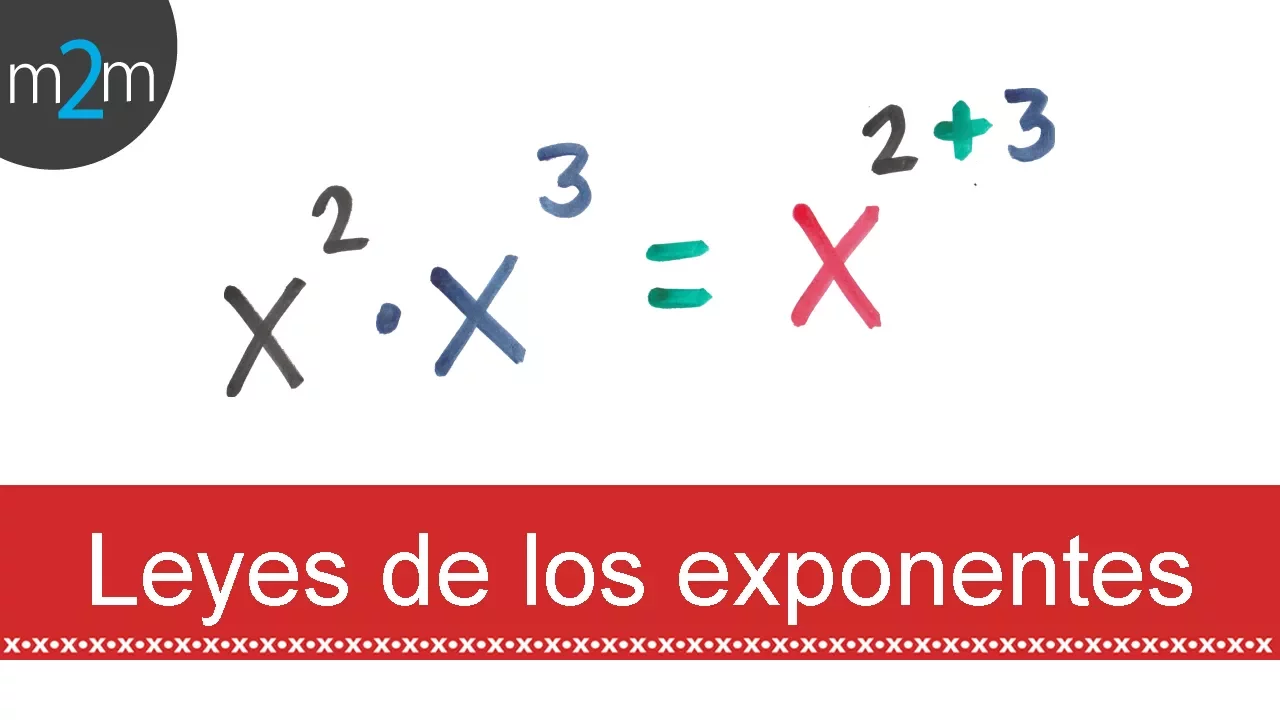
- When multiplying bases that are the same, the exponents are added together.
- Demonstrates exponent addition with an example of 5 to the power of 2 multiplied by 5 equals 5 to the power of 3.
- Explains the process of summing exponents when multiplying variables with the same base.
- Discusses how negative exponents affect addition or subtraction in exponent operations.
- Highlights the importance of being cautious when dealing with negative signs in exponents during addition or subtraction.
New Section
This part focuses on applying exponent rules to multiplication involving variables and numbers, emphasizing grouping like terms and simplifying expressions.
Applying Exponent Rules in Multiplication
- Demonstrates multiplying variables by pairing like terms and adding their exponents.
- Provides an example involving multiple variables (m, x, y) and showcases simplification steps.
- Explains how any base raised to an exponent of zero equals one and its impact on calculations.
- Emphasizes that exponent rules apply not only to two factors but also to multiple factors with the same base.
New Section
This segment delves into division operations involving exponents, showcasing how to subtract exponents when dividing like bases.
Division Operations with Exponents
- Illustrates division using a numerical example (3^3 / 3).
- Explores division of variable terms (x^4 / x^6), highlighting subtracting exponents as per exponent rules.
Laws of Exponents
In this section, the speaker explains the laws of exponents and provides examples to illustrate these concepts.
Understanding Exponentiation
- When an expression has an exponent raised to another exponent, it equals the multiplication of the exponents. For instance, if x^2 is raised to the power of 3, the result is x^6.
Application of Laws
- The base in an expression like x^2 raised to the power of 3 will be multiplied by itself three times, resulting in x^6. This multiplication applies regardless of the number of factors with the base.
Handling Positive Exponents
- Positive exponents follow the same law; they multiply existing exponents within the base. Identifying invisible exponents as 1 before calculations is crucial.
Multiplication and Sign Rules
- With a positive exponent like cubed and a positive sign, direct multiplication occurs. For example, (-2)^3 = -8. The process involves multiplying signs first and then numerical values.
Division with Exponents
This part delves into division involving exponents and how to handle such expressions effectively.
Division Rule Application
- When dividing with an exponent (e.g., a/b)^n, raise both numerator and denominator to that exponent for simplification.
Practical Example
- Dividing expressions elevated by an exponent involves multiplying each term in both numerator and denominator directly. For instance, dividing x^2/x^5 results in x^-3.
Advanced Exponentiation
Exploring more complex scenarios where multiple variables are involved in exponentiation.
Handling Multiple Variables
- When dealing with various variables under division or multiplication with different exponents, apply consistent rules across all factors involved.
Final Thoughts
Concluding remarks from Professor Jose Andalon about his video content on mathematics education.
Closing Remarks