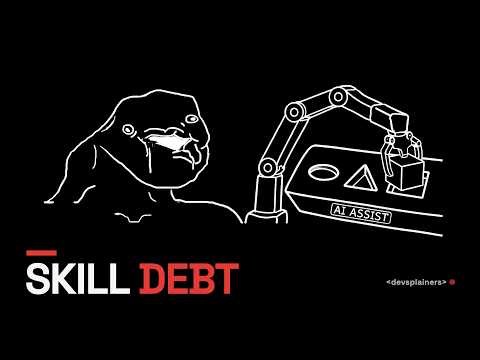
Is AI Coding Making Developers Dumber?
The Impact of AI on Developer Skills
Introduction to the Junior Developer's Experience
- A junior developer enters an interview with impressive credentials, but struggles when asked to perform a basic coding task by hand.
- This scenario highlights the reliance on AI tools that have handled much of the developer's work, leading to a lack of fundamental skills.
The Dangers of Relying on AI
- Handing off challenging tasks to AI can erode essential skills without notice, akin to "selling your soul" for convenience.
- Initial reactions may dismiss concerns about AI's impact as mere panic; however, evidence suggests significant skill degradation among developers using these tools.
Evidence from Studies on Skill Retention
Anthropic Study Findings
- In a controlled study, engineers using an AI assistant completed tasks faster but scored lower in understanding compared to those relying solely on documentation and their own knowledge.
- A larger experiment revealed that students who practiced with chatbots performed well initially but struggled significantly when required to code independently later.
Long-term Effects of Skill Erosion
- There is currently no longitudinal study tracking developers over five years to assess skill decay directly related to AI usage. However, existing research indicates concerning trends in learning retention and problem-solving abilities.
Understanding Skill Development
The Role of Struggle in Learning
- Expertise is built through overcoming challenges; this process involves grappling with complex problems and experiencing "desirable difficulty." Skipping this struggle leads to shallow learning and poor retention.
The Frictionless Nature of AI Assistance
- While AI can provide quick answers, it removes the cognitive effort needed for deep understanding, resulting in developers lacking critical thinking skills necessary for debugging and problem-solving.
Confidence vs. Competence
Misleading Confidence Levels
- Developers using AI often produce less secure code while feeling more confident about its quality; this false sense of security can lead to dangerous outcomes in software development practices.
Consequences for Junior Developers
- Many juniors become reliant on shortcuts provided by AI tools instead of developing foundational skills through experience and practice, which are crucial for long-term success in their careers.
Historical Context: Lessons from Aviation
Parallels with Pilot Training
- Similar issues arose in aviation where pilots became overly dependent on autopilot systems, leading them to lose essential flying skills over time—a cautionary tale relevant for software development today.
Navigating the Future with AI Tools
Balancing Automation and Skill Retention
- While past technological advancements (like compilers or calculators) led some skills to fade away without detrimental effects, current generative AIs present unique challenges due to their unpredictable nature—sometimes providing incorrect solutions confidently.
Strategies for Maintaining Skills
- To counteract skill erosion while using AI:
- Engage actively with generated code by questioning its functionality.
- Use tools like chatbots as quizzes rather than direct answer sources.
- Intentionally practice coding without assistance periodically.
- Maintain a rule: only delegate tasks you fully understand yourself; if you can't explain it simply, you haven't truly delegated it yet.
Conclusion: Keeping Skills Alive
Final Thoughts
- Skills may go dormant but are not lost entirely; continuous engagement with challenging material ensures they remain intact.
- Developers should strive not just for efficiency through automation but also prioritize maintaining their core competencies amidst evolving technology landscapes.